|
Archives
|
2010:03:28:15:31. Sunday. SOCIALIZED MEDICINE, BROUGHT TO YOU BY CISCO. New site design still in progress, but I wanted to get this down before I forgot about it. Cisco is running a lot of ads during the NCAA basketball tournament, so I've seen the one with Ellen Page visiting her old doctor probably a dozen times in the last week and a half. Something finally occurred to me about it -- it's the best ad narrative ever for socialized medicine. Now, obviously it's just as much a fictional narrative as that you'll find in any other product ad. But it's worth thinking about that narrative. Ellen Page, newly minted movie star, returns to her small hometown in Nova Scotia, Canada. For some reason, she decides to pay a social call to her doctor while she's there, suggesting that Canada's socialized medical system has allowed her to receive service from a doctor she knows and trusts. But the doctor's not there, he's in Denmark, but still seeing patients using Cisco's cutting-edge medical teleconferencing device. That's right, socialized medicine has so crippled Canada's economy that small-town doctors are able to use what must be a ridiculously expensive piece of equipment to treat patients while in another continent. The poor Canadians are so wiped out, in fact, that another ad shows that their schools are also able to make this kind of massive financial outlay (to communicate with Chinese students who go to school in the middle of the night, apparently). Cisco has broken with the US Chamber of Commerce over its position on climate change, and I wonder if this is a sly signal that not quite on the corporate line over health care, either; I doubt it. Nevertheless, it's nice to know that American audiences are being hit with this subtle reminder of the Canadian health system's awesomeness on such a regular basis.
posted by Aaron S. Veenstra 2008:12:18:23:15. Thursday. ALWAYS BE CENTRISIZING. Barack Obama won't become president for another month, and he's got over 46 months until he'll presumably be up for re-election. He won this year's election by about 53% to 46%. So how in the world can anybody defend the choice of Rick Warren to give the inaugural invocation as a way to "peel off" a few "moderate evangelical" votes? Are we to believe that Obama plans to spend his 2008 transition period campaigning for 2012, and that he plans to lose tens of millions of votes to poor performance or alienation of his existing supporters, so he's out there looking for replacement votes already? I'll be honest, I gave more money to No On Prop 8 ($50) than I did to Obama ($0), and his tendency to do-si-do with the Christian Right is big reason why.
2008:11:06:13:00. Thursday. 2009. I got a fundraising letter in the mail last week from Chief Justice Shirley Abrahamson, who is up for re-election in the spring. Democrats just took over the Wisconsin Assembly, giving them control of both legislative houses and the governorship -- they have an extremely tough budget project ahead of them and will be fought tooth and nail by the minority GOP. The Democratic caucus in the U.S. Senate isn't going to have 60 members, let alone 60 members that could be counted on for every cloture vote. In his victory speech Tuesday, Obama said that his win was not the change that his campaign pursued; it was the chance to make the change happen. Making it happen means keeping your checkbooks out, your feet on the ground and your mouth open. The year after a presidential election is typically when government and voters pay the least attention to each other, and if that happens in 2009 this was all for nothing.
2008:11:05:11:47. Wednesday. A VALEDICTORY. What happened yesterday -- really, what's happened since Election Day 2006 -- is nothing short of astonishing. On his way to the presidency, Barack Obama won two of the most strongly Republican states in Indiana and Virginia. He won the greatest popular vote percentage for a Democrat since Lyndon Johnson. Establishment stalwart Elizabeth Dole found herself removed from the Senate when her culture war tactics failed in North Carolina of all places. But for all of the incredible stuff that happened yesterday, we also saw what appears to be the first major failure of the Obama era. His electoral vote win wasn't called until the west coast polls closed at 11:00 EST, but his early wins in Pennsylvania and Ohio made it clear where things were going -- indeed, his huge lead in the polls in the last few days made it clear. And unfortunately, it looks like turnout wasn't what it should have been and that down-ticket races were never enough of a priority for the presidential campaign. Democratic gains in the House are going to be lower than they could have been, while Senate races in Minnesota and Alaska have worked out far below where they should have been. Proposition 8 in California, rescinding the right of gay couples to marry, is going to pass (ironically, exit polls suggest this is the result of strong black turnout). Watching the down-ticket returns come in (or not come in, as is still the case in Oregon, who could've counted most of their mail-only votes before Election Day, WTF?!?) I felt sick, because this was one of my major concerns about Obama throughout the campaign -- not that he would be a drag, but that he wasn't interested in building a party movement rather than an Obama movement. We've done this before. When Bill Clinton was elected we forgot about party cohesion (to be fair, there were a lot more Dixiecrats in the party at that time) and the rest is history. I desperately hope we don't forget the lessons of those first two Clinton years. The biggest one is that the GOP isn't going away. They are going to "filibuster" everything without having to actually get up and do it. They are going to be at Obama's heels from day one, if not before. It's been tempting for a lot on the left to read the accusations of Marxism as secretly being about race, and I have to think that's what the attackers want. In fact, this is how they go after Democrats, and they will continue to do so. Yesterday wasn't just about electing Obama, and tomorrow isn't just about Obama being the president; it's about Obama governing.
2008:11:04:08:23. Tuesday. A BENEDICTION. There's been a ghost haunting our politics of late, and his name is George W. Bush. Except for briefly materializing to nationalize the banks, Bush has been absent from our collective imagination, and I imagine we've all been glad for it. Unlike the end of the last eight-year Republican presidency, there's no last-minute uptick this time. Bush's ratings and the perception of the country as being on the right track are as low as they've ever been. His destruction of his party's brand is so complete that a much-loved Republican war hero and Wise Old Man of Washington is about to get taken apart by a black guy who's been in the Senate for less than four years. Most of us would probably like to forget this whole sad part of our history, pretend it's 1993 again, give that post-Bush consensus a second chance. I can understand that impulse and I certainly sympathize with it, but it would be a mistake. With 2012 already on the horizon, it's vital that we understand and remember what the Bush administration and modern conservatism have meant for this country. If we look at this election as the quiet demise of a bad relationship we're going to fall back into the same pattern again. So let's take a moment to understand what George W. Bush's leadership has meant.
And look, this isn't everything. The fact that, because of some hare-brained scheme that could never have worked in a million years, I can't take a bottle of water through airport security is ridiculous, and everyone knows it, and it's policy anyway, because we now live in theatre. Fully describing that bit of the Bush legacy is a book-length treatise in itself. The story told by these greatest hits is a simple one: We can't forget this time. Watergate, Iran-Contra, the smearing of Valerie Plame -- these are the same guys and the same plays, over and over. Whatever you do over the next four years, remember that. They aren't going to jail, and even if they somehow did, they'll still be back. They always come back. There's a lot they can do once they make their way back into office, but before they do we have an enormous power over them. We can say no. Saying no starts today with a vote for Barack Obama.
2008:11:03:13:46. Monday. PREDICTION TIME. Here are my presidential predictions -- amazingly, we could know if the basic contours of this are right by 7:30 eastern tomorrow night..
Electoral College
Obama/Biden: 367 (All the Kerry states plus NM, IA, CO, VA, OH, FL, NC, ND, MO) McCain/Palin: 171 (All the other states) Popular Vote (Rounded) Obama/Biden: 53% McCain/Palin: 46% Other: 1% Total turnout: 135,000,000 And the 111th Congress:
111th Congress - Senate
Democrats: 58 (pick-ups in VA, NM, CO, NH, OR, NC, AK, MN, GA) Republicans: 40 (no pick-ups) Other: 2 (Bernie Sanders (I-VT) caucuses with the Democrats, Joe Lieberman (I-CT) will leave the Democratic caucus) * Barack Obama and Joe Biden will both be replaced with new Democratic Senators. 111th Congress - House of Representatives Democrats: 258 Republicans: 177 Some states require December 2 run-offs if no candidate gets 50% of the vote, which could affect the composition of the House and the Georgia Senate race. Also, Prop 8 in California will fail. I sure hope I'm right.
2008:10:19:17:01. Sunday. ANECDOTES. A bunch of us went to Iowa City for the awful Wisconsin-Iowa game yesterday, and on the way down we stopped in Dubuque to play a round of golf. Among the handful of folks in the clubhouse on Friday morning were some older white guys talking about the election. All of them said they were voting for Obama, and all of them said it was because of Sarah Palin -- keep in mind, Iowa was a Bush state in 2004. Her selection as the VP nominee may go down as the most disastrous decision in modern presidential campaigning.
2008:10:03:18:15. Friday. I'M AMAZED YOU DON'T FIND ME DELICIOUS. I sure is looking like Barack Obama's going to be the next president, and I'd wager that John McCain's decision to pick a know-nothing beauty queen as his running mate will be seen as a bad move in retrospect, doggone it. This leaves two jobs undone for the American Left. The first is to push to the finish line on this year's competitive congressional races -- particularly the Senate campaigns in Minnesota, Mississippi, Oregon and North Carolina. The second is to destroy Sarah Palin. Think about where this woman has been and where she will go after the election. Until the last few days of August, no one outside of Alaska and a slim band of right-wing crazies had heard of her. She got about a week in the spotlight, a couple weeks in hiding, and then a couple of the worst weeks any candidate has ever had. Now that the VP debate has passed, she probably won't come up for much air for the rest of the campaign. Then what? Her first priority will be surviving Troopergate; then is will be re-election in 2010. Meanwhile, President Obama is going to inherit the worst conditions of anybody since Carter, and maybe FDR. I think it's just about dead certain that Palin -- assuming she gets through the next couple years -- will run for the GOP nomination in 2012. She remains popular in crazy baseland -- Rich Lowry all but said her debate performance made him hard -- and when she re-emerges in the summer of 2011, she'll have spent three years preparing for the campaign. She'll have name recognition and base popularity, and she won't sound like a high-school drop-out anymore. No one will remember much about her five weeks in the public eye in 2008, except that the 2012 version doesn't look like the stories they're hearing. The thing is, she won't be any more prepared to be president. She won't be any smarter, more curious or more engaged with the issues. She will be just as dangerous. She may also be more appealing to the core of the Republican party than Mitt Romney or Tim Pawlenty. What we need to understand is that destroying her now is the only sure way to keep this from happening. Hammer McCain too, of course, but hammer him also through her.
2008:09:14:20:44. Sunday. REFS. Imagine if, instead of having on-court officials, NBA games were played like street games -- you call your own fouls. Fans watching at home would undoubtedly get into heated disputes about whether contact was made on a particular play, and if so, how much was too much. The sports press would talk about which players tend to honest about their calls, who tends to take dives, and so on. They'd also probably spend a lot of time looking at replays, doing Around the Horn-type discussions about particular plays, and generally presenting the basketball-following public with a framework through which to understand this now-odd sport. Now let's say one day in this alternate NBA, Kermit Washington coldcocks Rudy Tomjanovich. Literally adding insult to injury, he flat-out refuses to acknowledge the act as call-worthy. With nobody in a position of authority over the contest, there's nothing to do but continue playing, careful to avoid the bloody and near-dead Tomjanovich lying in the middle of the court. I put it to you that Kermit Washington is running for president on the Republican ticket, and that he's counting on our traditional reliance on the honor system to keep anyone from noticing what he's done. The question of what is the motivating drive of campaign journalism is the absolutely central issue to the mockery John McCain is making of this election. Every word out of his campaign -- whether from him, Sarah Palin or one of his surrogates -- is a bald-faced lie. If the point of campaign journalism is to inform voters, they need to confront this garbage much more strongly than they have been; indeed, that the fairly tepid response to McCain "stretching the truth" has been so well received in the liberal blogosphere is kind of embarrassing. McCain is lying to the public about anything and everything, constantly; a press that doesn't point this out in unambiguous terms is helping him.
2008:08:28:22:29. Thursday. BALLS. Throughout the convention, ads for DividedWeFail.org and HarryAndLouiseReturn.com have been running on Comedy Central (and probably elsewhere, but I've been watching all my actual convention coverage on C-SPAN and PBS). These ads, respectively, admonish viewers to "demand action" on health care and tell the next president to "make it happen." The balls it takes for the actors from the original Harry and Louise ads, and some of their original sponsors, to reprise this foolishness would make Stephen Colbert jealous. The ads that ran in 1993 were integral to killing the Clinton health care plan, and they salted the earth in their wake. Their scare-mongering then led directly to the problems they cite in the new ads now. DividedWeFail.org's ads are, if anything, stupider and more simplistic. They're being run by the AARP, fresh off getting played by the Bush Adminstration on the Medicare Part D bill. Not surprisingly, they show the same kind of political acumen as John McCain, who's suggested the best solution to the Iraq War is to "sit the Shiites and the Sunnis down and say, ‘Stop the bullshit.’" Guess what, you schmucks. Republicans don't want a government health care solution, and they don't particularly care about pushing the private sector into doing anything that might cost them money. This is simply not something that there is a bipartisan consensus for. On top of that, health insurance companies will fight for their very existence against real health care reform. If you want something to be done about the number of uninsured, underinsured and "insured" who can't actually get care, you need to elect more and better Democrats. You need to create a mandate for a health care reform that doesn't strengthen the profit motive. The obstacle to this is not "partisan bickering," it is Republicans. Barack Obama gave his first partisan speech of the campaign tonight (making Mark Warner's horrible keynote all the odder), and I hope it's a prelude to him campaigning with the convention's other partisan warriors (more Bill Richardson, please) and for other Democrats (Oregon Senate candidate Jeff Merkley, Washington House candidate Darcy Burner, Connecticut House candidate Jim Himes, etc.). I think Obama has finally come to realize that whatever his movement is now, it can't survive outside the womb of the campaign without folding into the party. It will soon become apparent to a lot of people that Barack Obama's election is not America's redemption; rather, America's redemption can come from Obama's administration, and what he can accomplish with a strong Democratic Congress.
2008:08:28:09:29. THE BIG DOG AND THE ELEPHANT IN THE ROOM. Last night, Bill Clinton demonstrated the real value of political experience -- it's not that it makes you a better decision-maker or a wiser crafter of policy, it's that it makes you better able to see where the contours of power are. And while they exist around individuals, they are much stronger around parties and ideologies. In Clinton's speech, George Bush and John McCain are symptoms of a disease called conservatism. This passage is the most important thing anyone has said at this convention:
On the two great questions of this election — how to rebuild the American dream and how to restore America's leadership in the world — [John McCain] still embraces the extreme philosophy that has defined his party for more than 25 years.
And it is, to be fair to all the Americans who aren't as hard-core Democrats as we, it's a philosophy the American people never actually had a chance to see in action fully until 2001, when the Republicans finally gained control of both the White House and the Congress. Then we saw what would happen to America if the policies they had talked about for decades actually were implemented. And look what happened. They took us from record surpluses to an exploding debt; from over 22 million new jobs to just 5 million; from increasing working families' incomes to nearly $7,500 a year to a decline of more than $2,000 a year; from almost 8 million Americans lifted out of poverty to more than 5.5 million driven into poverty; and millions more losing their health insurance. Now, in spite of all this evidence, their candidate is actually promising more of the same. ... They actually want us to reward them for the last eight years by giving them four more. In just a couple minutes he articulated an argument that had nothing to do with Obama in particular, and little to do with Bush or McCain in particular, but was all about electing Obama, defeating McCain and expanding the Democratic majorities in Congress. But he fucked it all up by leading in talking about what a great guy John McCain is:
The Republicans will nominate a good man who served our country heroically and suffered terribly in Vietnam. He loves our country every bit as much as we all do. As a Senator, he has shown his independence on several issues.
Later, Joe Biden gave a solid speech, making quite a few pointed attacks on McCain. Unfortunately, he undercut himself as well:
John McCain is my friend. We've known each other for three decades. We've traveled the world together. It's a friendship that goes beyond politics. And the personal courage and heroism John demonstrated still amaze me.
It seems that as the convention goes on, John McCain becomes a better and better man and friend of various high-ranking Democrats. So, a request to Howard Dean, Al Gore, Barack Obama and all of tonight's speakers: Please ask your friend John McCain to vacate the premises so that dangerous warmonger John McCain can be brought in for our examination. This man is not your friend, this man is "Bomb bomb bomb, bomb bomb Iran." This man is eating cake while New Orleans drowns. This man is overturning Roe and opposing the Ledbetter Act. This man is privatizing Social Security. If this man is your friend, and the harshest thing you can think of to say about him is that he's got seven or eight or twelve houses, kindly piss off. Some of us are trying to save this country and you're not helping.
2008:08:26:21:23. Tuesday. ON PARTISANSHIP. So this month has been ridiculously busy, and I've been sitting on a bunch of Toadies clips from late July that hopefully will be coming out imminently. But right now I'm watching Unity Night at the DNC, and for fuck's sake, I'm seeing another opportunity get pissed away by party leaders that simply refuse to understand the reality before them. This night at the convention is being billed as all about Hillary Clinton's speech, but the unity that's really being sold by the likes of Mark Warner, Deval Patrick and Brian Schweitzer is much darker. There are two words that are not being used nearly enough by any of tonight's speakers. The first is "Democrats" and the second is "Republicans." Speaker after speaker is going hard after McCain as an individual, and tying him to George Bush, and talking about "those folks in the White House" -- and hey, did you hear that McCain has a lot of houses or something? -- without even alluding to the fact that these people represent an entire party that holds the same or worse views on all the issues being discussed tonight. Without mentioning that a vote for a reasonable Republican House candidate is a vote for John Boehner as Speaker of the House. Without mentioning that the Senate remains the biggest hurdle to making real, effective change -- in fact, the closest to any such mention was Barbara Boxer telling us that "60 is the new 50," though that's only true as long as Harry Reid feels that Republicans don't need to actually do their filibusters. Right now Schweitzer is telling various delegations to "stand up," which I think is meant to be a big, dramatic moment, and he's just made one of the night's few (and fairly oblique) references to Iraq, but the message of this night and the convention so far is this: Obama is change, and he apparently doesn't need any help. But the fact is, your national GOP will keep on keepin' on whether Obama or McCain becomes president in January. Bipartisanship, particularly on the campaign trail, is simply not a luxury one party can afford when the other isn't on board. Seeing this happen, again, now, is like a slow-motion daydream: We did this in 1992. To be honest, the results that were borne out in Bill Clinton's first term were probably my most important formative experience with politics, but it was hardly the only example of the modern Democratic Party getting played and torn apart. Hillary just came out and announced herself as a "proud Democrat"; her second paragraph warned against allowing "another Republican" into the White House. It'd be great if some of her people could take the DNCC people aside and tell them about what happens when you don't party-build.
2008:06:21:11:34. Saturday. BARACK OBAMA DRINKS YOUR MILKSHAKE. Something kind of amazing happened yesterday. After several days of pregnant silence, Barack Obama released a statement on the reprehensible new FISA legislation that essentially affirms his support for the entire enterprise, minus the retroactive telecom immunity, which he will "try" to remove in the Senate, but will vote for anyway when he can't. Russ Feingold, the man who should've been our nominee, had this to say: The proposed FISA deal is not a compromise; it is a capitulation. The House and Senate should not be taking up this bill, which effectively guarantees immunity for telecom companies alleged to have participated in the President’s illegal program, and which fails to protect the privacy of law-abiding Americans at home. Allowing courts to review the question of immunity is meaningless when the same legislation essentially requires the court to grant immunity. And under this bill, the government can still sweep up and keep the international communications of innocent Americans in the U.S. with no connection to suspected terrorists, with very few safeguards to protect against abuse of this power. Instead of cutting bad deals on both FISA and funding for the war in Iraq, Democrats should be standing up to the flawed and dangerous policies of this administration.
Republicans, for their part, said that they got more than they even thought possible. The upshot of this is that Obama's biggest and most monolithic source of support in the blogosphere, Daily Kos, is undergoing a sudden case of No One Could've Predicted. E.g.: When it comes time to fight global warming will we be regarded as day-old pill bugs?
Sure, there's an election on, but what will be the excuse the next time a corporate giant's income stream is threatened? If Hillary issued the verbatim statement that Obama did, this site would be lit up with FPs and diaries calling her a traitor and worse. And I'm willing to bet that you'd be right up there.
what you mention is a huge issue, one that is no different than ending the war or the economy to me. And for posters and diarists here to brush that aside, call Obama and the rest of the capitulators mere "politicians" and state they were merely being "political" is a downright insult to our intelligence.
Of course I'll still vote for Obama, but what he said was insulting, and that needs to be recognized. And the only way I know how to tell them about this that will make a dent in their world is to act on my frustration. Meanwhile, long-time DKos editor DHinMI: Seriously, please explain how FISA changed anything like whether one gets a job or whether Obama was supposedly spied on.
Can you explain why the initial FISA vote in the House last Summer wasn't a problem for most people, why the Senate vote was, and what two provisions that got added by the Senate made it a problem? Do most of you ranting about FISA even understand what is objectionable, or are you just addicted to histrionics? Guess what, Democrats. This is what Unity looks like, and it's Unityman's party now. Expect many more House votes that pass with the support of all the Republicans and 46% of the Democrats.
2008:05:31:16:37. Saturday. ERROR. Mark Blumenthal has a comprehensive response to a London Review of Books piece that suggests, among other things, that the problem with primary polling this year has been too-small sample sizes. This implies a pretty fundamental misunderstanding of what sampling is on the part of the author, David Runciman, but it got me thinking in general about how we conceptualize error in public opinion polling and how it might relate to the scattershot nature of this year's polls. First, as Runciman correctly points out, there have been plenty of election-eve polls this year that were totally out of the ballpark, and it appears more than the 5% that should be allowed by the standard margin-of-error application. Zogby famously had Obama winning California by six, and multiple concurrent fieldings of head-to-head match-ups are frequently quite disparate. Indeed, Gallup has gotten dissonant findings from their own two concurrent polls at several points this year. Something is going with the polls, and it goes far beyond the hew and cry of the New Hampshire "debacle" that was addressed ad naseum at AAPOR this year. I think there are a couple of major issues that could easily be addressed just in the way polls are handled in the media. The first is something that Keith Olbermann is already doing, and that he's calling the "Keith Number" because nobody else is bothering to follow his lead. This number is the stated margin of error plus the percentage of undecided voters in the sample; so, a poll with Obama leading McCain 47-44 with an MOE of +/-3 would have a Keith Number of 12. Putting aside for the moment that it should be 15, since the MOE moves in both directions, this is a pretty stark change in the way poll stories are framed. When most polls are reported, undecided voters don't exist, and neither do supporters of third parties, unless and until they make enough noise to force their candidate into the polling instrument. Undecideds are a huge part of the story of why polling has erred so much to the Obama side this year -- Democratic primary voters who decided on the last day tended to support Clinton, and those people would've been undecided when the polling was conducted. Another problem is how strength of support is measured. Some polls include leaners -- that is, soft supporters of one candidate or another -- in the same category is strong supporters. But leaners, quite obviously, are much more likely to switch candidates or wind up not voting than are strong supporters, making their inclusion another important source of potential error. This, too, is some that could be clarified by the media. But polling error goes deeper than that. How is it that polls conducted at the same time, purporting to measure the same thing, can be so different? Something that's almost never acknowledged in the reporting of poll results is the impact of question wording and question order. The order of names within a question can matter, whether the question includes individuals' titles or party affiliation can matter, whether the question is built around the word "vote" or "support" can matter, etc. Can this alone explain the wildly divergent results we've seen in some races? Of course not, but this and other methodological factors -- such as live vs. automated interviewer, etc. -- contribute some error in places that are often kept in shadow. When we compare polls not to other polls but to actual election results, the situation is complicated further. For example, Obama won the Missouri primary by about 11,000 votes out of over 827,000 cast. What is the likelihood that 11,000 Missourians thought about voting in that primary, but ultimately decided not to? To take an even more extreme example, what is the likelihood that 538 Floridians wanted to vote for Al Gore in 2000, but got side-tracked on Election Day and never made it to the polls? Close elections are toss-ups for reasons that are anything but political and may not even have anything to do with individual voters -- bad weather, traffic jams, etc. Given all this potential error, how we discuss poll results is incredibly wrong-headed. While journalists give a nod to the margin of error, swings within it -- particularly swings in which the "lead" changes -- are treated as real events. Political scientists are guilty of this as well, as they try to construct predictive models that account for unaccountably close elections, which for all intents and purposes are ties from a data perspective. What I think is clear from this year's polls is that a) we have a media problems, and b) we have a polling problem. I was glad to see AAPOR talking a lot about it at this year's conference, but I'm somewhat concerned that the focus was so acutely on New Hampshire and journalist education, and not on working towards a set of best practices for public opinion measurement. What's within the power of pollsters is to sample better and measure better, and those ought to be the first steps.
2008:03:20:11:50. Thursday. QUICK QUIZ. In the wake of Geraldine Ferraro's awful comments about Barack Obama being "lucky" to be black, it's worth wondering what to think about the person who said this:
If he were white...he would simply be one of nine freshmen senators, almost certainly without a multimillion-dollar book deal and a shred of celebrity.
So who said it? Answer here.
posted by Aaron S. Veenstra 2008:03:05:13:50. Wednesday. RELIABILITY. The Texas primary has been called for Hillary Clinton; meanwhile, the Texas caucus is still being counted with Obama in the lead. The differential is nearly the same in each contest, about 4%. Same electorate, same candidates, eight-point swing. Does this make sense? Is this ridiculous Texas system the perfect illustration of why our primary model is screwed? In social science, we have an idea called reliability. The idea is that you take different measures of the same thing to be sure you're measuring it right. For instance, I might measure somebody's propensity to use blogs for surveillance reasons -- that is, to observe and follow news stories -- by asking whether they use blogs to "learn how politicians stand on issues" and to "help me make up my mind about things." Using a statistical test, I can find out how much these questions seem to be tapping the same underlying idea (in this case they went with four other items, and had a Cronbach's alpha of 0.844). If an election is meant to provide an estimated measure of the "will of the voters," something is unreliable in Texas -- they're coming up different. I don't mean to say that the outcomes are necessarily statistically different -- 52C-48O and 48C-52O are fairly close -- but that these two processes, ostensibly designed to measure the same thing, appear to have different outcomes. That's kind of crazy! Texas has inadvertently given us a field experiment comparing the caucus and primary processes, and given us different results. I find that very interesting as a social scientists, but as a small-d democrat, I find it both baffling and disturbing. UPDATE: A handful more precincts have reported in, bumping Obama's caucus lead to 12 points with 39% of precincts counted. And that will be it, because the rules in Texas make precinct reports voluntary. But rest assured, superdelegates are the real problem in this system.
2008:02:21:13:45. Thursday. NOT DEAD YET. Hillary Clinton got crushed in Wisconsin and has had a bad February, which makes todays new polls kind of surprising. Keep in mind that, as of a couple days ago, Obama was up 7 in the national polls and that he pulled to within 5 in Texas before Wisconsin's primary.
Gallup Daily Tracking: Clinton 45, Obama 44
Fox News/Opinion Dynamics National: Clinton 44, Obama 44 Diageo/The Hotline National: Clinton 45, Obama 43 IVR Tex. Feb 20: Clinton 50, Obama 45 Caveats apply, of course, but I think it's clear that there's still a lot of room to move in this race, thanks in large part to proportional delegate allocation. If the Obama backlash is on the horizon, Clinton will get an opening that she's got a decent shot of taking advantage of. Either way, the continued splitting of national Democrats is going to make convention season very interesting.
2008:02:18:23:02. Monday. HILLARY CLINTON FOR PRESIDENT.
Tomorrow morning I'll walk to Lapham Elementary School and cast a vote for Hillary Clinton to be the presidential nominee of the Democratic Party, making me a hypocrite, a cynic, or worse. I've spent more time and energy going back and forth on this vote than any I've ever cast. However, the fact that I was going back and forth between Clinton and a protest vote for Chris Dodd, who dropped out after securing about four votes in Iowa and New Hampshire, ultimately made the pragmatic decision clear. Having just decided on my choice this weekend, I have spent the past couple days coming around to the idea that I can be OK with this, and not just resigned to it. posted by Aaron S. Veenstra 2008:02:09:09:12. Saturday. THERE ARE CULTS, AND THERE ARE CULTS. The Obama people may be causing a certain reaction because we don't generally see major candidate supporters acting the way they do, but political cults are nothing new. Minor and third party candidates manage to generate small ones all the time, and Obama's is by far not the oddest of this cycle. That distinction belongs to Ron Paul, whose people have brought in ridiculous amounts of money (especially compared to the rest of the Republican field), little of which has been spent, to win their guy 16 delegates. Paul ran on the Libertarian Party ticket in 1988, so there's been a lot of speculation that he was using the GOP primary to raise his profile, but banking his cash for a third-party run. But yesterday he said:
With Romney gone, the chances of a brokered convention are nearly zero. But that does not affect my determination to fight on, in every caucus and primary remaining, and at the convention for our ideas, with just as many delegates as I can get. But with so many primaries and caucuses now over, we do not now need so big a national campaign staff, and so I am making it leaner and tighter. Of course, I am committed to fighting for our ideas within the Republican party, so there will be no third party run. I do not denigrate third parties — just the opposite, and I have long worked to remove the ballot-access restrictions on them. But I am a Republican, and I will remain a Republican.
I also have another priority. I have constituents in my home district that I must serve. I cannot and will not let them down. And I have another battle I must face here as well. If I were to lose the primary for my congressional seat, all our opponents would react with glee, and pretend it was a rejection of our ideas. I cannot and will not let that happen. So, he all but acknowledges that he can't win, won't run on the Libertarian ticket, is concerned about being targeted Kucinich-style in his primary, and is probably still sitting on a decent amount of money. Campaign finance laws allow him to transfer funds back to his congressional campaign, I believe, but he's in a pretty safe seat. Meanwhile, not a single one of his heterodox ideas got picked up by the other GOP candidates, who love the war more than ever. So what was the point of his campaign? I really don't get it. It's not like a Tom Vilsack or Jim Gilmore campaign, where they had no shot and figured that out pretty early on. There's something about the strategy that's just not lining up.
2008:02:09:00:34. SOME POINT. At some point in the evening, a light is going to shine down and you will have an epiphany and you’ll say, "I have to vote for Barack."
This line from Obama, reported at CJR, has been going around for the past couple days, and I wonder if it's the beginning of the end. Getting so close to explicit messianicism in his own words can only help to enhance the perception of his most rabid supporters as a cult. If people -- non-supporters and supporters alike -- are getting ready to start talking about how creepy some in the Obama base are, it's going to be a tough narrative to deal with. That's especially true if it happens now, at a time when Hillary Clinton has suddenly found a swath of small-dollar donors to tap. Whether it's her Super Tuesday showing, her urgent e-mails or more reaction to the MSNBC id, her people are suddenly opening their wallets. I can't imagine hearing that Obama thinks he's Jesus is going to do anything but make them pony up more.
posted by Aaron S. Veenstra 2008:01:30:21:02. Wednesday. THE SMILER AND THE BEAST.
Running against him is a Senator that Jerusalem calls "The Smiler." He's a charming, young figure, pushing for unity and reconciliation in the wake of the Beast's divisive approach. He gets Jerusalem's endorsement largely on the strength of not being the Beast, but it's not long before Jerusalem discovers the superficial campaign hides and much more authoritarian and power-mad approach than anything the Beast had to offer. It's too late, though; the Smiler wins and Jerusalem unleashes his anger by throwing hand grenades off his balcony. Ellis modeled the Smiler on Tony Blair, New Labour and the Third Way -- an optimistic style and a generational shift at the end of a reign of terror, with no mind being paid to what it all will mean in terms of governing. But I'll be honest: It's hard not to think of the Smiler every time I hear Barack Obama speak. He sounds like a well-meaning man whose greatest quality is that he's Not George Bush. I've been thinking of Obama as a new Jimmy Carter, but maybe Blair is the better analogy. I got on this line of thinking thanks to Avedon who recalls a lot of what the Obama people are expressing coming from young Labourites in 1997, only to see it fizzle as Blair and his party suddenly had to deal with the reality of governing. Avedon, in turn, jumps off this post by Roz Kaveney which ends as such:
What I do think is that I would rather have a battered pragmatic public servant than an untried personable spinner of wonderful empty words; I see the idealism that has focussed on [Obama] and I remember how many of my friends had real hope from Blair as opposed to voting for him because it was important to get the Tories out.
A Clinton Presidency is going to be unexciting, not especially idealistic and only better by comparison with Bush. But it will break no one's hearts. I look at my friends list and see a lot of wonderful ideals and I worry that Obama will break your hearts if he attains power. I hope that I am wrong. Me too. One way or another, 2008 is probably not going to be the only time he runs for president.
posted by Aaron S. Veenstra 2008:01:05:20:09. Saturday. DEBATE THOUGHTS. My guy quit the race after Iowa, so I'm paying a bit more attention to tonight's debate than I have to the others held in recent months. These are some thoughts on it. 8:09 CST - John Edwards looks like he's aged more than four years since the 2004 campaign. I'd hoped he might call bullshit on the "If you know where Osama is" question, which is about as reasonable as ticking clock torture questions, but he didn't. No one's actually talking about nuclear weapons, which is ostensibly what Charlie Gibson's question was about, though even he quickly veered into the bin Laden stuff. 2008:01:03:21:22. Thursday. IOWA. There's been a lot of talk in the last couple days (and generally over the last few months) about the badness of the Iowa caucus system, but how's this for odd irrelevance? Checking out CNN for full results I find that the caucuses are responsible for choosing 45 Democratic and 37 Republican convention delegates. That's out of totals of 4,049 and 2,380, respectively. Barack Obama, for winning, gets 14 delegates, compared to 13 for Clinton and 12 for Edwards (CNN has Edwards in second, but Iowa has some kind of undemocratic delegate allocation scheme). So, to recap: about six months of light campaigning, about three months of heavy campaigning, about three months of really heavy campaigning, tens of millions of dollars, dozens of columns from east coast pundits about how "real" Iowans are, a couple handfuls of petty scandals, and a one-delegate lead for Obama that will be spun as several orders of magnitude more important. (While I was writing this post, CNN took down their projected delegate allocations, but I dare say the point still stands even if Obama heads to New Hampshire with, for example, a four-delegate lead.)
posted by Aaron S. Veenstra 2007:12:17:14:33. Monday. BACKLASH SYNDROME. Matthew Yglesias links to a New Republic essay on the "new atheism," and agrees that it is self-defeating: In a raw power struggle between people who, like Harris, want public schools "announce the death of God" and those who want them to indoctrinate us all in the Gospel, the numbers aren't on the side of the non-believers and the outcome is unlikely to be a happy one for anyone. The liberal consensus, by contrast, has served the country well and undermining it from the point of view of ideological atheism is really no better than undermining it from any other direction.
This is essentially a version of the backlash argument that "serious" liberals have used to undermine their "fringe" compatriots for the past several decades. It derives, I suspect, from the fruits of the Nixon era, and all the Brokaw-ian beliefs that certain liberals hold about 1968. As the story goes, the country turned to the right as a result of all those dirty fucking hippies that behaved so horribly at the Democratic National Convention, among other places. Since then, leftist "extremism" has been the boogeyman that has scared the Democratic Party toward the center and allowed the Republicans to push ever rightward in response. Thus, countenancing the idea that secular society ought to be, in practice, secular, is seen as the kind of thing likely to destroy the liberal consensus and take tolerance of atheism with it. This is sort of ridiculous on its face, as atheism has simply never had a seat at the liberal consensus table in the United States -- this was, for decades if not centuries, a passively Christian society until very recently. When people began to suggest that the First Amendment had something to say about that, things moved toward secularism for the most part, and the Christianists dug in their heels. This is a lot like what happened leading up to 1968, when blacks, women and other political minorities stood up and demanded to be given their due. What people tend to forget about 1968 and how horrible it all was for the Left, is that a lot of what was sought was achieved back then. The way it was achieved was by fighting for it. Similarly, respect for secularism won't be achieved by people who pretend that secularism doesn't matter or who are afraid to acknowledge their own beliefs, as well as the logic behind them. And if you don't like the tone being taken by activists without much to lose individually, maybe you should hook up with the national political leaders who actively support secularism, particularly when it comes to issues like the Pledge of Allegiance court case. Actually, there aren't any of those, but thank God for that liberal consensus, eh?
2007:11:06:21:17. Tuesday. IRAQ POLLING ROUND-UP (DECADE-LONG EDITION). My students read about the selling of the Iraq War last week, and I spent some time looking for old polling data so I could describe the public opinion context in which all this stuff was happening. In so doing, I found that the context of 2003 -- pretty strong support for the invasion, but only if the UN comes along for the ride -- was itself made more interesting by the context of 1998. Check this out: "Do you think the United States should use prolonged military force in response to Iraq's refusal to allow weapons inspections?" CNN/USA Today/Gallup Poll. Nov. 13-15, 1998. N=1,039 adults nationwide. "Which one of the following possible goals do you think should be the specific goal of any U.S. attack on Iraq at this time: to pressure Iraq into complying with United Nations weapons inspections, OR, to remove Saddam Hussein from power?" Gallup/CNN/USA Today Poll. Dec. 16, 1998, 6-9 PM EST. N=543 adults nationwide. "Do you think this attack will or will not achieve significant goals for the United States?" CBS News Poll. Dec. 16, 1998. N=413 adults nationwide. "Do you think getting Saddam Hussein to comply with United Nations weapons inspectors is worth the potential loss of American life and the other costs of attacking Iraq, or not?" It's also worth noting that there was a lot of polling relating this matter to the Clinton impeachment, and that majorities consistently did not buy the "Wag the Dog" line -- that Clinton was just trying to distract us -- and did want the impeachment put on hold. Shockingly, many of the same Republicans who are in power today had no problem with impeaching Bill Clinton while our troops were in the field. Anyway, while the rhetoric of the crazy days of 2002 was certainly different from that of 1998, I do find it interesting that public opinion wasn't really all that different.
2007:10:22:14:41. Monday. DODD'S SHRILL HIPPIE ARMY. This month's Daily Kos straw poll is happening today, and as it stands Chris Dodd is up to 21% from 7% in September, running second to John Edwards at 31%. His gains appear to have come largely at the expense of Edwards (down 8%) and Barack Obama (down 5%), and are almost certainly reflective of fundraising gains as well -- I threw him another $25 at our last wireless sit-down in Vancouver. This isn't a particularly surprising result, and it's a welcome one; Dodd's the only candidate that's actually strongly pushing for the agenda that the Democrats ran on last fall, and he's in a position to do something about it as a sitting Senator. Perhaps not coincidentally, approval polls for Nancy Pelosi and Harry Reid have also been posted today at DKos -- they're at 12% and 10%, respectively.
posted by Aaron S. Veenstra 2007:10:20:13:01. Saturday. DODDMENTUM. About a month ago I gave $25 to the Chris Dodd campaign, and added support for Dodd to my Facebook profile. The reason is that he started to be extremely vocal about getting us out of Iraq right away, and also started to make waves about it in the Senate. Unlike Bill Richardson, who has the same approach to Iraq but the worst campaigning style in history and a tendency to sell out domestic Democratic principles, or Dennis Kucinich, who is an elf and a flip-flopper on reproductive rights, Dodd is right on basically all the issues (I hate his national service proposal, but I'm sure it would be a legislative non-starter). He's showing it now by placing a hold on the completely unconscionable bill to retroactively immunize telecom companies for working with the Bush Administration to illegally wiretap American phones and computer networks, and he may get some more money from me for it, depending on how much this Vancouver trip winds up costing. I'm not the only one to fall under the sway of the senior Senator from Connecticut -- he leapt from 2% to 7% in the latest Daily Kos straw poll, and got some public support from Kos himself. This has yet to translate into real world polling support, however, as Richardson's online support eventually did. I have to wonder if there's still time for Dodd -- Richardson broke through into double digits after the bloom was off his online support rose, and he's still there in some polls. With any luck, his pushback on the telecom thing will be enough to break him into some mainstream attention, or at least get him more free airtime on Sunday mornings and in the horribly structured "debates." I'm not prepared to say I'll vote for him yet -- he may not even be in the race anymore once it gets to Wisconsin -- but he's the only candidate that doesn't have a big strike against him in my book, and maybe the only hedge against me writing in Al Gore.
2007:10:13:21:24. Saturday. QUALITY QUESTIONS. A couple weeks ago, Esther Thorson from the University of Missouri was here to give a talk about the decline of American newspapers. Like most such talks in the academy, it was full of concerns over structural changes in American political media and awful it is that nobody wants to have a civil discussion anymore, etc. In the Q&A, one of our professors raised the idea that perhaps we're not turning away from the traditional press because we want an ideologically-driven one, but because we don't really care about "the news" and we never have. This comment got me wondering something else -- why don't these discussions ever contain any suggestion that there has been a dramatic drop in the quality of American political reporting over the past two decades? There are perfectly understandable practical reasons for this, to be sure, the big one being that even the most scientifically rigorous analysis will be at least a little bit subjective, and thus open to being dismissed by partisan critics. But so what? Social science findings are frequently controversial, both inside and outside the academy. I'm posting this because a couple recent comments by Matthew Yglesias have really gotten me thinking closely about the quality issue and the extent to which journalists and the audience view it differently. As he notes as part of an ongoing debate about why cable news channels spend so much time on tabloid stories -- the common answer seeming to be that it's because they bring in ratings -- there is no allowance for the idea that these news organizations are doing nothing but produced lots of useless crap:
Given that the country adds over two million people a year to its population, the fact that the audience seems to have stalled for years at around 1.5 million hardly suggests a wildly successful programming model. Indeed, it seems to me that in some ways the worst damage financial pressures have done to journalism is to let so many people get off the hook by using it as an excuse. It's considered sacrilege in the business to suggest that low quality might be a cause of declining circulation for newspapers or audience for network news broadcasts. Instead, we're supposed to believe that it's the reverse -- problems are all caused by cutbacks which, in turn, are caused by the audience's stubborn unwillingness to cooperate and subscribe.
As for the news organizations themselves, they also like to place the blame on the viewers by occasionally doing stories about how much the public likes these tabloid affairs, so jeez, what else can they do? When anybody complains about the content of their rare political reporting, they point fingers in both directions and declare, "Both sides are complaining, so we must be right!" But then they do things like correctly quoting Fred Thompson claiming that Medicare Part D cost $72 trillion, rather than the actual figure of $72 billion, without noting Thompson's error. Yglesias:
Now you're walking around thinking a $72 trillion commitment was made. You read it in the newspaper, after all. Except it's wrong! But you shouldn't be un-learning things when you read the paper.
The problem here is that, as Yglesias says, people now believe the incorrect figure to be true, because a legitimate newspaper printed it without making note of Thompson's mistake. But the reporter would likely say that there was nothing wrong with her story because, hey, Thompson said "$72 trillion," and that's what she printed. Pointing out his mistake wouldn't have been objective, since it would mean, I guess, taking a position on whether or not Medicare Part D cost $72 billion or a thousand times that much. This inability to apply standards of truthfulness in even the most objectively supported situation is the number one problem with modern American journalism, and it should be a scandal in journalism education.
posted by Aaron S. Veenstra 2007:07:18:07:52. Wednesday. MICROTARGETS. Yesterday we had a talk from Sunshine Hillygus about political microtargeting via direct mail, and its relationship to cross-party vote-chasing. It seemed kind of out of place, since the general references she made to the Internet in the introduction weren't followed up with anything in the specific talk -- "information technology" was in the title, but the technology in question was data-mining and market analysis. Also, it seemed like there was a lot to be said about intra-party vote-shoring-up that she didn't cover, for whatever reason. This morning I'm introducing Dan Gillmor, whom I'm sad to say is the only OII speaker that I'd heard of before the schedule and syllabus went out. Gillmor is something of a citizen-journalism/net-media evangelist and preach-practicer, so I'm eager to hear what he has to say about the state of the American press and its relationship to the rise of its new competitors.
posted by Aaron S. Veenstra 2007:06:25:15:04. Monday. SMALLNESS. It's things like this that make it impossible for me to support Barack Obama:
Let's review: In Act One, Barack Obama clasped hands with the coal industry and promised subsidies for liquefied coal fuel. In Act Two, environmentalists growled that Obama was backing one of the worst technologies ever devised from the standpoint of global warming, and, eventually, the senator backed away, which in turn made the coal industry very upset. So now we've reached the finale, in which Obama tries to pacify all sides with a clever compromise.
He's a bad candidate for the same reason that Fred Thompson is a bad candidate: He's accomplished little in government and doesn't seem to know what he's doing. It's hard to fault progressives for not noticing this, though, because our other choices kind of stink as well -- it's the story that's most completely getting buried by the story of the even worse Republican field. As of now I will be writing in Russ Feingold.
posted by Aaron S. Veenstra 2007:03:21:15:31. Wednesday. WHY GORE WILL RUN. Much has been made of Al Gore's post-2000 rededication, specifically, to the cause of sane environmental policy and global warming awareness. In fact, most pieces that conclude that he won't run for the presidency again do so on the basis of his unrelenting drive in this area. He's found the passion that works for him, and he believes his current path is the best one to follow to achieve his goals. The artistic, informational, commercial and politic success of An Inconvenient Truth (both the film and the book of the same name) has put him in the most advantageous position of his long pursuit on change when it comes to human activity and governmental policy that affects the climate. He made a splashy appearance before the House Energy and Commerce Committee today to talk about potential solutions to the crisis. He's even putting on a Live Aid-style event this summer to raise money for and the profile of the global warming issue. Meanwhile, he's got another book coming out in May, which will presuming involve numerous promotional appearances, signings, talks, etc. The book could've been a Truth follow-up of some kind, but it's not, at least not in any linear sense. The book is called The Assault on Reason and it appears to be nothing like the autohagiographic campaign books that most candidates and would-be candidates write today. Here's the description listed at Amazon:
At the time George W. Bush ordered American forces to invade Iraq, 70 percent of Americans believed Saddam Hussein was linked to 9/11. Voters in Ohio, when asked by pollsters to list what stuck in their minds about the campaign, most frequently named two Bush television ads that played to fears of terrorism.
We live in an age when the thirty-second television spot is the most powerful force shaping the electorate's thinking, and America is in the hands of an administration less interested than any previous administration in sharing the truth with the citizenry. Related to this and of even greater concern is this administration's disinterest in the process by which the truth is ascertained, the tenets of fact-based reasoning-first among them an embrace of open inquiry in which unexpected and even inconvenient facts can lead to unexpected conclusions. How did we get here? How much damage has been done to the functioning of our democracy and its role as steward of our security? Never has there been a worse time for us to lose the capacity to face the reality of our long-term challenges, from national security to the economy, from issues of health and social welfare to the environment. As The Assault on Reason shows us, we have precious little time to waste. Gore's larger goal in this book is to explain how the public sphere itself has evolved into a place hospitable to reason's enemies, to make us more aware of the forces at work on our own minds, and to lead us to an understanding of what we can do, individually and collectively, to restore the rule of reason and safeguard our future. Drawing on a life's work in politics as well as on the work of experts across a broad range of disciplines, Al Gore has written a farsighted and powerful manifesto for clear thinking. [emphasis added] I can't help but contrast this with Barack Obama's rather weak-kneed decrying of "the smallness of our politics." Here's a man who, in the middle of a very specific and detailed campaign to get the public to understand a sometimes confusing scientific issue, steps back and looks at the context the debate is taking place in. What he finds -- not at all surprisingly -- is that our culture is epistemologically poisoned. That finding is so much bigger than any one issue, including biggies such as global warming and Iraq, that I cannot help but see his timing in presenting it as the opening volley of a campaign not just for the presidency, but for a true cultural revolution. More to the point, this is a kind of leadership that we have not had in the United States since... maybe FDR? Maybe Lincoln? I don't mean to sound hyperbolic here, but I have to believe this is something that can change our system in ways that tweaking emissions standards or US Attorney confirmation rules or the earned-income tax credit can't. For instance, middle-east "expert" and New York Times columnist Tom Friedman said again today that US forces have about six months to get things "working" in Iraq, or else. Friedman, you may recall, was a major booster of the war beforehand, and has declared "the next six months" to be crucial so many times since 2003 that the unit of measurement is now named for him. He is a joke (see Matt Taibbi's takedown for more), he has been wrong about any and everything to do with the war since before it began. He remains, inexplicably, a respected "expert" nonetheless, and has suffered no apparently consequences for his devastating wrongness. And he is not alone. Frankly, he is the product of a culture that does not value being right -- either before or after the fact -- but does value a) certitude, b) boldness, c) counterintuitiveness, and d) narcissism. The kind of leadership we need now is the kind that reconfigures our society so that the Tom Friedmans of the world come to account.
2007:03:11:18:34. Sunday. CYNISCHISM. I've just watching a piece on 60 Minutes about the Iraqi refugee crisis, and specifically about the Iraqis who worked with the U.S. Army during the invasion and occupation, but who are now being left to fend for themselves when it comes to, you know, getting killed by their countrymen. What strikes me as telling about this report and others like it is that so much of the mainstream reporting about the failures of the Bush administration is told from the perspective of a war supporter who feels duped upon realizing that Bush, Cheney, Rumsfeld, etc. never really cared about doing a "good job." And yet, these stories belie a complete lack of cynicism on the part of the reporter. When you talk to a Ford administration official about the migration of over 130,000 Vietnamese, then to the corresponding Bush official about the 7,000 or so Iraqis we're willing to bring in -- along with every other screw-up, from body armor to Al Qaqaa -- it's hard to imagine why you don't come to the obvious conclusion. This is not a matter of good intentions paving the road to Hell, or of government failing, or of a lack of political will. Everything that is happened or not happened in Iraq in the last four years has been because of the unprecedented venality of a small handful of officer-holders. The worst President in American history. The Vice-President with the least respect for the Constitution and the American legal system ever. The Defense Secretary who is, frankly, one of the stupidest people on the face of the Earth. This lack of cynicism marks what I see as the ebb in an ongoing cycle of political dominance, and I think it's not coincidental that it's occurring at the same time as the Christian right is experiencing loud disagreements between those who want to go along with the impure Republican Party to get along in American politics, and those who want to extend beyond abortion, gay marriage and stem cells to encompass within their movement issues like social justice and global warming. Technocrats and cynics create ideologues to use as fuel, but the fuel tank explodes when it's too full. The problem for the ideologues that blow up the machine that created them is that cynics prosper in American politics, and there's always another cynical faction waiting to step up to the top spot. The Gingrich/Rove axis kept themselves just out of the red for about eight years, but they've lost many of the true-believer hawks and they're starting to lose the honest Christians. They're so mired in scandal that they can't even get a proper pushback operation started -- I'd wager the calls for Alberto Gonzales to resign are going to make it much more difficult to pardon Scooter Libby in the short term. Meanwhile, Halliburton is moving their headquarters from Texas to Dubai. Will any of our disillusioned press corps wonder if this has anything to do with Dick Cheney wanting somewhere to go in 2009 that doesn't have an extradition agreement with the United States? My guess is no.
posted by Aaron S. Veenstra 2007:03:04:15:00. Sunday. DROWNING AND WAVING. A follow-up to yesterday's post, from the AP:
In one measure of news interest, campaign stories have consumed 95 minutes of attention this year through Feb. 27 on the ABC, CBS and NBC evening newscasts. That's more time than in the comparable periods for the previous four presidential election cycles combined, according to the Tyndall Report.
Presidential politics was so far off the radar in January and February 1991 that the three newscasts together spent less than a minute on the upcoming campaign. The study doesn't even take into account time chewed up by the cable TV networks, with their gaping 24-hour news holes. CNN was around in 1991, but Fox News Channel and MSNBC didn't exist. Neither did "The Daily Show" with "It used to be that campaigning was the interval between governing," said Bob Schieffer, host of CBS' "Face the Nation." "Now governing is the interval between campaigning." This doesn't even get into the issue of nearly-two-year-long House campaigns, which are already starting to ramp up.
2007:03:03:15:41. Saturday. SMART MONEY. Is there anyone in the 2008 presidential contest who doesn't have one or more major negatives in his or her profile? We presently have a field comprised of nearly 20 candidates, six of whom are considered, for whatever reason, "top tier" -- those six would be joined by Newt Gingrich and Al Gore if either of them were to enter the race. All six of these candidates seem to be objectively weak, in both the primary and general elections. Alphabetically: Hillary Clinton - The weaknesses fretted about by the pundits -- she comes with "baggage" (i.e., she is married to an extremely popular former president), she's a woman -- are non-starters. But the fact is, she remains the most hawkish Democrat in the Senate. She's basically topped out on name recognition, but most rank-and-file Democrats don't know her policy positions and probably won't like them. She's not a natural campaigner. She will have the support of the remaining centrist power centers in the Democratic coalition, but the new progressive base will do whatever it takes to keep her from being nominated. John Edwards - Lost twice in 2004. Only came around on Iraq after the second loss. Says his support of the Iraq war was a mistake, but appears to have learned nothing from it when it comes to Iran. Is developing a reputation as a fall-back candidate for after Hillary and Barack destroy each other. Seems to have been running since early 2005 because he has nothing else to do. Rudy Giuliani - Has been married three times, which is the second least popular of the demographic problems that five of these six will have to face. Lived with gay friends between marriages. Holds generally more liberal views than many prominent Democrats -- bad for the primary -- but is willing to jettison those beliefs for political expediency -- bad for the general. Is a "national security expert" with no expertise on national security issues. Was stupid enough to put NYC's emergency response center in the World Trade Center after it had already been attacked once. John McCain - Will be 72 next year, which is the first least popular. Is transparently pandering on every possible issue, including at times flip-flopping within a single interview. Authored the plan for a surge of 20K troops, then disavowed the plan as "not enough" when Bush threw in an extra 1500. Has a short fuse and likes to use the word "gook." Barack Obama - Is viewed as a political savior by many of his supporters, but the rest of us can't get a straight answer about what he would do as president that makes him so great. Seems to have inherited Ralph Nader's tin ear for progressives' concerns on social issues. Can't stop talking about unilaterally disarming the Democratic Party in order to fix "the smallness of our politics." Models himself after Joe Lieberman. Mitt Romney - If it's possible, a more egregious flip-flopper than McCain. Has spent much of his time since leaving the governorship of Massachusetts explicitly bashing that state. Is a Mormon. Has the endorsement of Ann Coulter, who provided that endorsement just after calling John Edwards a "faggot." No one knows why he's considered top tier. So the question is, where are the good candidates? Why can no Democrat stand up and condemn the war, or acknowledge that our foreign policy is beyond fucked and leaving options "on the table" can now only be taken a threat of invasion? Why are there no Republicans that actually believe -- and have a record of voting accordingly -- in core conservative positions? Well, there are such candidates, of course, and not just in Gore/Gingrich ponyland. Bill Richardson seems to have settled into a comfortable fourth place among the Democrats, in what many observers think is a bid for the vice-presidency (though any Democrat that does not demand Russ Feingold join the ticket is wasting a golden opportunity). He's repeatedly made the point that arguing about details while George Bush is still in office is irrelevant -- Bush has destroyed our diplomatic credibility, and anyone who goes along with the kabuki on Iran is just making things worse. On the other side, actual conservatives like Mike Huckabee and Sam Brownback are struggling to be taken seriously, presumably because they lack the Reagan-esque hair sported by Mitt Romney. These are candidates who lack name recognition right now, but who have the ideological credentials to win voters much more easily once their names are out there. And yet, here we are, over 10 months from the first ballots being cast, and the fields have already been set for two months. How can this be? I suspect part of it is an unprecedented obsession with early campaign metrics -- polling, money, hires, etc. The big liberal blogs are lousy with polling and strategy information that helps to reify the notion that Clinton, Obama and Edwards are the big three -- sometimes it's information about the whole field, and sometimes it's a focus on one or more from the top tier. What's ironic is that this is just the opposite of what I'd expect the community members of those sites to what their efforts to amount to. The democratic ideal case of Howard Dean (and later Wes Clark) is about as far as you can get from what the Democratic field looks like right now. Progressives are unable to coalesce around a single candidate, because neither of the big non-Clinton candidates are especially good fits, and none of the lower tier candidates count. What's worse is that it's only March 2007, but there's probably no one out there besides Al Gore who can step into that vacuum.
2007:02:17:21:05. Saturday. WHO CAN WIN. It's early 2007, and who knows what's going to happen in the next 20 months, but I don't think I can vote for Hillary Clinton.
Two key black political leaders in South Carolina who backed John Edwards in 2004 said Tuesday they are supporting Sen. Hillary Rodham Clinton's bid for the Democratic presidential nomination.
State Sens. Robert Ford and Darrell Jackson told The Associated Press they believe Clinton is the only Democrat who can win the presidency. Both said they had been courted by Illinois Sen. Barack Obama; Ford said Obama winning the primary would drag down the rest of the party. "Then everybody else on the ballot is doomed," Ford said. "Every Democratic candidate running on that ticket would lose because he's black and he's at the top of the ticket -- we'd lose the House, the Senate and the governors and everything." Ford and Jackson are playing some long odds here. Clinton's support among black voters is undeniable, but even her supporters are unlikely to be happy hearing "black political leaders" say that black candidate would cost the party "everything." On top of her Lieberman-esque belief that her Iraq war vote wasn't "a mistake" and that holding that line shows resolve, which Democratic primary voters are sure to love, I am optimistic that a good chunk of her early support will evaporate. It's not a sure thing, though, and I fear the cause of female advancement in American politics will be more set back the longer she stays in. Would someone kindly draft Kathleen Sebelius into the race?
2007:01:16:12:07. Tuesday. JACK AND TEDDY. After two years on the national stage, Obama is running for President. I can't help but feel he's right on the issues but wrong on the politics. From his speech today:
But challenging as they are, it's not the magnitude of our problems that concerns me the most. It's the smallness of our politics. America's faced big problems before. But today, our leaders in Washington seem incapable of working together in a practical, common sense way. Politics has become so bitter and partisan, so gummed up by money and influence, that we can't tackle the big problems that demand solutions.
And that's what we have to change first. We have to change our politics, and come together around our common interests and concerns as Americans. Obama sees himself as Jack Kennedy, I think, but 2008 is not a Kennedy moment. Jack Kennedy was able to happen, in part, because we'd found a way beyond the rancor of McCarthyism. It was the beginning of a new era, and time for younger men to take charge. It was a fairy tale, really, but there it was. But right now we are anything but beyond rancor. Indeed, the "smallness of our politics" is liable to get worse over the next two years, as the Republicans bristle against their new place in the minority and over a dozen candidates seek the Presidency. When we need right now is not a Jack Kennedy, but a Mikhail Gorbachev -- someone who can lead a transition with purpose and then disappear. Obama underestimates the GOP machine, I think, probably because he never saw it firsthand in the Illinois statehouse and during his two years in Senate its been imploding. That's not going to last, and even if it did, its last throes would be violent ones. A truth and reconciliation moment is needed, but it can't happen until the old guard's defeat is total. Still, I can't help but hope he wins. He is probably the most unlikely major candidate ever, and his victory would put some meat on the bones of "anyone can grow up to be President" for the first time in the country's history. But that's not why I'd like to see him win. If 2008 isn't his moment, he does still have one in the future, and that moment's probably never going to come. If he runs a competitive campaign (that is to say, well into the primary season at least) but doesn't win, he becomes Teddy Kennedy instead of Jack, close but not close enough and leading the liberal caucus in the Senate for decades. I can't see him getting another chance after his honeymoon is well and truly over and he's already lost once, and even if 2008 is not the time, I'd rather see an imperfect Obama moment than none at all. While Al Gore bides his time, I'm waiting for Obama to convince me.
2007:01:11:15:31. Thursday. HOW AN IMPEACHMENT REALLY FEELS. Those who remember the proceedings that would have led to the impeachment of Richard Nixon may recall that the hearings weren't limited to the crimes committed relating to Watergate -- they also probed Nixon's escalation of the Vietnam War into Cambodia. For a variety of reasons, these actions weren't included in the articles of impeachment that were eventually drawn up. Nonetheless, this is the historical context in which George Bush's subtle promise to attack both Iran and Syria should be considered. There is, I think, no chance that the Democratic Congress would approve any action against Iran or Syria barring some exogenous event (e.g., one of those countries opening attacking U.S. troops in Iraq). There is also, I think, no chance that the Bush Administration cares. If they decide it's time to shock and awe Tehran, then it's going to happen. In that eventuality, there is only one recourse: impeachment. More specifically, double impeachment, since President Cheney would hardly be inclined to change course just because half the House and two-thirds of the Senate said he ought to -- after all, he's already got 88% of the American public against him on escalation. The rub of removing both Bush and Cheney is this: Next in line for the Presidency is Speaker Nancy Pelosi, a Democrat and a woman. This sets up the Republican noise machine for the only thing it's really good for: counter-whining. The opportunity to spin such a move as a coup -- notwithstanding the fact that it would take the help of at least 16 Republican Senators -- would give them a chance to take the focus off Iraq and put it on the perception gang that the Washington media love to play. So here's the solution. Impeach them both simultaneously, with the proviso that Pelosi promises not to run for a full term in 2008. This is not because there's anything necessarily wrong with her as President (though I suspect she would rather be a long-term Speaker than become President), but because it takes the long-term coup question off the table. The double-impeachment move then becomes about the steadying and securing of the ship of state for the next 18 months or so. Pelosi could pledge to appoint Chuck Hagel as Vice-President or something, but the details of such a compromise aren't especially important in the big picture. That's the kind of bipartisan moxie that every can approve of.
2006:11:08:01:03. Wednesday. DENOUEMENT. Welcome back to America and the real world.
posted by Aaron S. Veenstra 2006:10:31:10:49. Tuesday. THE WIRE. There's a week left until the most important midterm elections in 32 years. There's no point in talking about individual races, because if you don't know by now how essential it is that you vote Democratic in every race, words won't convince you. But I do want to talk about what may happen as we come to and cross the finish line, and move immediately into the 2008 election cycle. First, what I think will happen next Tuesday:
House of Representatives - 232 Democrats, 203 Republicans (30-seat swing)
Senate - 51 Democrats*, 49 Republicans (Democrats take MT, OH, RI, PA, MO, VA; retain all held seats) Governorships - Democrats take OH, NY, MA, MN, MD, AR; retain all held seats * This total includes Joe Lieberman winning on the Connecticut For Lieberman ticket, over Democratic nominee Ned Lamont. Lieberman has said that he will caucus with the Democrats and vote for Harry Reid for Majority Leader. I think there's a much better than even chance that if the Senate comes out 51-49, as I've predicted, that Lieberman will go back on his pledge and support Mitch McConnell (R-KY) for Majority Leader, giving Dick Cheney the tie-breaking vote and Republicans control of the Senate. And indeed, the fact that Lieberman looks like he's going to win despite everything he's done is one of the most perplexing things about this election cycle. Were he nominally, instead of just spiritually and behaviorally, a Republican, he would be ridden out of town on a rail alongside Rick Santorum; instead the blue voters of Connecticut seem content to line up behind one of the Iraq War's biggest cheerleaders and one of the GOP's biggest money-dumps of 2006. But I digress -- fuck Joe Lieberman. For many people, I expect this campaign has felt like a 15-round brawl, and perhaps one that they had no interest in seeing or being a part of. Folks will feel justifiably relieved when the morning of the 8th rolls around, if only because it'll be over. But it won't. George Bush isn't going to go away. The modern GOP isn't going to go away. Fox News isn't going to go away. Katie Couric isn't going to go way. Mark Halperin isn't going to go away. If the Democrats take over either house of Congress, these people are all going to lose their minds a week from tomorrow. Washington will face its greatest fire risk since the War of 1812 from the sudden and frantic construction of strawmen all over the city, which heroic Republicans and their surrogates will immediately swat down. All this screeching is part one of their 2008 election strategy -- blame "the Democrat Party" early, often and loudly. This is the silver lining in losing Congress: They'll have somebody else to blame. And as bad as the last two years have been, the next two will be much worse because of it.
2006:08:29:16:30. Tuesday. FOR THE WIN. What is the pathology that allows self-proclaimed conservatives that continue to rally to George Bush to do so? Glenn Greenwald today examines an interview with Richard Posner, a hero to the group that Norman Mailer calls "flag conservatives" for his support of unchecked executive power and the view that terrorism is such a novel existential threat to the United States that we must fundamentally remake ourselves in order to fight it. Posner's take on the nature of the Constitution is, and there's no way to put this any milder, diametrically opposed to the view taken by such arch-conservative jurists as Antonin Scalia. He calls the Constitution "flexible" and a "loose garment," arguing that we must reinterpret it to deal with problems the Founders couldn't have foreseen. The embrace of Posner's argument to support the radical conclusions of those like John Yoo -- the unitary executive theory -- is hardly the only bit of cognitive dissonance that flag conservatives have glossed over in the past few years, but it makes for a nice archetype. John Dean argues that these people are simply desperate at their cores to be ruled over, and so they support authoritarianism whenever they can, but I have a hard time seeing how that applies to them all. Sure, some of the more prominent flag conservatives may be opportunists, looking to project themselves to an audience (Rush Limbaugh comes to mind, as does noted glibertarian Glenn Reynolds), but think there's something else going on at a base level that neither of those two things explains. For this bunch -- fiery partisans, the sort of people who stormed the vote-counting sessions in Florida's 2000 recount -- 2003 was the high-water mark of their political influence and maybe the first moment of its kind since FDR's partisan political capital peaked. Republicans -- conservative Republicans, aided by a relatively small cadre of neocons -- could've done anything they wanted then. They got the war they'd been asking Santa for for years, but little else. Now that public opinion has reined them in somewhat, they're making a last ditch effort to finally win the game at all costs, to close things out once and for all before the Democrats are able to take the field again, by instituting a quasi-Constitutional monarchy. Very few of them will benefit in any way from this, and none of them will feel "safer," but all of them will feel like they won, and that they finally showed those goddamn liberals what America is really all about -- them and the stars on their bellies.
2006:08:21:13:36. Monday. I'M BEING TOTALLY SERIAL! Glenn Greenwald deftly tackles two issues of urgent national importance in one post:
But the FISA ruling from Judge Taylor is of a much different nature. The question being decided by NSA cases is, effectively, whether George Bush and his top officials, along with those at the NSA following his orders by eavesdropping without judicial approval, are guilty of felonies.
... This has been the most bizarre part of the NSA scandal all along: the President got caught red-handed violating an extremely clear law -- he admitted to engaging in the very behavior which that law says is a felony punishable by up to 5 years in prison and a $10,000 fine -- and yet official Washington (the political and pundit classes) simply decided to pretend that wasn't the case. He goes on to connect this almost unbelievable fact of the NSA scandal -- and easily the most underreported implication of it -- to the general culture of mulliganism that prevails in Washington.
This is the same mindset that has placed off limits any real accounting for the abject disaster that our country has been lead into in Iraq. Official Washington won't accept any emphatic declarations of guilt over what happened because virtually the entire Washington establishment endorsed the invasion of Iraq, continued to defend the occupation, and is thus responsible for it. Thus, it's acceptable to offer polite and muted criticisms of those responsible, but they are not to be castigated or stigmatized in any way for their horrendous misjudgments and ongoing deceit.
... Bill Kristol, Charles Krauthammer, Newt Gingrich, Dick Cheney and on and on -- all of them treated by the national media as Important, Wise, Serious foreign policy figures despite their being fundamentally and recklessly wrong about virtually everything with regard to our Iraq disaster. The one thing which the permanent Washington class does not want is accountability -- not for tragic errors, not for lawbreaking -- because being held accountable is the one real threat to their fiefdoms. There's not much to add, except to point that once criminal charges become a known and repeated part of this story, the Mulligan Caucus is going to become that much more desperate and vicious. If that coincides with the peak of the election season, things could become ugly on a historical level.
2006:08:13:23:05. Sunday. THERE'S BEEN AN A. WHITNEY BROWN SIGHTING. The Daily Show has recently been playing clips from past shows in honor of its tenth birthday, and one a couple of weeks ago featured former contributor A. Whitney Brown. He's probably best known for his commentaries (called "The Big Picture," also the title of a similarly themed book by Brown) during the Dennis Miller-era "Weekend Update" on Saturday Night Live, but he's done very little since leaving TDS in the late 90's. After briefly seeing him discuss the constant presence of NAMBLA members at Disney World, I started looking around after him. Apparently he worked as a producer for Air America Radio, got fired for "insubordination," started a blog that lasted exactly two days and is now a semi-regular diarist at Daily Kos. It's kind of weird to see, because I think he was one of the best political humorists of the late 80's and early 90's, both in terms of message and style, and now he's part of a mass of what amounts to long tail political commentary. It'll be nice to hear something from him once in a while now, and maybe this is a stage that suits him. Two of my favorite bloggers, Digby and Billmon, distinctly remind me of his style, after all. Still, somebody, please, put him back on television. Everytime I think of A. Whitney Brown, I'm reminded of what a do-nothing punk Lewis Black is.
posted by Aaron S. Veenstra 2006:06:29:14:19. Thursday. PLEASING FICTIONS. Anonymous Liberal (posting at Glenn Greenwald's blog) has a terrific post about the providence of the title of Ron Suskind's new book, The One Percent Doctrine:
According to Suskind, Cheney's epiphany came after a briefing in which he was told that two Pakistani nuclear scientists had met with Osama Bin Laden. Cheney is then reported to have said: "If there's a one percent chance that Pakistani scientists are helping al Qaeda build or develop a nuclear weapon, we have to treat it as a certainty in terms of our response."
But do the Bush administration's policies really reflect that sort of response? It's been over four years since Cheney made this remark, and in that time, the Bush administration has done almost nothing to increase security at the most likely point of entry for a nuclear device or other WMD, our ports. The percentage of shipping containers that are inspected is still very small. And even less has been done to protect potential domestic targets, like chemical and nuclear plants. Could it be that the "one percent doctrine" gives way when it comes to safety measures that are unpopular with the business lobby? A.L. does a nice job of digging into this issue, but I think both he and Suskind miss the essential point that they're driving towards: Bush and Cheney are not concerned about any of the foreign policy goals that they constantly espouse -- particularly national security and the spread of democracy. Unfortunately, most reporting and analysis on this subject -- even from liberals -- takes as a starting point just the opposite, that the administration's actions, even the boneheaded ones, are taken up in the service of a sincere pursuit of "freedom" or "security." But in fact, the full context of what the administration has done in the last five and a half years does not bear this out. First, as A.L. points out, the administration has taken no action to protect America's most truly vulnerable points. Our ports remain as open as they were five years ago, and will soon be controlled in part by Dubai. Security at our chemical and nuclear sites remains abysmal. Cities that have already been shown to be likely targets -- New York and Washington -- are seeing their federal security funds cut, while small town police departments in Wyoming and Alaska rake in thousands to put CCTV on every street corner. Despite the illusion of increased security at airports, investigators were able to easily slip weapons onto planes -- the only thing actually increased by the TSA is passenger frustration. Every move made by the Bush administration to shore up national security was a theatrical one, and closing night was November 2, 2004. The same is true on the democracy front. The administration's aversion to democratic principles at home is well documented, of course -- from demonization of the courts and the press to their use of signing statements to attempt to legitimize their outright lawlessness, it is clear that the Bush administration does not believe it answers to anyone, let alone the people. But overseas, where they claim that "freedom" is the elixir that will eradicate evil, their deeds have consistently failed to match their words. It was only under pressure from Ayatollah Sistani that they agreed to hold elections in Iraq at all -- the initial plan was to simply install Ahmed Chalabi as king and call it a day. Since Iraq's various election cycles began, they have consistently meddled in the affairs of what they boldly refer to as Iraq's sovereign government. Meanwhile, they continue to support friendly dictatorships such as those in Saudi Arabia and Pakistan, while conveniently condemning the democratically elected (as democratically elected as Bush is, at any rate) but generally unfriendly Hugo Chavez. The mistake that this administration's opponents have made with it from day one is thinking that Bush, Cheney and the rest are operating in good faith. They are not. Their goals are the accumulation of money and power, now and in the future. To accomplish these goals as thoroughly as possible, they plan to destroy the liberal society through which all Americans have prospered for the last 70 years. Anything else they say is a lie. I know it would much nicer to believe that they're just strategically misguided, but generally want the best for the world. But even the most misguided of administrations would have some clue about what to do when a hurricane wiped one of our most important cities off the map (hint: the answer is not to continue doing photo-ops in Arizona for three days). This is one of those pleasing but fundamentally flawed narratives that our elite analysts are going to have to find some way to get past, like the idea that Europe's socialized health systems are worse than ours or that Al Gore really did tell a bunch of lies during the 2000 campaign. But unfortunately, it's going to take leadership from the top to make it happen. That means Democrats like Harry Reid and Howard Dean are going to have to not just criticize the administration for failing to protect our ports, but also for why they've failed to protect our ports. It's not just a vague reference to "business interests" -- it's because they don't give a shit.
posted by Aaron S. Veenstra 2006:06:11:21:28. Sunday. THOSE FAT CATS IN WASHINGTON. For the last little while, many Democrats have hoped to avoid the dirty aspects of politics which the Republican Party has mastered, assuming that the fact that most people agree with Democratic positions on a wide range of issues is enough. This, however, hinges on something which Kevin Drum points out doesn't exist:
I'm probably late to the party on this (no pun intended), but when did it become standard practice to write stories about legislation without even taking a single sentence to provide the vote count and the party breakdown?
For the record, the net neutrality amendment failed 269-152. Republicans voted against it 211-11 and Democrats voted in favor 140-58. But anyone reading the LAT article would have no idea who to blame or praise for this outcome. It was just "Congress." If we're just going to run on "the issues," we need the media to get that information out to the voters. And if the media have shown us anything in the last five years, it's that they're deathly afraid of "influencing elections." They aren't interested in telling people what party supports what position. If we want to play the politics of contrast, we have to put the contrast out there, and that means slamming Republicans for their positions as well as promoting our own.
2006:06:06:11:30. Tuesday. JACKSONS. In the 2004 election cycle, I donated a total of $27 to Howard Dean and John Kerry. Both candidates would later get my vote in the primary and general elections, respectively. So far this year, I've given a total of $100 to three candidates outside my home districts and the DNC. I certainly don't think I'm necessarily representative of the Democratic polity in general, but I if the presence of candidates like Francine Busby, Ned Lamont and Jon Tester in the primary season is having a generally positive impact on fundraising, given the Dem leadership's continued efforts to shoot themselves in the feet. There's been talk that Rahm Emmanuel -- chair of the Democratic Congressional Campaign Committee, the guy whose job it is to win back the House -- should replace Minority Leader Nancy Pelosi if the party fails to take the House back in November. On the one hand, this is actually a good sign -- it means that conventional wisdom is starting to turn towards a change of control in Congress. On the other hand, the idea of promoting another Beltway insider who's failed at his primary goal is just sickening to me. If the Democrats don't win back the House in November, Pelosi and Emmanuel should both resign. They've been presented with the best electoral environment in decades -- better than the Republicans had in 1994 -- and their weak-willed inability to stake out positions on the left is going to put at least part of that opportunity to waste. Candidates like Busby, Lamont and Tester are not just supremely viable candidates, they should be seen as part of a vanguard of new progressivism. Instead, they languish with strong support coming only from the grassroots. The Democratic leadership can't even commit themselves to supporting Lamont if he wins his primary against Joe Lieberman -- they've hedged on whether Lieberman would get support if he ran as an independent. Busby is in a special election for California's 50th district (the one where Randy "Duke" Cunningham had to resign because he was convicted of all sorts of corruption) and Tester is in the Senate primary in Montana; both elections are today. For Busby a win means that she goes to Congress but has to run again in November; for Tester, it means he faces the unpopular (and -- shock -- extremely corrupt) Max Burns in the general election. Both will continue to need support, as will Lamont, whose primary is on August 8. I'm going to continue sending money their way when I can -- both to provide support and to send a message to the leadership of the Democratic Party that what the mass of us want is candidates who will speak out against the war, against corporate giveaways, against cronyism, against incompetent opposition, and for oversight, fiscal responsibility, tolerance, civil liberties and the Constitution of the United States.
2006:05:29:12:47. Monday. OPEN LETTER #5. Dear News Media, Many of you have taken the opportunity this weekend to do human-interest pieces on the American soldiers in Iraq who are "defending our freedom." In your next round of these stories, please explain from what they are defending our freedom. If you don't know, please ask George Bush. If he doesn't know, please ask Henry Waxman and John Conyers. Love,
2006:04:05:15:39. Wednesday. FINALLY! Well, it's been a long three years, but the troops are finally coming home. The policy-making power of 24,000 Madisonians has done what Scott Ritter, Joe Wilson, Pope Jizzy Pizzy, the Democratic Congressional Caucus and tens of millions of protesters couldn't -- forced the Bush Administration to end its long-term treasure hunt in the Middle East. Wait, that's not the case? So the non-binding resolution to bring the troops home that attracted a whopping 15% of Madison voters yesterday has no binding effect? Ever get the feeling you've been cheated? I voted yes on the referendum yesterday, but I steadfastly refused to sign petitions for it last year when people were trying to get it on the ballot. Why? Because a 69/31 win for this referendum, in Madison, was a foregone conclusion. It tells no one anything that they didn't already know. How much time, money and effort went into this whole thing? How much of that could've been spent on candidates who could've actually effected policy change? "Winning" this resolution carries with it no benefit. Losing would've been disastrous (frankly, I think winning with only 69% is pretty close). How much did all those lawn signs cost? All the lit drops? How much more beneficial would Democratic control of the 110th Congress be?
posted by Aaron S. Veenstra 2006:03:15:16:00. Wednesday. A SENATOR IS MISSING. The U.S. Senate is supposed to be the world's greatest deliberative body. It's also supposed to be where the grown-ups of official Washington reside. As power has been replaced by decorum as the currency of Washington Democrats, it has come also to be a wonderful, golden stable -- a cage for dozens of geldings who have learned that obediance gets them a sugar cube, or at least staves off the crack of the whip. And even though the stable doors are kept wide open, to show us all how docile they are, none but one ever dare to stray. A Senator is missing today, again, and worse, he seems to be unlearning his training. He voted against dismissing the impeachment proceedings against Bill Clinton, he voted to confirm John Ashcroft and Condi Rice and John Roberts. He also voted against the Uniting and Strengthening America by Providing Appropriate Tools Required to Intercept and Obstruct Terrorism Act, the Iraq War and thrice against "Strip Search" Sam Alito. Yesterday he left the ranch again to introduce a motion to censure George Bush for his illegal wiretapping of American citizens in violation of the Foreign Intelligence Surveillance Act, the Fourth Amendment to the U.S. Constitution and every measure of human decency. With the exception of Iowa's suddenly feisty Tom Harkin, none of Russ Feingold's stablemates will stand with him, most demurring to the completion of an investigation which has already been voted down by the Senate Intelligence Committee. Many in the Democratic horse show were in the Senate during the prologue to our current national nightmare, and 21 of them voted to censure Bill Clinton for spying on an intern's genitals without a warrant. Two years later, not a single one of them would stand with the Congressional Black Caucus to challenge the certification of Florida's electoral votes. A stream of Representatives -- including one white guy who just got swept up in the moment and wanted to support the cause, even he'd had no intention of doing so prior to seeing what his colleagues were doing -- took to the floor of the House, showered in boos and catcalls from the members of God's Own Party (and probably one or two from Joementum, to boot) and presented official challenges to the results. As sitting President of the Senate, Al Gore asked each one if their challenge was signed by both a Represenative and a Senator. "A Senator is still needed." "Not a single Senator would sign." "A Senator is missing." A Senator is missing today and the stable masters are in a tizzy. The doors are open and one's already gone. What if the others get spooked? Even if they're just for show, even if they've had their testicles removed, 43 horses can cause a lot of damage. We'd better just thank the lord that these animals know their place and little else. If they ever realized they were free, our whole system would be fucked.
2006:03:12:17:54. Sunday. NOTHING MORE NEED BE SAID. From the NYT's coverage of the Southern Republican Leadership Conference:
The session culminated with a straw poll of delegates, organized by The Hotline, a political newsletter. The results were clouded by a request by Mr. McCain that his supporters cast write-in votes for President Bush, as a show of support for the president.
What an amazingly INDEPENDENT MAVERICKY thing to do. Yes, rarely has the Senate seen such an INDEPENDENT MAVERICKY shithead graces its halls as John McCain. Why, he's even INDEPENDENT from his own laws:
The complaint stems from a large donor fundraising event with Sen. McCain on behalf of Gov. Schwarzenegger scheduled for March 20, 2006 at the Beverly Hilton Hotel in Los Angeles, where platinum sponsorships go for $100,000. The complaint alleges that Senator McCain violated his own federal campaign finance law which restricts federal officeholders from taking part in such political fundraisers.
You could call this guy Mel Gibson he's such a fucking MAVERICK.
2006:02:13:16:46. Monday. BADLY, OBVIOUSLY. It's still relatively early in 2006, and we haven't had an opportunity for something like "I don't think anyone anticipated the breech of the levees" yet, but Mary Matalin is on the fast track for absolute, shit-eating dumbest quote of the year:
The vice president was concerned. He felt badly, obviously. On the other hand, he was not careless or incautious or violate any of the [rules]. He didn't do anything he wasn't supposed to do.
Really? Because he shot some guy in the face. Ladies and gentlemen, the hack that couldn't spin straight.
posted by Aaron S. Veenstra 2006:02:03:22:34. Friday. ISSUES OF IMPORT. Blogpulse tells us what's what on the important topics from the State of the Union:
Damn you, Baxter Stockman!
2006:01:25:14:46. Wednesday. RUSS FEINGOLD AND THE EXECUTIVE. I've long maintained that Governors beat Senators in Presidential contests not just because Senators often have complicated records to explain, but because legislators and executives speak differently. Legislators have to be able to talk in specifics to justify their jobs -- what legislation they would propose or support, why, etc. -- whereas executive candidates can speak in more general terms and allow their responses to the legislature to fill in the gaps. This is why John Kerry lost, I think -- he allowed Karl Rove to bait him into acting like a Senator instead of a President on the campaign trail. The exception to this rule is Russ Feingold. I've had this inkling for a while -- it's why he has my tentative support for the 2008 nomination -- and it was solidified during his debate last year with Tim Michels. Feingold is not just more rhetorically skilled than Michels, as evidenced by his ninja-like takedown of Michels for having not actually read the PATRIOT Act, he spoke in more general terms, in more colloquial terms and in more congenial terms. Throughout the debate, as he sat at across the table from the poor newbie he was annihilating, Feingold had a broad, earnest smile on his face. It's part of the real, personal charm that's helped keep him popular far away from his home base on the west side of Madison. Feingold knows how Senators lose elections, even Senatorial ones sometimes, and he knows how to go the other way. I wasn't sure that actually meant anything until now, though. It turns out that, since entering the Senate in 1993, Feingold has never opposed a Supreme Court nominee:
While the seven other Democrats on the Judiciary Committee had all voted against one or more Republican nominees for the high court, Feingold had, until Tuesday, voted to confirm every Supreme Court nominee, Republican or Democrat, to come before the panel.
I was annoyed by Feingold's votes to confirm John Roberts, but in light of this information and his committee vote against Sam Alito, I'm starting to see a picture of a man who values the power of the executive in a way most of his colleagues -- including John "Tap My Phone, Tap My Computer, Tap My Ass, Just Don't Let The Terrorists Get Me!" Cornyn -- don't. To be honest, I'm not entirely sure what to make of it. Feingold is a career legislator, but he's made his way without using legislators' tactics -- his first Senate campaign featuring a list of non-legislative promises written on his garage door and an ad in which he received an endorsement from Elvis. The last legislator to run for President with that kind of style was John Kennedy. He was also the last President to enter office from a legislative job. National security issues will make federal experience extremely salient in 2008, and Feingold's characteristics may be just right to turn his candidacy into the perfect storm. Now if we can just get these moronic Democratic primary voters to see that.
posted by Aaron S. Veenstra 2006:01:22:15:03. Sunday. TEA LEAVES. One of the raps against Bill Clinton in the popular press was that his administration put a lot of energy into reading and following polls. This never made much sense to me -- it seems like, in a representative democracy, elected officials ought to be taking their constituents' opinions into account as much as possible. And while polls aren't perfect, I've never seen anybody take issue with a particular poll's methodology when the results favored their side. I suspect that what was actually going on was an application of the big strong leader myth, most recently on display following Brownie's removal from New Orleans, when Chris Matthews demanded that the burly and virile Dick Cheney send a real man to take care of things. The pundit class wanted somebody who just didn't give a shit about the public and was going to do whatever he wanted anyway. They frame it as a question about "principles," but it's not as if Clinton was coming out for Coke one day and Pepsi the next. Since Clinton left office, the Democratic Party has fallen prey to every negative narrative the press has to offer about him, including the portrayal of him as a finger-in-the-wind waffler. Now, instead of getting their perceptions of public opinion from polling data, they simply let Republicans and the Beltway pundit class tell them what's what. Molly Ivins gets to the heart of this:
What kind of courage does it take, for mercy's sake? The majority of the American people think the war in Iraq is a mistake and we should get out. The majority (65 percent) of the American people want single-payer health care and are willing to pay more taxes to get it. The majority (86 percent) favor raising the minimum wage. The majority (60 percent) favor repealing Bush's tax cuts, or at least those that go only to the rich. The majority (66 percent) want to reduce the deficit not by cutting domestic spending, but by reducing Pentagon spending or raising taxes.
The majority (77 percent) think we should do "whatever it takes" to protect the environment. The majority (87 percent) think big oil companies are gouging consumers and would support a windfall profits tax. That is the center, you fools. Whom are you afraid of? Even if reading polls is not a perfect way to run a campaign or a government, it is a damn sight better than not reading polls. Howard Dean understands this. State-level Dems like Montana Governor Brian Schweitzer understand this. Even certain liberal pundits understand this, and I might be convinced that Harry Reid and Nancy Pelosi kind of get it, too. The rest of the national leadership of the Democratic Party doesn't. The people running the DCCC and DSCC don't. Joes Biden and Lieberman don't. This is why I almost certainly won't vote for Herb Kohl this year, to be honest. One of things that I hope blogs are mature enough to accomplish this year is to create a shadow network that can operate apart from the party's power structure -- a group of people able to exchange information on a national level and act as opinion-leaders in their own districts. In order to rival the existing power structure, though, everything's going to have to be working efficiently and together, in a focused way. One issue -- winning on strength.
posted by Aaron S. Veenstra 2006:01:05:13:04. Thursday. WORDS MEAN THINGS. When I was in seventh- or eighth-grade social studies, we learned all about the American Revolution, then called simply "The Revolutionary War." Of course, when I say "all," I don't really mean "all" -- I mean we learned the broad strokes of history, the stories that provide the mythic geneology for our dysfunctional national family. We learned, for example, that we had the Articles of Confederation before we had the Constitution, but we didn't really learn about why the switch was necessary or that ten guys, nine of whom you've never heard of, were President of the United States during that period.* But we learned about the Continental Congresses, the Constitutional Convention, various battles with the British, the Stamp Act, the Sugar Act, the Tea Act. But what we were really being taught, looking back, was the drama wrought by men like Nathan Hale and Patrick Henry. Henry, as has been noted around the left blogosphere this week, famously demanded, "Give me liberty or give me death!"** Kos's direct reference to the deriliction of American character shown by conservatives since The Day Everything In The History Of The World Changed Forever And Ever Including The Pee Contents Of Our Collective Undies has sparked a minor firestorm among right bloggers, who have responded to everything except the substance of his charge. Conservatives are scared out of their minds, and they don't give a tinker's damn about the freedoms that Henry fought for over the course of two decades. They want a King. They want to give up their Constitutional rights -- except the ones codified in the Second Amendment, because, hey, they might have to shoot a terrorist someday! These people are now being faced with the uncomfortable reality that words mean things. "Liberty" is not a void into which you may toss an NRA membership card, a Toby Keith CD and a dozen warrantless domestic wiretap transcripts. When Henry stirred the Virginia House of Burgesses to war, it was not over a meaningless concept designed to put political opponents on the defensive. "Liberty" meant self-determination and freedom from tyranny -- freedom of body and mind from the aggression of a corrupt government. When people in the reality-based community point out that their scare-pee has soaked their liberties, they have to implicitly acknowledge that that's true. This is the first step not just to reclaiming our country, but to reclaiming the language of national decency -- "freedom," "democracy," "justice." These words, too, mean things that for too long the Phobocons have kept hogtied in a basement at NSA headquarters. As for Nathan Hale, we learned that, before being hanged by the British for espionage during the war, he declared, "I only regret that I have but one life to give for my country." "Sacrifice" is the other one we need to reclaim, because for most Phobocons, this terrorism gambit has been the biggest exercise ever in what the French might call le sacrifice des autres.*** Noted fearmonger Jonah Goldberg can't fight in the war that he thinks is so vital and that he champions so tirelessly because, well, he's out of shape and he has a kid and anyway, he can do much more for the war effort by screaming into the echo chamber through his computer and eating Cheetos all day. Goldberg and his Phobocon cohort all have but one life to give for their country, and for the ideals that it used to represent; the tragedy is that they don't give it, and they never will. * The one you've heard of was the seventh President of the United States in Congress Assembled -- John Hancock. ** He was given neither at the time, but took his liberty by force. In 1799, he was given death anyway. *** They probably don't call it that, though.
2005:12:21:21:08. Wednesday. FEAR ITSELF. Digby and Maha articulate today what I haven't been able to. First, Digby:
[Late 20th century Republicans] won elections in the west and the south by swaggering around extolling the blessed Bill Of Rights and the need to keep the federal government at arms length because Real Men and Women don't need no Democrat sissy nanny state and her Big Brother taking away their rights.
9/11 changed everything. Suddenly the he-men of WalMart and the NRA leaped into Big Brother's arms and shrieked "save me, save me! Do what ever you have to do, they're trying to kill us all!" They now look to Daddy Government not to discipline the children, but to check under the bed for them every night, reassure them that the boogeyman won't hurt them and then read them a nice bedtime story about spreading freedom and democracy. It turns out that underneath all this swaggering bravado, the Republicans aren't the Daddy party --- they're the baby party. And Maha:
But what the hell does “confronting dangers with new resolve” mean? What has actually been asked of us? With the exception of the sacrifices made by our soldiers and Marines … nothing. We go on with our lives just as before. We are not buying liberty bonds, growing victory gardens, knitting socks or rolling bandages for the troops. As illustrated by the World War I-era posters, in past wars citizens were asked to at least give up some extravagances for the war. Today the president and the Republicans in Congress won’t even consider raising taxes to pay for their war. Instead, they’ll shift the burden to the future. Our children will thank them, Im sure.
So what is Bush asking of us, except to trust him? Is that what we’re supposed to be “resolved” about? All over the Right Blogosphere today the righties argue that Bush must be allowed unprecedented presidential powers because we are fighting terrorists. And terrorists are scary. They killed people on 9/11. They might kill more people, like me. I’ll gladly trade some civil liberties for safety. Honestly, what in the goddamn hell is wrong with these pantywaists? The swagger that Digby attributes to the Gingrich Republicans was really a brief phenomenon -- the pants-pissing fear that these people have experienced and expressed every minute of every day since 9/11™ destroyed their Gary Condit hard-ons is exactly the same as the fear that empowered McCarthy, Hoover, Nixon and the various Reagan underlings who were tasked with replacing "communist" with "terrorist" to create "new" talking points for the current Administration. Memo to those who can't submit to executive power fast enough: Grow up, you fucking babies. Some of us on the left like to cite federal policy decisions when explaining our rejection of national pride, but really it's the thought of being associated with pussies like you.
2005:12:20:17:34. Tuesday. PURGE. I've noticed that since starting the podcast, I've basically stopped writing about anything else. This may seem particularly odd to those who know me because, frankly, the American political system is crumbling through our fingers at the moment, and that's something that I sort of care about. But it's getting to the point that I just don't want to think about it anymore. This isn't "outrage fatigue," although I am pretty tired of all this outrageous shit, it's fatalism. The past five years have been such an assault on my principles and the principles that conceived this country that I've hit the point of physical effects. Reading things like this is like getting repeatedly kicked in the gut by the corpse of your dreams. George Bush has declared himself above the law and unaccountable. He's just straight up saying it, with no hint of subterfuge. Does anybody honestly think it's a sure thing that he'll voluntarily leave office in January, 2009, if a Democrat beats JEB! in 2008? But what turns this horrible perversion of American ideals from the challenge of a generation into a downward spiral of abomination with no end in sight is the utter lack of a cohesive opposing force. To wit, Marshall Whitman, the DLC's Republican-in-residence, has this to say:
What we do know is that we have not suffered another attack on the Homeland since 9/11. That is a miraculous fact. And President Bush should be applauded for protecting the country rather than excoriated, to say nothing of impeachment which is on the lips of some Democrats.
"Miraculous"? Putting aside for a moment the anthrax attacks, as Whitman and his fellow travelers always do, anyone who finds this to be honestly miraculous, even in the figurative sense, ought to be locked up. I'm serious. This is a simply mindless assessment of how Islamic terrorists operate, and having such mindless people in positions of any influence over American policy or Democratic strategy is too dangerous to tolerate. But for everything the Democrats do to make noise about these illegal wiretaps, they're not willing to muscle their party brethren the way the GOP does. This is the party, after all, that failed to rebuke Zell Miller even while he gave the keynote address at the Republican National Convention. The first step to becoming a truly effective opposition party is becoming a truly effective party, and that means publicly and loudly cutting off agents provocateurs like Whitman and Joementum. They are not just sabotaging the Democratic party from within, they are accessories to a criminal organization for which the Nixon Administration was just the opening act.
2005:11:14:15:14. Monday. TIME TO BOYCOTT TARGET. Details here. The money bit from Target's shill:
As an Equal Opportunity Employer, Title VII of the Civil Rights Act of 1964 also requires us to accommodate our team members' sincerely held religious beliefs.
In the rare event that a pharmacist's beliefs conflict with filling a guest's prescription for the emergency contraceptive Plan B, our policy requires our pharmacists to take responsibility for ensuring that the guest's prescription is filled in a timely and respectful manner, either by another Target pharmacist or a different pharmacy. The emergency contraceptive Plan B is the only medication for which this policy applies. What? I don't recall Title VII having a subsection that indicates that it only applies to cases involving Plan B. What if some asshole "pharmacist" at Target decides not to give out birth control? Is that not a sincerely held belief? Morons.
2005:11:10:15:12. Thursday. THE LOGS IN ALL OUR EYES. Congress generally doesn't get very good approval ratings, as a body; however, these low scores usually don't translate into big changes in the biannual elections. The reason is that most voters, despite not approving of Congress in the aggregate, do approve of their Representives. So, when you see polls that ask, "Who would you like to see control Congress after the next election cycle: the Democrats or the Republicans?" it doesn't really matter that the Democrats have a healthy lead. But a poll like the new one from NBC and The Wall Street Journal is something else entirely:
In the 2006 election for U.S. Congress, do you feel that your representative deserves to be reelected, or do you think it is time to give a new person a chance? (10/2005 results in parens)
Deserves to be reelected 37 (49) For big change to happen in the make-up of Congress, general dissatisfaction has to turn into specific dissatisfaction with the one Representative you have some control over. It appears that's happened.
2005:11:05:10:56. Saturday. SPJ: STUPID POLITICO JUNKIES (OR: SHARKS PEOPLE JUMP). A couple weeks ago, despite the overwhelmingly obvious stupidity of the move, the Society of Professional Journalists gave Judith Miller their "First Amendment Award" for helping the government secretly smear a critic by refusing to testify against Scooter Libby, even though she actually had testified by the time they gave her the award. Oddly, since Miller seems to be such a hero to them, the SPJ has not rebuked Tim Russert, Matt Cooper or Bob Novak for not going to jail, nor, to the best of my knowledge, have they rebuked Novak for publishing his treasonous column in the first place. But now this, from the new president-elect of the SPJ:
The U.S. Senate acted unwisely when it closed its chamber for the first time in 25 years this week. Senate Democrats claimed the move was necessary to discuss a 'derelict' Senate Intelligence Committee's review of prewar issues. Senate Democrats clearly want more information about government intelligence leading up to the war in Iraq. SPJ contends that the best way to get that information is by conducting inquiry and debate out in the open so that the public can make observations, demand answers and hold government officials accountable for their actions. It makes so sense to criticize or combat secrecy with more secrecy.
Are you kidding? Aside from the factual wrongness of this (the Senate went into closed session at least six times during the Clinton impeachment alone), the superficial tone-deafness of the statement is just astounding. Holden Lewis, via Romenesko, hits the important points, so I won't bother to restate them, but can you believe this is our press corps? One of our professors used to tell his Intro to Mass Comm students that the one subject where journalists had as much expertise as the people they were covering was politics; he doesn't tell them that anymore.
2005:10:29:15:28. Saturday. CONFIDENTIALITY BY I have to echo what Atrios says here:
Russert explains himself thoroughly here and I think this is quite important.
Tim Russert: We were subpoenaed at NBC, and myself, in May of 2004. We fought the subpoena and lost. There you are. Just because some important person calls a journalist on the phone does not mean that the important person is a source or that the journalist has promised them confidentiality. Similarly, just because journalist and important person are chatting at the bar, at a dinner party, or anywhere else does not mean that the important person is a source that the journalist has promised confidentiality. Indeed, it turns out that subpeona Russert and NBC fought against required him to, of all things, reveal to the Grand Jury that Libby had called to complain about an MSNBC program. What? The NBC Customer Care Hotline is strictly confidential now? I guess it's good to know that if I call to complain that The West Wing makes absolutely no sense these days, my concerns will not be revealed without NBC putting up a fight. So, Atrios is right that we've kind of gone through the looking glass on what "source confidentiality" means (and "anonymous sourcing," too, for that matter). All conversations in Washington are considered absolutely confidential, no matter how innocuous or trivial, and all sources are to be considered anonymous. But Li'l Russ didn't just sin by hiding information that shouldn't have been considered confidential or germane to any kind of journalist-source relationship, his attempt to hide this information essentially helped keep confidential the fact that Libby was lying through his teeth about how he learned of the status of "Wilson's wife." There is no reason for Russert to keep his MSNBC quality control conversation unless he felt a responsibility to not out Libby as a liar -- to keep confidential the implied true nature of his conversations with other reporters. The Washington press corps has gone native, and unfortunately, no one who's particularly concerned is in any position to bring them back.
2005:10:28:15:22. Friday. 39 MONTHS LEFT. One year ago today:
posted by Aaron S. Veenstra 2005:10:25:15:29. Tuesday. FITZMAS EVE. That's a heckuva naughty list.
3PM ET, tomorrow.
posted by Aaron S. Veenstra 2005:10:24:09:05. Monday. I'M DREAMING OF A WEDNESDAY FITZMAS. My man on the inside says indictments come down Wednesday. Get your party supplies now!
posted by Aaron S. Veenstra 2005:10:10:23:39. Monday. PREACHER/MONEYMAN/SLAVEMASTER, HEAL THYSELF. Marion "Pat" Robertson, on CNN's Late Edition:
The elimination of Roe v. Wade won't stop abortion. Abortion's a private decision. But I just think it shouldn't be federalized.
On the surface, this sounds like more of the ridiculous, late-model pander from the nutcase right that posits that an overturned Roe won't lead to abortion being outlawed absolutely everywhere, but only in those godliest of states. That's if you focus on the "shouldn't be federalized" part. But come on -- "private decision" is where it's at. The logic that the Fake-Reverend Robertson is displaying here is the very essence of what it means to pro-choice. "Abortion's a private decision." Marion wants us to read that, somehow, as being up to a women, her doctor and her Governor. But that's not what "private" means, and I hope someone -- anyone, I mean I'll take fucking Geraldo if that's what it takes -- calls him on it. Oh yeah, he also said that Hugo Chavez "sent $1.2 million in cash to Osama bin Laden right after 9/11." How does he know this? "Well, sources that came to me. That's what I was told." The same place Dobson learned about Harriet Miers' double-secret qualifications?
posted by Aaron S. Veenstra 2005:09:02:11:59. Friday. LI'L RUSS GETS PHILOSOPHICAL. Quoth Russert:
Second-guessing is easy, but it is also, I think, a requirement of those in a free society to challenge their government, when the primary function of the government is to protect its citizens and they haven't been protected.
I suspect fewer Republicans than Timmy thinks would agree with this, but it is, indeed, the central tenet of representative democracy.
2005:09:01:15:38. Thursday. BRING ON LORD VADER. I have never taken seriously the various movements to impeach George Bush, either as policy or politics, for several reasons. The main one is that I think President Dick Cheney, as official rather than shadow President, would be even worse than Bush. I no longer believe this to be the case. "I don't think anybody anticipated the breach of the levees." I believe that Cheney, for all his many faults, understands better how to implement a democratic tyranny than Bush does, and would never be quite so incompetent, nor stupid enough to so overtly betray that incompetence. Cheney would not be surrounded by concentric filters to keep scary information away from him until the last minute. Cheney would have been able to understand on Saturday what was about to happen, rather than spending an additional four days It's time for us all to understand that dangerous incompetence is worse than dangerous competence every time. Even if it takes until 2007, which would potentially allow Cheney to reign for close to a full decade, Bush must be removed for our own safety. Whatever comes next -- be it the big one in San Francisco, more massive blackouts in the northeast, a midwest shock freeze or a major terrorist attack -- we are not ready, and we never will be with Bush as President. [LATE UPDATE: Turns out Cheney stayed on his vacation at least through Wednesday as well. Still, "I don't think anybody anticipated the breach of the levees" has kind of a "If the President does it it's not illegal" ring to it.]
2005:07:28:11:24. Thursday. WHAT WOULD JESUS DO? Ann Coulter says conservatives "have the media." I guess George Bush hasn't gotten that memo yet, as this is how he politely declines to answer questions from the press:
2005:07:19:11:42. Tuesday. FIRST OBLIGATION. E&P's Sam Smith gets it:
When Bob Whitehouse dropped Plame's identity on Miller, he immediately breached his contract with her. An agreement of confidentiality binds both parties, not just the reporter. When the source swears the journalist to secrecy, he/she incurs an obligation to behave ethically, as well. A reporter's good faith oath isn't a license of indenture, and it may not be played in bad faith to place a reporter in undue jeopardy. If Whitehouse breaks that trust, the reporter is no longer under any obligation whatsoever to protect his name.
Miller needed to step back and say "thanks Bob, but no thanks -- you're the story now." Reporters are obligated to the truth, and allowing themselves to be pimped by those who would use them as tools against the truth is a crime against the profession and the society it serves. Protecting that which you are bound to expose is malpractice." Judith Miller is choosing to martyr herself against common sense, journalistic integrity and the Times's own policy on revealing source (that is, sources that use you to pass disinformation must be burned). Fuck her.
posted by Aaron S. Veenstra 2005:07:09:12:59. Saturday.
So what does George Bush have to say after London is bombed?
"We will stay on the offense, fighting the terrorists abroad so we do not have to face them at home," Bush said.
Unbelievable. Up is down.
2005:07:01:19:33. Friday. ONE DAY I WILL ASK YOU FOR A FAVOR. Ed Kilgore says the religious right is tired of being teased:
This appointment represents the giant balloon payment at the end of the mortgage the GOP signed with the Cultural Right at least 25 years ago. Social conservatives have agreed over and over again to missed payments, refinancings, and in their view, generous terms, but the balance is finally due, and if Bush doesn't pay up, they'll foreclose their entire alliance with the Republican Party.
I believe that Bush will send an extreme nominee to replace O'Connor, but I don't think it's specifically to appease the fundies -- it's to reignite the filibuster debate and get the rules changed before replacing Rehnquist. I don't buy Kilgore claim that the religious right will abandon the GOP if they're not happy with the pick, and the reason is that black voters still vote for Democrats at a rate of about 90%, even though the Democratic Party hasn't done much for black people in the last couple decades. While the black vote is not as organized a bloc as the religious conservative vote, and thus not as likely to up and quit the party all at once, I fail to see what the religious right will do. They won't vote Democrat, and they've been indoctrinated in the politicization of religion for a quarter century, so I don't see them just taking their votes and going home. A third party? It might work in some districts, but it wouldn't work nationally and it would definitely work their cause on balance. Unfortunately, I doubt we'll ever know.
2005:06:26:22:51. Sunday. THE END OF POLICY? As liberal bloggers go back and forth on the future of the Democratic Party, the question of big issues necessarily comes to the fore. While the discussion has correctly reasoned that conservatives don't really have any new ideas to offer (Social Security privatization, deficit spending and big-money military boondoggles are all at least 20 years old at this point), the collective seems unsure of what big ideas Democrats should pursue, what qualifies as a core principle, what's actually new, etc. Kevin Drum writes:
What's more, I continue to think that we've won about 80% of these battles, which is why they don't resonate strongly enough to reliably win elections for us any longer. Since the opposite is true for conservatives, who are almost comically bereft of serious new ideas these days, the result is the 50-50 deadlock we've found ourselves in for the past decade.
In other words, the next big thing is going to be something completely different from the ideas that have won elections in the past. But I still don't know what it is. Some say privacy is the next big thing, some say economic instability, Drum says it's something we can't yet see. But look to what he says earlier in the post -- we, as liberals, have accomplished much of what we set out to accomplish 70+ years ago, and we, as Americans, are mostly pretty content with what we've got; as Drum has argued recently, the fights that are actually happening these days are mostly around the edges. When someone comes around and really tries to get rid of Social Security, it simply doesn't work, for instance. So if we're happy, if there's no mass of discontent in America -- and I tend to believe that, absent the Bush Adminstration as a target of vitriol, there isn't -- how can we possibly expect there is a big issue coming down the pike, let alone figure out what that issue will be? What if it's not coming from within? The last big issue-paradigm shift was the sudden appearance of the military approach to counter-terrorism as an issue; this was a totally exogenous force. Whatever arguments can be made about "knowing" things ahead of time about the attacks, they were certainly not part of anyone's issue calculus until they happened. So what if all of our policy approaches don't matter, and the next big thing is something we can't predict? Making markets is one thing, but the genuinely new additions to the issue space in the past have tapped real concerns that could readily be related to political outcomes. Right now, the Democrats are in no position to take advantage of something like economic instability, because they've spent the last 10+ years showing us what great friends they are to the business community, and the last several months showing us what great friends they are to MBNA. Essentially, what I'm saying is that the Democratic leadership is not in a position to take over new issue space that will be workable right now. Between now and the time the leadership rights itself, the party needs to rediscover the importance of real economic populism, without getting dragged into tangential debates about wedge issues and whatever the beltway media are squawking about this week.
2005:06:13:00:07. Monday. OH, WAITER, THERE ARE SOME TESTICLES IN MY PARTY. Sweet baby Jesus on a kaiser roll, what I wouldn't have given to have seen this kind of thing last fall. Last week, Howard Dean said:
[The Republicans are] a pretty monolithic party. They all behave the same. They all look the same. It's pretty much a white Christian party.
On Fox's Sunday morning circle-jerk, Dick Cheney implied that not even Dean's mother loved him, and lied about his electoral record for a cheap chuckle:
I've never been able to understand his appeal. Maybe his mother loved him, but I've never met anybody who does. He's never won anything, as best I can tell.
Howard came back with this:
My view is Fox News is a propaganda outlet for the Republican Party and I don't comment on Fox News.
Fucking awesome. Note to Washington Democrats: Complaining about Fox in private is meaningless if you still validate them by appearing on their programming to be whipped. And when I say "Washington Democrats," I'm talking to you, Joe Biden (D-MBNA) and Joe Lieberman (D-GOP).
2005:05:07:11:07. Saturday. DUDE, YOU ALREADY FUCKING LOST! John Kerry, despite seeming to have given up hope almost immediately on the night of November 2, is clearly still on the campaign trail:
US Senator John F. Kerry said yesterday that he believes it's a mistake for the Massachusetts Democratic Party to include a plank in its official platform in support of same-sex marriage, saying that such a statement does not conform with the broad views of party members.
Kerry, who opposes same-sex marriage but supports civil unions, said in an interview with the Globe that he would prefer that the party not mention gay marriage in its platform, because Democrats continue to disagree on how to handle the issue. ''I'm opposed to it being in a platform. I think it's a mistake," Kerry said shortly after hosting a forum on his universal children's healthcare bill in Baton Rouge. ''I think it's the wrong thing, and I'm not sure it reflects the broad view of the Democratic Party in our state." For fuck's sake, it's already law in Massachusetts. Kerry is suggesting that the state party not talk about supporting one of their positions which is the law of the state, the one place where the battle is basically won. The mountain came right to Mohammed's fucking doorstep on this one and he still doesn't want to climb the goddamn thing. Amazing. At this rate, Kerry will catch up to Bush by roughly mid-2006.
2005:05:04:12:51. Wednesday. IF YOU LIVED IN SPACE, YOU'D BE HOME BY NOW. Within a year, NASA will have to stop funding Soyuz flights to the International Space Station, effectively mothballing the $40,000,000,000 exploratory venture. Why? Iran's nuclear system. What?
The legislation in question is the Iran Nonproliferation Act (INA), which came into force in 2000. The orbiting tin can is the International Space Station (ISS), an American-led (and largely American financed) project which also involves Japan, Canada, Brazil, the EU and, most notably, Russia. To keep people on it requires regular servicing trips. In practice, that means visits from America's space shuttles (grounded at the moment) and Russia's Soyuz spacecraft. But after April next year, an agreement that committed Russia to supply the space-station programme with flights on Soyuz will expire. From then on, America's space agency, NASA, will not be able to pay for any more Soyuz flights because of the INA.
The act prevents NASA from buying such flights until the president certifies that the Russian government is demonstrating a �sustained commitment� to prevent the transfer of weapons of mass destruction and missile-delivery systems, and also that neither the Russian Space Agency nor any entity reporting to it has made any such transfers in the previous year. So even if the space agency were as clean as a whistle, Russia's government has to be behaving itself. And it isn't, so there is something of an impasse. In the absence of the shuttle, visits to the station require two Soyuz vehicles: one docked as an emergency escape pod and one to transport astronauts to and from the station, an arrangement that NASA would not be allowed to benefit from after April 2006. But even if shuttles return to service this year, as is planned, they can only remain docked to the station for a few weeks at a time, which puts a limit on the span of any American stay there. Mars, bitches!
2005:04:25:21:52. Monday. THE MISSING MIDDLE. One of the many unfortunate effects of the journalism of "balance" is that when one party is taking actions that are legitimately extreme -- threatening the lives of judges, trying to eliminate the filibuster, etc. -- the other party will also be described as "extreme" no matter what it's doing. In responding to this Ron Brownstein column about the potential for an independent, centrist candidate in 2008, "moderate" liberal blogger Kevin Drum reads "The result is that both parties are offering policies and messages aimed primarily at their core supporters" as "both Democrats and Republicans are pandering...heavily to their extreme wings these days." Honestly, I found the Brownstein piece through Drum's post, and I initially presumed the column would be yet another polemic about how those Washington insiders Just Don't Get It. Instead, it was a reasonable, though highly flawed attempt to examine the lay of the land for 2008 (the flaws come in finding John McCain and Bob Kerrey either "centrist" or "independent"). Brownstein's idea is that the Internet would allow such a hypothetical candidate to find his or her constituency directly, quickly and cheaply. Step 1? Start blog! Step 2? ???! Step 3? Profit! Drum is rightly skeptical, but his skepticism is based as much on what he perceives as the general lack of centrist grassroots and the nature of the Internet as anything else. To support his "pandering to the extreme" thesis, Drum shows us that the center has been abandoned: "regardless of their actual policy positions, Howard Dean and MoveOn succeeded on the internet by pushing strident political rhetoric, not calm moderation." Regardless of the actual policy positions? Wouldn't centrist policy positions be the hallmark of a centrist candidate? I highly doubt Brownstein is using "centrist" and "moderate" to refer to somebody who will be less than strident in proposing immoderate policy positions. Here, as usual, Drum is showing everyone his bonafides as the self-appointed conscience of the liberal blogging community. Has he really drunk the "Howard Dean is an extremist" Kool-Aid? It seems unlikely, but what else explains a post like this? If the center has been abandoned -- and for all intents and purposes, it has -- it is because Republicans have succeeded by abandoning it, and Democrats are trying to ape that strategy. The GOP has moved as a bloc to the right, and drug the rest of the spectrum with it; liberal Democrats have held fast on the left, while conservative and corporatist Democrats have occasionally crossed the abyss to try to make peace. But those Democrats are crossing all the way, back and forth; they're not setting up camp in the middle.
2005:04:22:18:07. Friday. WHO DO THESE PEOPLE THINK THEY ARE? From Barry Goldwater, the man upon whose back Richard Nixon developed the "Southern Strategy," and whose ideological legacy swept Ronald Reagan into power:
However, on religious issues there can be little or no compromise. There is no position on which people are so immovable as their religious beliefs. There is no more powerful ally one can claim in a debate than Jesus Christ, or God, or Allah, or whatever one calls this supreme being. But like any powerful weapon, the use of God's name on one's behalf should be used sparingly. The religious factions that are growing throughout our land are not using their religious clout with wisdom. They are trying to force government leaders into following their position 100 percent. If you disagree with these religious groups on a particular moral issue, they complain, they threaten you with a loss of money or votes or both. I'm frankly sick and tired of the political preachers across this country telling me as a citizen that if I want to be a moral person, I must believe in "A," "B," "C," and "D." Just who do they think they are? And from where do they presume to claim the right to dictate their moral beliefs to me? And I am even more angry as a legislator who must endure the threats of every religious group who thinks it has some God-granted right to control my vote on every roll call in the Senate. I am warning them today: I will fight them every step of the way if they try to dictate their moral convictions to all Americans in the name of "conservatism."
Please compare and contrast with John Kerry, the man from whose shattered shell the modern Democratic Party must emerge:
I am sick and tired of [them saying] they somehow have a better understanding of Christianity, of the Judeo-Christian ethic, of values. We're talking about values? You show me where in the New Testament Jesus ever talked about the value of having taxes and taking money from poor people to give to the rich people in this country.
We are faithful, but. We are faithful, but. Wrong, wrong, wrong. How dare they? Who do they think they are? Have they, at long last, no sense of decency left? Right, right, right. As long as we allow, as a given, the idea that policy should come from Jesus, just as long as we can figure out the "correct" interpretation of Jesus, we will always lose. ALWAYS LOSE.
posted by Aaron S. Veenstra 2005:04:15:20:44. Friday. ENMESHED. Cass Sunstein, in today's Los Angeles Times, aggregates the recent activities of the Rapture Right and comes to the proper conclusion: "What we are seeing, for the first time, is a fundamental challenge to the rule of law itself."
But now we are witnessing a third wave of attack, in which originalism is receding, and in which many conservative politicians want judges to read the Constitution, and the law in general, as if it fits with the Republican Party platform. After all, Republican presidents have succeeded in reconstructing the federal judiciary so that it is dominated by handpicked GOP appointees. Liberal activism is dying if not dead. Why shouldn't Republicans take advantage of their dominance of the judiciary to ensure that their preferred policies are implemented by courts?
The problem, as the legal battle over Terri Schiavo demonstrated, is that whatever their politics, judges are unlikely to ignore the law. In that case, the law clearly did not authorize federal judges to order Schiavo's feeding tube reinserted � but some Republicans are outraged that the judges did not have it reinserted anyway. On Wednesday, House Majority Leader Tom DeLay instructed the Judiciary Committee to investigate federal court decisions in the Schiavo case. The attack on the judges who refused to order the feeding tube reinserted may be trivial by itself. But it is of a piece with something much more important. In recent years, some conservative politicians have been insisting that federal judges should strike down affirmative action programs, protect commercial advertising, invalidate environmental regulations, allow the president to do whatever he likes in the war on terrorism, use the Constitution to produce tort reform, invalidate gun control regulation, invalidate campaign finance laws and much more � regardless of whether they can find solid justification for these steps in our founding document. Sen. Bill Frist is setting out on his 2008 Presidential bid with an appearance on a telecast a week from Sunday, in which he will denounce Democrats as "against people of faith." Rep. Tom DeLay and Sen. John Cornyn have issued threats against judges serious enough to prompt the U.S. Supreme Court to increase their security detail. Guess what? Turns out the revolution is being televised after all. Just turn to one of those unbearable Christian channels, sit back and wait for it all to be over.
posted by Aaron S. Veenstra 2005:04:12:12:56. Tuesday. THAT'S THAT DONE. Russ Feingold's getting a divorce, so everybody who thought the Democratic Party had a super-duper new white knight coming to McGovernize things can cool out. He may still run in 2008, but unless he's remarried, he doesn't stand a chance. Americans tend to be surprisingly tolerant of divorced public figures, but not single ones.
2005:03:28:16:18. Monday. THAT OL' LIBERAL Having sensed that they reached the point of diminishing returns with the "liberal media" meme, conservative activists have recently turned their attention to the one institution in American society that is still mostly dominated by the liberal ethos: higher education. Led by erstwhile communist David Horowitz and a bevy of unproven allegations by conservative students whose main beef seems to be that their claims were not given the same credence as their professors', the American Right has quietly begun submitting bills to state legislatures that would mandate "balance" in public university classrooms, and keep educators from expressing "irrelevant" political opinions. Some have spoken unironically of instituting a kind of "affirmative action" in hiring conservative academics. Please. These bills are gross, but I don't believe they will have any lasting impact on the academy, and certainly not the kind that the Right effected on the mass media. Why? First, higher education is not essentially market-driven the way media content is. My institution has a student body of roughly 40,000 and a reputation as "the Berkeley of the midwest," even though it's in the middle of a tight swing state. If conservatives were going to use the market to create an alternative, they would've, but they can't, and trying to put in place mealy-mouthed guidelines at the legislative level is simply not going to be enforceable (or especially popular). More important, though, is the fact that education and research are inherently unconservative, in the literal sense. The functions of academic institutions are to expand knowledge, to change ways of thinking, to progress. The heart of conservatism is tradition, and that literal conservatism still contributes a lot to the make-up of modern American political conservatism. And if you can't stomach the idea that agreed-upon scientific findings might contradict your superstitions, well, maybe the academy is not the place for you.
2005:03:08:13:37. Tuesday. ...AND HELL FOLLOWED WITH HIM. Here's what's bothering me. George Bush, Sr., was sent over to Newsweek recently to once again tell the tale of JEB!'s disinterest in running for President in 2008. This has been an ongoing talking point for the Bushes, both before and after JEB!'s assignment to south Asia to tour the tsunami ruins. But I've been reading Fear and Loathing... '72 lately, and Thompson spends a lot of his primary coverage discussing the looming juggernaut of Ted Kennedy making a late entry into the race. The conventional wisdom is that Kennedy was only interested in running if the rest of the field looked weak and if somebody else (ie. John Lindsay) built up a constituency he could poach. Back in 1972, the primary season didn't begin until March, and the prelude campaign was much shorter than what we have now, so it wasn't too outlandish to think that a well-known politician might wait until late April to enter the race (it's also worth noting that conventions were less scripted then, and it would've been possible for Kennedy to have emerged there as a consensus candidate). I think there's a roughly even chance that this is the sort of thing JEB! is planning. The names being proposed for the 2008 GOP field are extremely uninspiring. Bill Frist, the "presumptive frontrunner," is one boring, cat-killing motherfucker; he is saddled with a near-total lack of personality and a lengthy record as a Senator. Condi Rice is incompetent and a known liar; normally that would be just fine for Republican primary voters, but in this case, she's also a black woman. John McCain will be opposed by the entirety of the party machine; he'll also be really old and still just as creepy as he was in 2000. Rick Santorum has only a smooth bump between his legs and a piece of molded brown plastic on top of his head; he's also pathologically obsessed with people fucking dogs. Meanwhile, the Democrats will likely have two bonafide political rockstars running in Hillary Clinton and John Kerry. The media will have stopped paying much attention to JEB! by October, 2007, when he still will not have entered the race, leaving the lion's share of the attention to go Clinton's way. I tend to doubt she will win the nomination, but I suspect she'll have some relatively strong showings and will continue to be a major presence in the race into late February and March. Then, with the Republican field looking like a bit of a sideshow, JEB! will burst onto the scene to rescue his party. He will have escaped a good six months of national scrutiny. He will not have had to spend any money at all on the first half dozen or so primaries. He will be able to attract true independents by declaring that the party machinery was failing to do what was necessary to connect with the American people. He announces just in time to get on most of the Super Tuesday ballots, and staging write-in campaigns in the states where he's missed the deadline. He sweeps the rest of the contests, picks up more delegates when Frist drops out, wins the nomination on the first ballot, then kills and eats John McCain to cap his acceptance speech. If there are two things I believe about these Bushes, they're that they are congenital liars and power-fiends. Given that the private sector has been somewhat hostile to his generation of Bushes, I don't think there's a chance that JEB! will simply walk off into the sunset of CEOness after leaving the Governor's mansion.
2005:02:17:12:42. Thursday. YOU KNEW IT WAS COMING. Not only was Guckert in the pool before his supposed employer even existed, it turns out that, directly contrary to what Scott McClellan claimed, he had a "hard pass," not a daily one, the whole time. Photographic evidence at dKos. Hard passes have your photo and news organization on them, dailies just say "PRESS." That's at least two bald-faced lies from McClellan about Guckert. Bets on what #3 will be?
posted by Aaron S. Veenstra 2005:02:16:16:03. Wednesday. THE GIFT THAT KEEPS ON GUCKING. It just keeps going. "Talon News" began operation on March 29, 2003, and shortly thereafter sent Jim Guckert, aka Jeff Gannon, to the White House press corps as its correspondent. According to WH press secretary Scott McClellan, Guckert was granted a daily pass (and another one everyday until earlier this month) because "[h]e, like anyone else, showed that he was representing a news organization that published regularly." Except Guckert was in the press corps at least a month before Talon began publishing. In early March, 2003, on a site called Winds of Change, Guckert bragged about asking then-press secretary Ari Fleischer a particular question on February 28 (White House transcript). So if he wasn't sent by an extant news organization, how did this prostitute find his entry into the White House press corps? [Via dKos.]
posted by Aaron S. Veenstra 2005:02:15:17:19. Tuesday. THERE ONCE WAS A MAN NAMED JIM GUCKERT... I haven't posted anything about the Jim Guckert/"Jeff Gannon" scandal yet because I haven't come up with a cohesive framework from which to address the whole thing yet. But I do have a laundry list of questions that ought to be asked of various parties by those attempting to move this story forward. To the White House (whether Scott McClellan in the daily, or George Bush himself):
To Jim Guckert:
To Howard Kurtz, Glenn Reynolds, etc.:
posted by Aaron S. Veenstra 2005:02:03:00:13. Thursday. OPEN LETTER #3. Dear Republicans, If you're going to dirty your fingers -- fingers which have never known the strain of exceeded grasp and which had about as much to do with the Iraqi elections as they do with the nation's collective Yellow Pages usage -- with blue-ish purple ink and then randomly hold them up during a speech, it might make sense for the speech to contain an explicit reference that people can connect to the dirty fingers. Otherwise it just looks like a punch of sloppy pool sharks are trying to flip off the President without getting caught by the study hall monitor. Idiots. Love,
posted by Aaron S. Veenstra 2005:02:02:20:22. Wednesday. OPEN LETTER #2. Dear Democrats, Don't stand and clap when he pretends to address your issues. He's not going to help anybody get better health care. He's not going concern himself with environmentally friendly energy technologies (you should have been able to tell that when he followed it up with "nucular" rather than "wind.") A real opposition party wouldn't have shown up for this charade, let alone allowed themselves to be used as props for his applause lines. When Howard Dean gets to town, you people better get your fucking ducks lined up, or get the hell out. Love,
posted by Aaron S. Veenstra 2005:02:02:15:38. PURPLE PEOPLE-EATERS. Congressional Republicans are planning to mark their fingers with purple ink for tonight's State of the Union address, because Iraqis were fingerprinted before voting on Sunday. Indeed, the address is taking place this week and not last week, as is usually the case, so that Bush can tell us how wonderful Iraqi democracy is. Funny, the Bush Administration didn't seem that interested in Iraqi democracy a year and a half ago:
U.S. military commanders have ordered a halt to local elections and self-rule in provincial cities and towns across Iraq, choosing instead to install their own handpicked mayors and administrators, many of whom are former Iraqi military leaders.
The decision to deny Iraqis a direct role in selecting municipal governments is creating anger and resentment among aspiring leaders and ordinary citizens, who say the U.S.-led occupation forces are not making good on their promise to bring greater freedom and democracy to a country dominated for three decades by Saddam Hussein. The go-slow approach to representative government in at least a dozen provincial cities is especially frustrating to younger, middle-class professionals who say they want to help their communities emerge from postwar chaos and to let, as one put it, "Iraqis make decisions for Iraq." "They give us a general," said Bahith Sattar, a biology teacher and tribal leader in Samarra who was a candidate for mayor until that election was canceled last week. "What does that tell you, eh? First of all, an Iraqi general? They lost the last three wars! They're not even good generals. And they know nothing about running a city." Then, they decreed that elections could only take place after a U.S.-selected committee of exiles wrote a new constitution. Pressure from within Iraq forced them to change their plans, but the citizens of Iraq are still stuck with numerous illegal orders from Paul Bremer, saddling them with a flat tax system and a marketplace about to be destroyed by multinational corporate interests. The Bush Administration is still making promises to various people about the nature and make-up of the new Iraqi government. They made sure that it would be as difficult as possible for candidates and parties to campaign. They do not care about the future of the Iraqi people or the future of democracy in Iraq -- they care about making centrist voters in America think they care. Much the way Republicans "reach out" to blacks in a way that sways no black voters, but pulls in a few white moderates who decide the GOP is "compassionate," these efforts are all about using one group as a prop to attract another. George Bush, you will almost certainly make reference to the state of the Iraq union in your speech. You will deem it strong; it is a farce. Iraq remains on the brink of civil war, and no America-loving parliamentary body is going to change that, especially you couldn't get more than 20% of the Sunnis to vote. You can fuck right off. Meanwhile, the purple-fingered drama queens in the Senate, who want to make sure that everyone knows they "support" Iraqi voters (without the purple ink, I think we'd be left in the dark on that one), will all be voting to confirm Torture Man as our next Attorney General. So, a hearty "fuck you" to you guys, too. 2005:01:25:19:52. Tuesday. SEE YA IN HELL, YOU PIGFUCKERS. The Buffalo Beast has determined the 50 most loathsome people of 2004. Some highlights:
39. Tom Cruise ... Consistently influential in casting women in his movie for the sole purpose of nailing them. Extremely convincing when he plays an ambitious, superficial prick.
19. Zell Miller ... Part Yosemite Sam and Part Foghorn Leghorn. Miller doesn�t make the list for his salivating, traitorous keynote speech at the Republican National Convention, or even the duel thing with Chris Matthews. He makes the list because he really does represent Southern Democrats. 5. John Kerry ... Managed to lose to the most hated president in American history by virtue of his total inability to convincingly portray himself as a human being. 4. Dick Cheney ... The kind of guy who starts talking cannibalism the minute he steps on the lifeboat. 2. Donald Rumsfeld ... Carries himself in press conferences like a cranky grandfather who is sick of hearing his daughters whine about how he molested them every now and then. Somehow not featured: Dennis Miller, Jim Belushi and every football announcer in the employ of Fox Sports.
posted by Aaron S. Veenstra 2004:12:19:11:11. Sunday. INTRODUCING THE CHALLENGE. White House Chief of Staff Andrew Card, addressing Social Security on ABC's This Week:
We have a responsibility not to pass on problems that we know about to future generations.
Pure class, these guys.
2004:12:17:12:27. Friday. WHY I AM NOT A MAINSTREAM NEWS CONSUMER. Today's Daily Howler looks at a CBS Evening News report filed on Wednesday by John Roberts, potential successor to Dan Rather. Roberts says, in part:
Franklin Roosevelt's Social Security safety net is quickly developing huge financial holes. In 1935, the system was flush, 16 workers paid in for every one that drew retirement benefits. That ratio is now just a little more than 3 to 1. By the time all the baby boomers have retired, just 2 to 1. In 2042, Social Security will become insolvent, and today's young workers risk losing their benefits.
"Quickly?" We first started addressing what is now being called the Social Security "crisis" in 1983. And those "huge financial holes" will not even be visible for almost four decades; when Roberts says "insolvent," what he really means that Social Security won't be able to meet the benefits it promises as of right now, based on the long-term projections we have right now. If the economy were to grow at 2% instead of the projected 1.8%, well, then everything would be just fine. This is no more "insolvency" than is buying a new cellphone plan that you might not be able to afford if your Christmas bonus is $1,000 instead of $1,200. Incredibly, he continued:
President Bush wants to mend the holes, allowing workers to invest a small portion of their weekly payroll taxes in stocks and bonds that will grow or fall with the market.
"A small portion" is likely to be "two-thirds" when the bill hits Congress. This report was such a disservice to the public that Dan Rather actually had to add after it that "many critics" don't buy the Bush Administration's lies about Social Security being in "crisis."
2004:12:13:21:12. Monday. A FEW WORDS ABOUT MR. BERNARD KERIK. So the pundit class is all a-flutter about the withdrawal of Kerik's nomination as Minister of the Homefront. Let's look at the things we know about this situation:
I think you can see where this is going. I think Rove et al. sandbagged Giuliani because they know that nobody's going to ask or even care if the White House knew about these things beforehand. Next week, Bush nominates Asa Hutchinson and he's never linked to Kerik again; in two and a half years, Giuliani can't stop getting asked about the guy.
posted by Aaron S. Veenstra 2004:12:13:18:34. THE WIDENING CRISIS GAP. Kevin Drum continues hammering on the made-up Social Security "crisis." It turns out that, in 1994, the Social Security trustees' projection had Social Security hitting serious trouble in 2029, 35 years out. Today, the 2004 projection says 2042, 38 years out. That's right, even though time marches on, the Social Security "crisis" is getting farther away. Drum's got a nice little graphic here and the absolutely correct solution to the "problem" as well: We should do nothing.
2004:12:10:11:23. Friday. THE FIX. Social Security is going to be privatized; I'd bet my retirement on it. The only things they're waiting for are:
The way you can tell the fix is in is that "news" organizations like CNN are no longer even pretending that there isn't consensus on this issue:
BRUCE MORTON, CNN NATIONAL CORRESPONDENT (voice-over): Social Security is in trouble. Politicians like South Carolina Senator Lindsay Graham know it.
SEN. LINDSAY GRAHAM (R), SOUTH CAROLINA: Between 2011 and 2030, there will be a 65 percent increase in retirees and an eight percent increase in the workforce. We're short of money to pay the benefits. If we do nothing, the cost will be trillions. MORTON: Non-politicians like Chelsea Naja (ph) know it too. UNIDENTIFIED FEMALE: The problem is, is I'm 27 years old. And every week -- every two weeks, I get my paycheck and I see the chunk that goes to Social Security. And what worries me is I'm not going to have that there when I retire. MORTON: The problem is all those baby boomers rushing toward retirement. But the real problem is that the obvious remedies, raise taxes, cut benefits, raise the retirement age, involve pain. And politicians hate to vote for pain. So can you fix it? ROBERT BIXBY, THE CONCORD COALITION: What we have is a system that promises far more future benefit than it can afford to deliver. So, somehow, you need to bring the benefit promises in line with the money coming into the system. If you take out benefit cuts, if you take out tax increases, or contribution increases, I don't know how you can get from here to there. In fact, Social Security is not going broke at all. It's not going anywhere. 2004:11:21:14:05. Sunday. A THREE-HOUR TOUR (WITH MANDATORY TWO-YEAR EXTENSION). Included in an omnibus foreign expenditure bill passed by Congress this weekend was money to repurchase the USS Sequoia, the Presidential yacht that was gotten rid of during the Carter Administration. Meanwhile, everything from education to interest payments on the federal deficit to military body armor is being underfunded. Members of Congress who voted for this imperial party barge and whose constituents read this site include:
As an added bonus, minority "leaders" Nancy Pelosi and Tom Daschle both voted for it as well.
posted by Aaron S. Veenstra 2004:11:17:12:53. Wednesday. TAPE. Black Box Voting found the fraud in Florida.
TUESDAY NOV 16 2004: Volusia County on lockdown
Dueling lawyers, election officials gnashing teeth, Votergate.tv film crew catching it all. Here's what happened so far: Friday Black Box Voting investigators Andy Stephenson and Kathleen Wynne popped in to ask for some records. They were rebuffed by an elections official named Denise. Bev Harris called on the cell phone from investigations in downstate Florida, and told Volusia County Elections Supervisor Deanie Lowe that Black Box Voting would be in to pick up the Nov. 2 Freedom of Information request, or would file for a hand recount. "No, Bev, please don't do that!" Lowe exclaimed. But this is the way it has to be, folks. Black Box Voting didn't back down. Monday Bev, Andy and Kathleen came in with a film crew and asked for the FOIA request. Deanie Lowe gave it over with a smile, but Harris noticed that one item, the polling place tapes, were not copies of the real ones, but instead were new printouts, done on Nov. 15, and not signed by anyone. Harris asked to see the real ones, and they said for "privacy" reasons they can't make copies of the signed ones. She insisted on at least viewing them (although refusing to give copies of the signatures is not legally defensible, according to Berkeley elections attorney, Lowell Finley). They said the real ones were in the County Elections warehouse. It was quittin' time and an arrangment was made to come back this morning to review them. Lana Hires, a Volusia County employee who gained some notoriety in an election 2000 Diebold memo, where she asked for an explanation of minus 16,022 votes for Gore, so she wouldn't have to stand there "looking dumb" when the auditor came in, was particularly unhappy about seeing the Black Box Voting investigators in the office. She vigorously shook her head when Deanie Lowe suggested going to the warehouse. Kathleen Wynne and Bev Harris showed up at the warehouse at 8:15 Tuesday morning, Nov. 16. There was Lana Hires looking especially gruff, yet surprised. She ordered them out. Well, they couldn't see why because there she was, with a couple other people, handling the original poll tapes. You know, the ones with the signatures on them. Harris and Wynne stepped out and Volusia County officials promptly shut the door. There was a trash bag on the porch outside the door. Harris looked into it and what do you know, but there were poll tapes in there. They came out and glared at Harris and Wynne, who drove away a small bit, and then videotaped the license plates of the two vehicles marked 'City Council' member. Others came out to glare and soon all doors were slammed. So, Harris and Wynne went and parked behind a bus to see what they would do next. They pulled out some large pylons, which blocked the door. Harris decided to go look at the garbage some more while Wynne videotaped. A man who identified himself as "Pete" came out and Harris immediately wrote a public records request for the contents of the garbage bag, which also contained ballots -- real ones, but not filled out. A brief tug of war occurred, tearing the garbage bag open. Harris and Wynne then looked through it, as Pete looked on. He was quite friendly. Black Box Voting collected various poll tapes and other information and asked if they could copy it, for the public records request. "You won't be going anywhere," said Pete. "The deputy is on his way." Yes, not one but two police cars came up and then two county elections officials, and everyone stood around discussing the merits of the "black bag" public records request. The police finally let Harris and Wynne go, about the time the Votergate.tv film crew arrived, and everyone trooped off to the elections office. There, the plot thickened. Black Box Voting began to compare the special printouts given in the FOIA request with the signed polling tapes from election night. Lo and behold, some were missing. By this time, Black Box Voting investigator Andy Stephenson had joined the group at Volusia County. Some polling place tapes didn't match. In fact, in one location, precinct 215, an African-American precinct, the votes were off by hundreds, in favor of George W. Bush and other Republicans. Hmm. Which was right? The polling tape Volusia gave to Black Box Voting, specially printed on Nov. 15, without signatures, or the ones with signatures, printed on Nov. 2, with up to 8 signatures per tape? Well, then it became even more interesting. A Volusia employee boxed up some items from an office containing Lana Hires' desk, which appeared to contain -- you guessed it -- polling place tapes. The employee took them to the back of the building and disappeared. Then, Ellen B., a voting integrity advocate from Broward County, Florida, and Susan, from Volusia, decided now would be a good time to go through the trash at the elections office. Lo and behold, they found all kinds of memos and some polling place tapes, fresh from Volusia elections office. So, Black Box Voting compared these with the Nov. 2 signed ones and the "special' ones from Nov. 15 given, unsigned, finding several of the MISSING poll tapes. There they were: In the garbage. So, Wynne went to the car and got the polling place tapes she had pulled from the warehouse garbage. My my my. There were not only discrepancies, but a polling place tape that was signed by six officials. This was a bit disturbing, since the employees there had said that bag was destined for the shredder. By now, a county lawyer had appeared on the scene, suddenly threatening to charge Black Box Voting extra for the time spent looking at the real stuff Volusia had withheld earlier. Other lawyers appeared, phoned, people had meetings, Lana glowered at everyone, and someone shut the door in the office holding the GEMS server. Black Box Voting investigator Andy Stephenson then went to get the Diebold "GEMS" central server locked down. He also got the memory cards locked down and secured, much to the dismay of Lana. They were scattered around unsecured in any way before that. Everyone agreed to convene tomorrow morning, to further audit, discuss the hand count that Black Box Voting will require of Volusia County, and of course, it is time to talk about contesting the election in Volusia. Quoted in its entirety to help get it spread as far as possible.
2004:11:10:13:57. Wednesday. WE MUST CENSURE SENATOR MICHAEL MOORE. Matt Welch makes the point that apparently the press corps can't see:
Jeff Jarvis says "Michael Moore lost the election." Roger Simon adds that Kerry blew "an obvious opportunity to win the election - the perfect 'Sister Souljah' moment," i.e., denouncing Moore.
Let's address Roger's point first, with a question: When, during the entire presidential campaign, was the incumbent president of the United States ever asked to come up with a Sister Souljah moment? (Widely understood to mean something like, "a controversial repudiation of your own party's extremism.") I did a Lexis search on "George Bush" and "Souljah moment" covering the last six months, and came up with exactly 8 responses. Six of those were actually about Kerry, and the 7th condemned both candidates equally. Only 1 result -- over six months -- was an unequivocal call for George Bush to distance himself from the lunatic fringe of his own party. Significantly, it did not come from the Mainstream Media, but rather from political director of the Log Cabin Republicans, who argued that keeping anti-homosexuality language out of the Republican Party Platform was an excellent way for Bush to reach out to moderates. We all know how well that went. "John Kerry" and "Souljah moment," meanwhile, produces 26 results. 20 are directly about Kerry, just 1 about Bush. Which begs the question: Is the Moonbat Left 20 times more worthy of denunciation than the Lunar Right? While you chew on that, here are some examples of the media either urging Kerry to go all Souljah on some Lefty's ass, or lamenting that he didn't. It's not just that no one asks Bush (or any other prominent Republican) to denounce people like Rush "Abu Ghraib is just frat hazing" Limbaugh, Ann "kill their leaders and convert them to Christianity" Coulter or Michael "the ACLU are America's worst vermin" Savage. These people are entertainers first, loudmouths second and fringe assholes with no policy influence last. It's that no one asks Bush to denounce Republican elected officials and candidates like PA Sen. Rick "stopping gay marriage is the ultimate homeland security" Santorum, OK Sen.-elect Tom "abortionists should get the death penalty (even though I am one)" Coburn or SC Sen.-elect Jim "gays and single pregnant women out of public schools!" DeMint. These views aren't just floating around under the Republican banner, they in the Republican mainstream, in our halls of power. Michael Moore's dangerous and troubling opinions that George Bush is a deserter (which is more right than wrong, legally speaking) and that Iraqis were better off before we invaded their country have no pull at all in the Democratic party. So -- not to sound like a broken record -- fuck you, idiots.
2004:11:10:13:46. OK, TWO MORE. I said there'd be more. 5. Do whatever it takes to stop gerrymandering. Did you know that without the outrageous redistricting of Texas last year, the balance of power in the House wouldn't have changed at all last week? Thanks to Tom DeLay, Rick Perry and the FAA, Texas is no longer a democracy. And guess what? Any state that has a unified governorship and state house can expect the same. Some states have decent protection built in -- Iowa, for instance -- but most don't. Something has to be done on the federal level. 6. Stop "conscience" clauses for pharmacists. The big thing in the last couple years for dominionist shitheads has been to convince Christian pharmacists not to give out drugs that they find morally objectionable, and then not to give the prescription to any other pharmacist; some states have even passed laws protecting this despicable behavior. I don't care what it takes, but somebody has to step in and stop this at the federal level.
2004:11:09:15:01. Tuesday. THE OL' PIGFUCKER PLAY. Here are some things Congressional Democrats should do in January and February, which I swear I am entirely serious about: 1. Propose a Constitutional ban on divorce. The terrific thing about this is that it forces Republicans, who claim that marriage will be "destroyed" if gays are let into the club, to defend not just the idea of divorce, but the country's current 50% divorce rate. As an added bonus, many of them will be forced to defend their own divorces. Perhaps a Constitutional amendment is a bit much, but it could include exceptions for physical violence, etc. -- the kinds of things that Republicans would hide behind when standing up for the only thing that actually ends marriages. This also will force into the national debate data that show Massachusetts as the least divorcing state in the union and red states running up the country's ten highest divorce rates. A subsection that bans the eating of shellfish at wedding receptions would be classy, too. This one feels like a Robert Byrd play, assuming he's not divorced himself. 2. Propose an end to welfare for states. Blue states pay more to the federal government in taxes than they receive back in services; we are subsidizing the red states that hate the federal government so much. The worst offender is North Dakota, which received $2.03 for every dollar it sent out in 2002; at the other end is New Jersey, getting back only $0.62, even though we're supposedly so concerned about security in the metro NYC area. If these phony conservatives say they don't need the federal government's help, fine, they don't get it. Let's cap state-by-state spending based on payments to the federal government. If they want to keep the status quo, hypocritical Republicans will have to stand up and defend their own acceptance of federal welfare. I think Charles Schumer's good for this, since his state of New York is getting screwed at $0.81 on the dollar. 3. Propose a link between federal contraception education funding and the number of abortions performed per annum. President Abstinence-Only has, not surprisingly, seen the American abortion rate climb during his term. This bill would bring this information to light and make anti-choice Republicans stand up in public and say that sex for purposes other than procreation is morally wrong. This seems like a good bone to throw Hillary's way. 4. Officially propose John Kerry's domestic agenda. Put the tax cut rollback out there and make the Republicans turn it down. Put health care out there. Put alternative energy out there. It doesn't matter that they won't go anywhere. The public needs to see a truly oppositional, reform party. If all the Democrats do is vote against Republican proposals, they look obstructionist; if they're forcing the Republicans to squash proposals with popular support, they look like a good alternative. If Kerry's going to step up and lead the Congressional opposition as he's said, this is where he should start. You may notice I'm picking exclusively on Senators here. This is because I think it'll probably be easier to make noise and get attention via the Senate, and because I think these things could make great filibuster fodder for when Bush tries to elevate Clarence Thomas to Chief Justice. Probably more of these will come to me, but really anything that fits the theme will do -- make Republicans stand up for their hypocritical, nonsensical or unpopular positions. Make them deny that they fuck pigs.
2004:11:08:21:19. Monday. WE CAN NOW CALL THE STATE OF OHIO FOR UNNAMED DEMOCRAT. I'm trying to figure out what all the little things were in this election outcome, and I'm going to start with the uncomfortable ones: What fault can be attributed to the selections of John Kerry and John Edwards as our candidates? Kerry first. Back in early 2003, we were all a-twitter about poll results that showed George Bush trailing an "unnamed Democrat" by four points. This led us to believe, rightly, that Bush was beatable, despite the general belief that he was guaranteed a second term. Thus, "electability" became the key issue of the Democratic primaries. Who can look Presidential? Who can stand up to Bush in the debates? Who can exploit his weaknesses? In a surprising show of party unity, we wound up with John Kerry instead of Edwards, Dean or Clark. Unfortunately, what we ignored in that same poll was that a 31% plurality said Iraq was the important issue. And here we find Kerry's most significant weakness as a candidate -- he voted for the war. Not just that, he voted for No Child Left Behind and he voted for the USA PATRIOT Act. He had ceded the basic premises of those issues to Bush ahead of time; all that was left was for him to campaign on "Yes, but...." Some other candidates had this same problem, but Dean and Clark didn't. The second problem is that Kerry tried for as long as he could to be that unnamed Democrat. Apparently hoping to ride Anybody But Bush sentiment all the way to the White House, Kerry never coherently and comprehensively explained his plans for Iraq, health care and the budget. I don't know why this happened, but I suspect it's because he wasn't comfortable campaigning on sheer competence, that he didn't want to just come out and say, "Listen, I'll do better at this because I'm willing to accept reality and deal with it as it comes, not plow ahead facts be damned." And then Edwards. I've seen the choice of Edwards, celebrated at the time, described as "disastrous" this week. I wouldn't go that far, but the fact is, Edwards ultimately brought nothing to the campaign. Kerry got a slight uptick from Gore's finish among rural and small town voters, but lost slightly among urban voters. He lost big in the south. Edwards was, to be blunt, the non-candidate, the next best thing to not picking a running mate at all. His votes in the Senate mirrored Kerry's, and he was never a risk to overshadow the man whose name came first. He disappeared after the convention, garnering even less media attention than Bunker Man himself; when they met in the debate, Edwards seemed cordial but unprepared while Cheney presented himself as the stern boss that his figurehead so desperately needed. In short, Edwards didn't cost Kerry anything, but didn't gain him anything either. Could Gephardt have delivered Iowa and Missouri? Could Clark have allayed concerns about national security? Could Dean have gotten out more than 51% of the youth vote? Nobody knows, but this election was the death of 1,000 cuts for the Democrats, and every little bit contributes.
2004:11:07:15:38. Sunday. ALL POLITICS IS ELITIST. We're finally letting it sink in now that the urban/rural split is the most important demographic division in American politics today. Look at any of the purplish, adjusted maps of election returns -- in each case, the country is colored plum red, with pockets of bruise blue signifying urban areas. To say the ensuing electoral results are caused by a "values" gap is a simplistic mass media's way of discussing the issue. In reality, urban vs. rural translates into Democrats vs. Republicans through a variety of processes. I'm going to try to unpack those over a series of stream of consciousness posts, but first I want to talk about John Gard. Gard is the Assembly Speaker here in Wisconsin. He is a 41-year-old Republican from tiny Peshtigo, a farm and outdoorsman community in the state's northeast corner. This week's issue of our free weekly, Isthmus (which is unfortunately not available online), has a profile of Gard, which shows him to personally exemplify many of the worst characteristics of modern American politics (this profile is actually an excerpt from a longer piece in Milwaukee Magazine, also not online). Gard's driving force is his loathing of "Madison elites;" he feels personally slighted because not everybody agrees with him that small towns like Peshtigo are the source of our most important wisdom. One of the things Gard's been pushing hard of late is a repeal of the state's concealed weapons ban. Apparently, the right to carry a loaded gun under your coat is considered an important "value" in Peshtigo, and the big city folks just don't get it. But this is one of many instances in which politicians like Gard put vitriol ahead of common sense; we have a concealed weapon ban in Wisconsin because it helps keep the crime rate down in places like Milwaukee, Beloit, La Crosse, Janesville, Oshkosh, etc. -- places where there are enough balls-out gun nuts to keep such a ban from happening on the local level. Instead of saying, "Yes, this is a reasonable compromise," Gard declares that his constituents are being demeaned. Similarly, Gard plans to push a gay marriage ban in the upcoming legislative session. Never mind that nobody in Wisconsin has actually put any political weight behind legal gay marriage in this state, and never mind that his legislation would also bar civil unions between gay or straight couples. The fact that Wisconsin is not a theocracy is evidence that Madison elites think they're better than the "real" people of Peshtigo. This whole idea that liberals think little of the "moral values" crowd and therefore deserve to be wedged out of the political discourse is laughable. Liberals disagree with Christian conservatives. Christian conservatives blame liberals for the terror attacks on New York and Washington, declare that liberals are not "real" Americans and believe that liberals will make their beliefs criminal if given the opportunity. At the end of the day, liberals call Christian conservatives names, and Christian conservatives call liberals names. We deal with it, learn to laugh at ourselves, and move on. They, in control of the whole of the country's power structure, tell us we're going to hell for persecuting them. So let's quit all this talk about reaching out. We've tried to be nice. We know how to understand without agreeing, and we've done that. They've interpreted anything less than full capitulation as the moral equivalent of slavery, so fuck it. We, as an ideological bloc, don't need their shit.
2004:11:06:23:17. Saturday. ARE YOU THE KEYMASTER? We're now four days out. I'm watching last night's Real Time With Bill Maher, in which Bill is duking it out with Andrew Sullivan over the "moral values" canard. This is just the latest piece of punditry in which people are coming to radical conclusions about what this exit poll means (the show opened with a similar but, frankly, insane exchange with former Senator Alan Simpson). Here's the thing. Twenty-two percent of respondents picked "moral values" from a list of seven choices for the most important issue (the other choices were "taxes," "education," "health care," "terrorism," "iraq" and "economy/jobs"). They did not give pollsters descriptions of what moral values they were concerned with -- whenever you hear someone saying that these were simply anti-gay voters, that's an unfounded extrapolation. All they did was check a box that said "moral values." All the other stuff is fake meaning inserted by fake "experts." This "moral values" trope has allowed the entire pundit class to unleash a torrent of unfounded claims that they've just been waiting for an excuse to bring out. [UPDATE: Wow, the original wacko asshole Andrew Sullivan is back. What a complete knob.]
2004:11:05:15:43. Friday. BANDWAGONESQUE. Josh Marshall has now jumped on the Bill Clinton for DNC Chair meme. I would just like to point out that I was calling for this two years ago, the first time Terry McAuliffe dramatically fucked up. [Edit to add that Paul Glastris is also pushing it, based on this Los Angeles Times piece.]
2004:11:05:11:44. MY VIEW IS THAT WE WOULD HAVE THE LARGER HALF. It appears that a number of Democrats are just now waking up to the Southern Strategy that the Republican Party initiated over three decades ago. Thanks for joining us, folks! The predominant intra-party recrimination of the past few days seems to be that Democrats have alienated the morality crowd, that we are "contemptuous" of religion. Kevin Drum says that certain lower-to-middle class whites might have voted for Kerry, except, "Too often, though, a visceral loathing of being lectured at by city folks wins out and they end up marking their ballots for people like George Bush." Who are these people? "They're the ones who are uncomfortable with homosexuality, but understand that a steadily increasing acceptance of gay rights is probably inevitable. They don't want to ban abortion, but feel like it's common sense to require parental notification. And they're ready to agree that we need to do something about global warming, but that doesn't mean they take kindly to thinly veiled accusations that they're personally responsible for it just because they drive an SUV or eat a Big Mac." For whatever reason, Drum is giving in to the popular framing device of Democrats as extreme secularists who want to ban the Bible and set lions free in the streets of Atlanta. Look at the examples he cites. "They're the ones who are uncomfortable with homosexuality." Wrong -- plenty of Kerry voters are uncomfortable with homosexuality, too. In fact, not a single one of the anti-gay ballot initiatives received less support than George Bush did in those states. They're the ones who actively want to discriminate against homosexuals, who believe that discriminating against homosexuals is more important than building an economic environment that creates jobs, or finding a strategy that leaves Iraq stable and out of our hands. "[T]hey're ready to agree that we need to do something about global warming, but that doesn't mean they take kindly to thinly veiled accusations that they're personally responsible for it just because they drive an SUV or eat a Big Mac." I don't know where the Big Mac thing is coming from, but again, no. The fact is, they are as likely as not to deny the trend of global warming, and, more importantly, are not willing to do anything at all about it. Would they like it if somebody else did something about it? Maybe, but only in the way they'd like it if somebody else fixed any problem that they don't think affects them. The problem here is not that Democrats are anti-religion or hardline ideologues, the problem is that right-wing extremists brand any opposition as jihadist and the mainstream media -- as well as many "liberal" pundits -- go right along with it. The problem inside the party is that we don't understand this Apocalypse Bunker mindset. These people, whose religion accounts for 85-90% of the population and every federal leadership position, truly believe that they are being oppressed and that anyone who disagrees with them is in the thrall of the Fallen One. Remember, the person who made the infamous ad comparing Bush to Hitler was one lone crank, whose work was immediately discredited by MoveOn.org -- the people who did the "Kerry will ban the Bible and force dudes to kiss!" mailer were the Republican National Committee. The fact is, both sides come off as arrogant lecturers to people on the other side. Can we honestly say Kerry lost more votes to "very real -- and often dripping -- condescension" than Bush lost to his inability to show even the slightest bit of humility? Oh wait, I forgot, not being able to name a single mistake he's made was good for him, because people like decisiveness. Look, we don't understand the right wing, and we need to stop pretending that we do. We spent about three months in the winter of 2003-4 trying to decide which Democrat was most "electable" by thinking about which one Republicans would vote for; brilliantly, we chose a liberal Senator from Massachusetts whose most recent votes would prevent him from solidly campaigning against the President's record. Josh Marshall has reposted a piece looking back to the Nixon re-election campaign. Pat Buchanan, the Nixon staffer who later launched the cultural war that has now elected a President he doesn't care for, wrote this:
In conclusion, this is a potential throw of the dice that could bring the media on our heads, and cut the Democratic Party and country in half; my view is that we would have by far the larger half.
They will not unite the country, and we cannot unite the country. What we can do is go on the offensive and move the dividing line. Drum is absolutely right about one thing -- we lost all across the board on Tuesday, but we lost close. If we hadn't allowed the Republicans to frame the debate to their advantage, a close state or two may have tipped to Kerry and we might be looking at a 50-50 Senate. We don't know; we can't. But when 2008 comes along, we can't do what we did this year, which is to play for a 4th down conversion. We looked at 2004 as a contest in which we only needed to pick up 538 votes; the Republicans looked at it as an opportunity to pick up 4,000,000 votes. They did it, we didn't. In 2008 we have to play for a touchdown. Right now that means a lot of squabbling inside the party. Fine. I welcome it. We have to reorganize. In an election this close, there are a lot of little things that might have caused the defeat. We can't try to just fix a few and hope that it's enough; we have to fix them all. We lost to an incumbent that people generally don't think is doing a good job and generally don't trust to handle the most pertinent issues in the next four years, and worse, we got outmanuevered. We didn't understand how the ballot initiative system can be gamed. We didn't understand how the mystery 4,000,000 voters view the importance of the judicial system, and how the sudden fragility of William Rehnquist may have driven them to the polls. I'm going to continue with this later, but I want to sum up with this thought: Both parties are obsessed at the moment with pleasing the conservative minority in this country. The Republicans get their Congressional leaders from Mississippi and Tennessee and Texas; we get ours from South Dakota and Missouri and Nevada. As long as that continues, they set the rules.
2004:11:04:20:19. Thursday. THE FUTURE BELONGS TO THE FURIOUS. Harry Reid has already been installed as the new Senate Minority Leader. We've seen a recrimination an hour over the past 48 hours. The Democratic civil war has begun and the DLC is going on the offensive. Today, George Bush said, "I will reach out to every one who shares our goals." It's time to get in line, people. Pick a team and armor up.
2004:11:01:21:10. Monday. THANK YOU. In his last letter before the election, Michael Moore addresses several constituancies and individuals. He ends with this:
To John Kerry:
Thank you. As I watch people like Rudy Giuliani and John McCain throw away lifetimes' worth of credibility for a one-term boob, I find myself simply astonished that George Bush has been able to form a cult of personality with so much of the former and none of the latter. But now, reading Moore's letter, looking at the pictures of 100,000 cheering John Kerry in Madison, I can sort of see the shape of what the true believers are doing. I don't know what President Kerry will do between now and January 20, 2009, but I see him as a more heroic figure than anybody else in America right now. The idea of a Bush term both supported by Americans' popular will and untethered by electoral oversight makes me want to curl up and die. Even as I fully expect a Kerry victory, I have spent much of the past week in a severe and sometimes physical state of anxiety. I want to thank John Kerry. I want to thank him for embracing the Deaniacs, even as he let them be a little pissed at him. I want to thank him for being a pragmatist with principles. I want to thank him for coming to a hardcore Democratic city, late in the campaign, and putting 100,000 people on the cover of a conservative, swing state newspaper (PDF). I want to thank him for standing up for himself and for us. And I want to thank him for taking on a job that might already be impossible and will only be made more difficult in the two and a half months before he takes office. He's never been one to shrink from difficult tasks and this will be the most difficult he's ever faced.
2004:10:31:10:36. Sunday. DESPERATION. Blockhead Tim Russert just declared that the missing explosives in Iraq -- the ones the Bush Administration never showed the slightest concern about securing -- are, in fact, WMD's. And then he told Bob Kerrey that Saddam Hussein himself was a terrorist because he funded "homocide bombers" in Palestine. Homocide bombers? Even Fox doesn't call them that anymore, you fucking idiot. The Kool Kids are getting scared.
2004:10:30:16:59. Saturday. THE SPREAD. OK, we're two and a half days away from the polls being closed, so it's time to talk predictions. Firstly, the Presidential race.
Electoral College
Kerry/Edwards: 313 (All the Gore states plus FL, OH, CO and NH) Bush/Cheney: 224 (All the other states) Other: 1 (A Republican elector from WV has said he won't vote for Bush) * Colorado's ballot initiative to proportionally divvy up its electoral votes will fail, giving all nine to Kerry/Edwards. Popular Vote Kerry/Edwards: 51% Bush/Cheney: 47.5% Other: 1.5% (Less than 1% for Nader, about 0.5% for Badnarik) Total turnout: 120,000,000 Perhaps most importantly, I predict that the media will collectively call the election on November 2 (or very, very early on November 3) for the man who will eventually be sworn in on January 20. There will be no protracted legal battle. And some general thoughts on the next Congress:
109th Congress - Senate
Democrats: 51 (pick-ups in IL, CO, OK, KY and AK) Republicans: 48 (pick-ups in GA, SC) Other: 1 (Jim Jeffords (I-VT) caucuses with the Democrats) * If John Kerry becomes president, MA will hold a special election to replace him in the Senate. Ties in the Senate are broken by the sitting Vice-President, as President of the Senate 109th Congress - House of Representatives Democrats: 209 Republicans: 225 Other: 1 (Bernie Sanders (I-VT) caucuses with the Democrats) * Unlike the other categories, I didn't put much thought into the House predictions, simply because it's impossible for an amateur observer to have a good sense of how these many, disparate races are going to pan out. The four pick-ups I predict for the Democrats are based on a general sense of how the entire country views the two parties at the moment. Because of Louisiana's strange primary system, we probably won't know the final numbers for the 109th Congress on November 2. In LA, an open primary is held on general election day. If a candidate gets 50% or better, he or she is declared the winner; if not, the top two finishers enter a run-off election on December 4. This likely will not affect the power balance in the House, but could conceivably decide into whose hands the Senate will fall. Your thoughts?
2004:10:28:19:32. Thursday. THIS IS WHAT DEMOCRACY LOOKS LIKE.
We rallied for Kerry and the Democrats with 100,000 people today. It was the largest event in the history of Madison. When I saw Kerry last month he looked weary; today he was a confident closer, a consummate prosecutor bringing his case to a victorious end. It wasn't quite a victory lap, but it also wasn't not a victory lap. He knows and we know that we're about to save this country. [UPDATE: To see this amazing sight from the other end, check out this 1MB photo from johnkerry.com.]
2004:10:26:15:02. Tuesday. THE EMINEM SHOW. The new Eminem video, for "Mosh" (streaming Quicktime link), is maybe the best anti-Bush and GOTV statement I've seen all year, and I say that as somebody who loathed most of the anti-war music that was quickly released online last year. This video is something else, and I suspect the high-point in animation production with Flash. The song's a little long, but if this gets significant play on MTV, expect Bush's already low support among 18-25 year olds to plummet. [Via Daily Kos.]
posted by Aaron S. Veenstra 2004:10:20:14:14. Wednesday. FAITH WITHOUT WORKS. Amy Sullivan questions whether George Bush is really such a Christian after all:
Both supporters and critics of the president point to his stirring religious rhetoric as proof of his faith--whether they believe his religious convictions are reassuring or disturbing. And yet those often eloquent and powerful words come from the pen of his head speechwriter, Wheaton College graduate Mike Gerson, not necessarily from Bush's inner soul.
She puts forth a brief but compelling case that I'm not prepared to pass a judgment on; I will ask a tangential question, though. Can Bush's alcohol-fueled mid-life conversion really be called a "conversion?" This is the man who, in his younger days, famously had an argument with his mother over whether Jews get into Heaven -- he said they didn't. No one disputes the Christian bonafides of Poppy and Barbara, nor that young George was raised as a good, fire-breathing Methodist. So why should we consider what he did later to be a conversion when it appears that what he really did was stop fucking around so much?
posted by Aaron S. Veenstra 2004:10:10:14:45. Sunday. KITV. The Republican Party is calling registered Democrats in West Virginia and telling them that they're not eligible to vote:
In a letter, Berkeley County clerk John Smalls cites calls from a cell phone were made to Eastern Panhandle democrats telling them that they were not registered to vote. The letter also said the calls informed democrats in some cases they wouldn`t be able to vote on Election Day.
John Ott is the top election official in Jefferson County. "This is an improper act and they should notify the proper authorities," he said. It`s considered an improper act because when upset citizens called the voter registration office to make sure they were registered to vote, indeed they were. So, who made these misleading calls? The Berkeley County Clerk`s Office traced the number voters gave as the source back to the Eastern Panhandle Republican Headquarters. ... Republican spokesperson Mary Diamond said the calls may have been an unfortunate part of a larger goal. "The purpose of the calls is to make sure everyone is registered to vote. If they are, then great. That`s exactly what we need. The point is to make sure they are registered. Everyone needs to be registered to vote in this election, it`s as simple as that," said Diamond. Sources inside West Virginia`s Republican Party said the calls aren`t made along party lines and the misinformation may have just been an oversight. This is why they hate us. No, wait, this is why I hate us.
2004:09:30:22:35. Thursday. LIGHTER. Here's part of a screenshot of cnn.com from immediately after tonight's debate:
Why, you might ask, is someone from VH1 being linked next to stalwart pundits like Begala and Novak on CNN's front page in the immediate aftermath of one of the campaign's biggest events? I don't fucking have a clue. The link goes to the blog of one Jessi Klein, which contains this editor's note:
VH1 Best Week Ever's Jessi Klein is providing a lighter take on the debate this evening through this CNN.com blog. Follow along as she shares her observations and insight into the political process tonight.
Klein, for her part, says this, among other things:
Overall, I think Kerry had the edge over Bush in this debate. He didn't seem too flip-floppy, he was clear and concise, and his haircut was pretty decent.
Bush, on the other hand, seemed pretty baffled for a lot of it, and there were some moments when he paused for so long before speaking that I thought I was going to have a nervous breakdown. Watching Bush talk always gives me that feeling like when you're watching an alcoholic uncle give a toast at a wedding - you're just kind of hoping he'll get through it without messing up too bad, but he inevitably does. None of this takes away from the fact that I still can't picture John Kerry and Teresa actually kissing. Fuck you, CNN. Fuck you, VH1, for not getting Viacom to step in and stop this inter-corporate madness. Fuck you, news-consuming public for going back over and over to the same poisoned troughs. And fuck you, Jessi Klein, for this:
The most important thing is, please remember to vote, and for Pete's sake, if you're one of those undecided voters, would you please get over yourself and make a choice already? It can't be that hard.
Your feigned impartiality sickens me, and is enabling these undecided morons to remain the focus of the able-minded among us. Get bent.
posted by Aaron S. Veenstra 2004:09:27:08:04. Monday. BY THE TIME YOU READ THIS LETTER. After The Daily Show won a Peabody award for its coverage of the 2000 Presidential election, there was a lot of "Man Bites Dog"-style reaction from the mainstream press. This year, the novelty factor is gone, replaced by propagandic moralizing about how terrible the state of our discourse must be that a comedy show ranks so highly in it. Ted Koppel took Jon Stewart to task on Nightline for making light of serious stuff, only to have Stewart return fire, accusing the mainstream press of, at best, a lack of due diligence in its reporting; Koppel ended the interview at that point. But Stewart, for his part, fails to live up to his responsibility at times, too. The show does its best work when standing in for reporters unwilling to report facts that are inconsistent with party talking points; it's at its worst in the live interviews, when Stewart is most likely to roll over and let his guest issue those same talking points without confrontation. Stewart is clearly not a Bush supporter, but also seems to be disenchanted with, at least, the leadership of the Democratic Party. I'm sure many of us can understand this, but we're not in Stewart's unique position. And so it is that Zephyr Teachout (late of the Dean campaign) and friends have launched Dear Jon Stewart, a petition and letter-writing site that aims to get Stewart to formally endorse John Kerry for President. I have no idea if this can really work, but I feel confident that it will eventually get to Stewart's eyes, which is all you can hope for. I urge you to sign it, because this endorsement is probably more important than any other press endorsement this year, and because ultimately, it'll only take ten seconds out of your day. Go.
2004:09:17:11:32. Friday. DUMB LUCK. Once I was guarding my uncle's flock of sheep and a wolf came to attack them. I summoned the townspeople, but the wolf was gone by the time they arrived. Four years later, it happened again. And like clockwork, the wolf returned yesterday. So I can really feel for this guy.
A Republican family attended the rally to show support for the Bush-Cheney ticket. Phil Parlock, a Barboursville resident and strong Republican, said his family was accosted by some Kerry supporters.
"We do it peacefully and quietly to show respect. And, we don�t want to get kicked out of anything," Parlock said. After standing on the tarmac with the Kerry supporters, Parklock and three of his children moved down to the airport road near a parking lot exit. With Parlock were sons Phil II, 21, and Alex, 11, and daughter Sophia, 3. Parlock said a Kerry supporter yanked a Bush-Cheney sign out of Sophia�s hands, making her cry. As they stood along the road later, someone threw the ripped-up remains of the sign at them as they passed. And wouldn't you know it, this is the third straight Presidential election in which this poor guy and his family have been so violated by Democrats. In 1996:
Phil Parlock's experience was less calm.
The Huntington man said he was knocked to the ground by a Clinton supporter when he tried to display a sign that read "Remember Vince Foster," the deputy White House counsel who committed suicide in a Washington, D.C., park. And 2000:
But each time they raised a sign, someone would grab it out of their hands, the two Huntington residents said. And sometimes it got physical.
"I expected some people to take our signs," said Louis, 12. "But I did not expect people to practically attack us." Oh, that poor, poor man. [Via Rising Hegemon and Eschaton.]
2004:09:10:13:17. Friday. WORDS, THEY MEAN NOTHING. Because I'm bored, here are several things you won't be hearing George Bush say during this campaign:
2004:09:08:11:31. Wednesday. BOUNCING TOWARDS BETHLEHEM. It's been a crazy week with school starting up again, but this caught my eye enough to post.
But that's what the internals of the latest Gallup poll tell us. Prior to the Republican convention, Kerry had a one point lead among RVs (47-46) in the battleground states. After the Republican convention, now that battleground voters have had a chance to take a closer look at what Bush and his party really stand for, Kerry leads by 5 in these same states (50-45)! Note that Kerry gained three points among battleground voters, while Bush actually got a negative one point bounce.
And wait--there's more! The Gallup poll's internals also show that Kerry continues to lead among independents (49-46) and that both parties' partisans are equally polarized for their respective candidates (90-7). Note that these findings directly contradict the results of the recent Newsweek poll, which showed Bush doing much better among Republican partisans than Kerry was doing among Democratic partisans. Note also that, given the equal polarization of partisans and Kerry's lead among independents, the only possible reason Bush has any lead at all among Gallup's RVs must be because their sample has a GOP advantage on party ID (my guess is 5 points) that is inconsistent with almost all other polling data from this campaign season. The continued focus on national polls -- and oftimes three-way national polls -- astonishes me. I know the press corps are stupid, but even they know the real story lies in the state-by-state races.
2004:09:03:07:24. Friday. CERTAIN FRIENDS CALL, AND OTHERS WON'T LISTEN. It's amazing how sometimes lines can get crossed in this crazy old information age. This message just somehow popped into my inbox:
From: ubljihad@gmail.com
To: president@whitehouse.gov Date: Friday, September 3, 2004 09:48 Subject: WTF?!? Man, I thought we had something together. But then I tuned in for your speech tonight and not even one name drop? Are you kidding? I made you, dude! You remember what you were doing before I put you on the map? You were taking a month-long vacation to think about stem cells, you tool! (BTW, I'm right with you on that one.) Without me, you'd never have gotten to throw down in Iraq, and that's no good for either of us. We've both wanted that dickhead Saddam out of the way for years. But how about a little appreciation? You know, I've been in the jihad game a long time and I've paid so many dues trying to get noticed. I even bombed some of your imperialist boats during your election, figuring that whoever won would have to give me some legitimacy. Instead you waste time making up stories about vandalism by that adulterer Clinton? When I finally did get your attention it was great for a while. It was "crush the evildoers" this and "they hate our freedom" that. And "Operation: Infinite Justice?" Or calling it a "crusade?" Brilliant! Do you know how great that was for recruiting? I bet you don't -- it's only been in about five PDB memos. J/K! :) I guess I should have known it wouldn't last, though. I had a lot of fun with the stuff you made up early on, like when you said you ran around the country like a "girly man" (I've been using that one a lot lately, thank Arnold for me) because you said Air Force One was a prime target. Then the duct tape stuff -- I have a couple of those 1001 Things to Do With Duct Tape books, they don't say anything about stopping anthrax, my man. But when you started talking about Iraq all the damn time, the writing was on the wall. I know you only have room in your life for one arch-enemy, and I guess I can understand why you'd pick the obviously weaker option, but can't I get something? What if I was your nemesis? I know Michael Moore was angling for that spot, but I really think I'm the more qualified man. Think about it. And hey, next time you give a speech, think about how you got where you are today. Respect is due. Kisses, Yep, it sure is a wacky Internet.
2004:09:02:22:56. Thursday. THESE ASSHOLES. The Kerry campaign's Grand Rapids, MI, office got a cinder block thrown through its window on Tuesday. This is what the local GOP jerk-off had to say:
Kim Yob, chairwoman of the Kent County Republican Party, said she was sorry to hear of the vandalism but dismissed the possibility of any Republicans being involved.
"We're not yelling at Democrats, telling them we hate them," said Yob, who The Grand Rapids Press contacted at the Republican National Convention. "But out here in New York, these (protesters) are out of control. I'm walking down the street and some people were screaming, "I hate Republicans."' Can't these assholes just say, "That's unfortunate and certainly not the sort of thing that should be infecting American democracy?" It's like listening to that asshole Scott McClellan turn any question about the Swift Boat Assholes into a chance to lash out at MoveOn.org. How long is it going to take rank and file Republicans to notice that their party has been hijacked by assholes, and that every election just makes the hole that much deeper? George Bush. Dick Cheney. Tom DeLay. Dennis Hastert. Trent Lott. Bill Frist. Karl Rove. Assholes.
2004:08:31:13:23. Tuesday. 144 KINGS. 144 delegates to the Republican National Convention are active duty military personnel, a violation of the Uniform Code of Military Justice. I just sent the following to the local Wisconsin State Journal:
For some reason the Republican Party has no problem violating laws when it makes them look good for the cameras. According to DOD Directive 1344.10, "A member on active duty shall not...Participate in partisan political management, campaigns, or conventions (unless attending a convention as a spectator when not in uniform)." This directive was most recently updated on August 2, 2004, and is signed by Deputy Defense Secretary Paul Wolfowitz. But according to an August 16, 2004, Associated Press story titled "Veterans Set for Republican Convention," which the GOP has recently removed from their convention website, 3% of the RNC delegates are "active military personnel." These delegates are in violation of the Uniform Code of Military Justice, and that violation is being encouraged by the Republican Party. I think we need to ask ourselves how much longer we are willing to put up with a President who uses the military for political purposes at every possible opportunity.
Keep in mind, this is also the Party that's mocking wounded vets by wearing Band-Aids with little purple hearts on them.
2004:08:27:12:31. Friday. MEANWHILE, BACK AT THE RANCH. Let's stipulate, for a moment, that John Kerry is going to win, if not a mandate, a decisive victory on November 2 -- somewhere in the neighborhood of 300 electoral votes. In this scenario, there will be post-election jostling, no room in which to pull another Florida miracle. Kerry wins, Bush loses, Bush packs up his shit and takes it back to the ranch. Then what? Where does George Bush go from here? If you think his lack of "gravitas" has been a liability for him as a candidate and a President, just think how it will hamper him as an elder statesman. He's got nothing -- NOTHING -- to offer the country or the world after he leaves office. He could hit the lecture circuit, I suppose, speaking to more audiences of hand-picked well-wishers. But really, that just puts him in a class with former football players and dotcom execs. Can he walk onto the stage at the 2008 Republican National Convention to the kind of ovation that Bill Clinton got back in July? Can he carry even the kind of weight that Richard Nixon was able to find again in his last years? I don't see how he can. Without him on TV every day, American acceptance of this awkward fool will wain, and the GOP will start looking to more personally presentable (if just as ideologically over the rainbow) folks as Bill Frist, George Voinovich, maybe even Elizabeth Dole. Ten years from now, will he have anything on his schedule other than reading The Pet Goat to his grandkids and still being glad that it's finally all over? I doubt it.
2004:08:24:09:55. Tuesday. SLEIGHT OF HAND. When did it become de rigeur for national-level politicians to explain their strategies in public? I wonder this because it appears to have become the S.O.P. for the Bush campaign. In mid-summer, chief strategist Matthew Dowd let everyone who would listen know that the campaign expected John Kerry to have a 15-point lead coming out of the convention. This was ridiculous, frankly, and everyone with half a clue knew it, but setting the expectations high may have fueled the mini-story that there was "no convention bounce." Lately, a couple more odd pieces of the GOP playbook have become part of the public record. First, Dowd has revealed that the Bush campaign will stop targeting swing voters.
But the Bush campaign's strategy is focused much more on the possibility that the race will be decided primarily by mobilizing the party faithful in closely fought states, not persuading swing voters.
"Motivating Republicans this year is as important, or possibly more important, than reaching the persuadable voters," said Matthew Dowd, the Bush campaign's chief strategist. Indeed, Dowd said one of the campaign's top goals is to ensure that Republicans cast as large a share of November's vote as Democrats. Typically, Democrats outnumber Republicans in presidential elections. What? In an election that's been polling within or nearly within the MOE for six months? In a situation where your guy needs to pick up votes to add to 2000's second-place finish? If this were actually true, they'd know that they'd be better off closing up shop, conceding the race and saving their warchest for whatever yahoo the Republican establishment decides to push in 2008. If Bush loses the "independent vote," even by a little, he loses the election. There are simply not enough Republicans in the country to overcome that. If this is truly the Bush campaign's strategy, it means they're expecting that John Kerry will win close to 60% of the popular vote. So, obviously, this is not the Bush campaign's strategy. True, they continue to run invitation-only, loyalty-oath-obligating rallies, but those aren't for the voters on the ground, they're for the voters at home. Everything about the Bush Administration has been made for TV, and these rallies are no exception. Now, it's true that they don't really know how to target undecided voters beyond offering them advances on their tax returns and telling them they're about to get blown up, but that's a failure of execution, not design. Meanwhile, Republicans are very publicly planning to link any violent demonstrations at the GOP Convention with the Democratic Party.
Republicans said they would seek to turn any disruptions to their advantage, by portraying protests by even independent activists as Democratic-sanctioned displays of disrespect for a sitting president.
This one I don't get. It's true that if things get out of hand in the streets of New York it will probably help Bush, so why risk opening yourself up by making claims that everyone knows are patently false? The Democratic Party is going to stay as far away from the protesters as possible, precisely because street violence will help Bush and because, to be honest, why protest a convention where it's so likely that Bush will just continue shooting himself in the foot? After all, they've already told us that the point of the convention is to make fun of John Kerry, which is only going to highlight the fecklessly negative campaign they've run from the start. I've long believed that Karl Rove's political vision is the equivalent of John Gotti's entrepreneurial genius. I still stand by that. He's a thug, and not a particularly original one. It'll be interesting to see if Republicans find the time in their next four years off to relearn the art of subtlety.
2004:08:13:17:32. Friday. BUT WILL YOU LOVE ME TOMORROW? I just realized, reading this post by Josh Marshall, what I'm dreading. Gallup's latest poll shows George Bush at 50% of "likely" voters; his job approval is at 51%. It should be noted that Gallup has been something of a pro-Bush outlier this year, but let's stipulate that it's legit enough. A significant portion of the "swing" voter category has swung against Bush. I say "against Bush" and not "for Kerry" because an election with an incumbent is necessarily a referendum on that incumbent. Voters in the middle are much more likely to vote for Kerry based on displeasure with Bush than on admiration for Kerry. For whatever reason, a bunch of them think that Bush is screwing up right now. And when I say "right now," I mean right now, as in, Iraq is a shithole at this very moment, and millions of people are living hand to mouth today. "Right now" is elastic, but it's not indefinite, and I'm concerned the voting populace is not interested in holding Bush accountable for his past performance if things turn around on any major issue or issues. If, for example, a foreign policy solution is found to the conundrum Marshall cites, notably lowering American casualties before the election, will voters let Bush off the hook for his incompetent performance throughout the recent past? What if that solution is substantively similar to a Kerry proposal? We keep hearing that a six-figure troop requirement must be met in Iraq for the foreseeable future; I don't buy that. Given the rumbling about Iran lately, I can see a large-scale withdrawal that would allow us to focus on Iran in the context of a foreign threat to Iraq, leaving the internal policing to Iraqi forces. The insurgencies would probably heighten under that scenario, but we would appear to be giving Iraq some real sovereignty at the same time that we would be taking our soldiers somewhat out of harm's way. Maybe that's this year's October Surprise -- a little 24th anniversary trip back to Iran. "Our intelligence indicates that Iran poses a grave and gathering threat to the democracy and freedom of Iraq." Whatever happens in the next 90 days, whatever corners it appears we've turned, the last three and a half years are still his fault. Don't believe his lies.
2004:08:12:08:55. Thursday. WHO WILL WATCH THOSE WHO WATCH THE WATCHMEN? The 9/11 Commission reported that "neither in 2000 nor in the first eight months of 2001 did any polling organization in the United States think the subject of terrorism sufficiently on the minds of the public to warrant asking a question about it in a major national survey." Wrong:
At the start of the new millennium, CBS News asked: "Would you say you personally are very concerned about a terrorist attack in the United States, or not? Would you say you are somewhat concerned about a terrorist attack in the United States or not at all concerned?" Responses: 37 percent very concerned, 39 percent somewhat concerned, 22 percent not at all concerned.
As President Bush took office in January 2001, Newsweek asked: "Which one of the following do you think should be Bush's top defense and national security priority? Should his top priority be: Developing a high-tech missile defense system to protect the United States from nuclear attack (34 percent); reconfiguring US military forces so they can move more quickly to deal with crisis situations around the world (29 percent); or improving our ability to identify and counteract terrorist threats (31 percent)?" And in May 2001, the Pew Research Center asked: "Do you think that international terrorism is a major threat, a minor threat, or not a threat to the well being of the United States?" Prescient answer: 64% major threat, 27% minor threat, 4% not a threat. Whoops. Maybe we shouldn't be so quick to kiss these guys' asses.
2004:08:05:18:04. Thursday. KINGS OF FEAR.
The day we left New York, heightened security went into effect due to the "new" "revelations" about potential terror attacks. We didn't realize it at the time, but the armored cops we saw at the NYSE were probably part of the lead up. Now, we know that the attack information was, at best, shoddy. It gets worse. Ken Layne has this:
After getting through the insane security at CitiBank Headquarters -- caused by four-year-old Evidence of Terror Plans released Sunday to scare the bejesus out of you -- you get to say "Hi" to Laura Bush in the lobby! That's neat.
It's true. Laura Bush was in the Citibank building during the time when the Bush Administration supposedly believed it was about to be blown up. Layne has a picture. Meanwhile, we are now told the attacks are really scheduled for September 2, the last day of the Republican convention -- no, seriously! Can any reasonable person continue to believe that these warnings are legitimate? That anything the Administration says has any relation to truth? No.
posted by Aaron S. Veenstra 2004:07:25:10:07. Sunday. THE NIGHT THE POLLS WENT DOWN IN GEORGIA. It appears that Diebold voting machines went all to hell during Georgia's primary elections on July 20.
We had a poll watcher in every precinct, informed and trained with the things to look for and how to address the problems the moment they cropped up. We insured the law was followed to the letter.
The calls from the poll watchers began promptly at 7:00 AM with every irregularity, improper behavior and machine malfunction they saw reported to the attorneys. One precinct reported almost upon opening of the polls that all machines (10) were failing. Voters inserted the access card and the card was immediately ejected. The pollwatcher reported that voters were offered provisional paper ballots, but they were prepared with only 25 of these ballots and ran out within 10 minutes. It took almost 2 hours to rectify the situation even though our HQ personnel reported it to the County office immediately. The report continues with more detailed information about breakdowns related to, among other things, overheating. What does Georgia's Secretary of State have to say about it? "It was a very ordinary primary election day."
2004:07:22:09:17. Thursday. STOP THE FRENCH, BEFORE THEY KILL AGAIN! Tony Blair now says the Iraq invasion was France's fault:
In a blunt attack he said French support for a UN resolution before the fighting could have forced Saddam Hussein to allow full-scale weapons inspections, thus averting any conflict.
The PM also revealed for the first time that Mr Chirac � dubbed Le Worm by The Sun � had warned him personally he would not back military action. Mr Blair told MPs: "France would not accept any resolution that contained an ultimatum. That was what was said to me on the phone. They did not agree to these benchmarks." So, France's participation would've caused Iraq to do what? Be more convincing when they said there were no weapons? Create some new weapons programs that they could publically dismantle?
2004:07:16:09:53. Friday. MEET YOUR NEW PRIME MINISTER, GENERAL LOAN. Tomorrow's Syndey Morning Herald will contain a story alleging that Iraq's new Prime Minister, Iyad Allawi, personally murdered six prisoners just days before taking power:
Iyad Allawi, the new Prime Minister of Iraq, pulled a pistol and executed as many as six suspected insurgents at a Baghdad police station, just days before Washington handed control of the country to his interim government, according to two people who allege they witnessed the killings.
They say the prisoners - handcuffed and blindfolded - were lined up against a wall in a courtyard adjacent to the maximum-security cell block in which they were held at the Al-Amariyah security centre, in the city's south-western suburbs. They say Dr Allawi told onlookers the victims had each killed as many as 50 Iraqis and they "deserved worse than death". The Prime Minister's office has denied the entirety of the witness accounts in a written statement to the Herald, saying Dr Allawi had never visited the centre and he did not carry a gun. ... The names of three of the alleged victims have been obtained by the Herald. If true -- hell, if not proven false with some reasonable evidence -- this is it for the Bush Administration. There's nothing here that they can blame on the CIA. They handpicked this guy after their first handpicked guy turned out to be a profiteer/spy and now it appears that he's just as bad as Hussein. Are we going to have to reliberate Iraq now?
2004:07:14:23:40. Wednesday. ONE OF THESE THINGS IS NOT LIKE THE OTHERS. An article that postulates George W. Bush as non-existent has gotten me thinking. Let's look at three things that happened on TV in 2004. 1. On January 19, following a third-place finish in the Iowa caucuses, Howard Dean finishes a speech to cheering supporters by energetically listing off the states whose primaries and caucuses were soon to come. He closes with a loud "Yeah!" The speech is broadcast live on the cable news networks. 2. On February 1, a variety of pop music stars, including Janet Jackson and Justin Timberlake, perform at the halftime show of Super Bowl XXXVIII. At the end of their performance, Timberlake rips off a piece of Jackson's bodice, momentarily exposing her right nipple. The nipple is broadcast live on CBS. 3. On April 13, George W. Bush holds his eleventh solo press conference since becoming President. Toward the end of the questioning, he is asked, "After 9-11, what would your biggest mistake be, would you say, and what lessons have learned from it?" Following 30 seconds of near silence, he responds, "I wish you'd have given me this written question ahead of time so I could plan for it. John, I'm sure historians will look back and say, gosh, he could've done it better this way or that way. You know, I just -- I'm sure something will pop into my head here in the midst of this press conference, with all the pressure of trying to come up with answer, but it hadn't yet." The press conference is carried live on the broadcast and cable news networks. While the first and third items have a common element in politicians, the first and second have a more pressing common element in that they were both replayed ad infinitum by all television news outlets. Have you seen a clip of Bush confoundedly biting his lip since April 14?
2004:07:11:12:45. Sunday. MARRIAGE FOR SOME, MINIATURE AMERICAN FLAGS FOR OTHERS! Emily and I have been sending out letters announcing our marriage to friends and family lately. They include a snarky opening in which we attempt to bridge the partisan divide by supporting John Kerry's advocation of universal health care, but also demonstrating that George Bush's drive to get straight people married for no particular reason is good too. This was, of course, not so much bridge-building as it was a shot at Bush. In today's New York Times, Barbara Ehrenreich takes the same shot is a more classy, intellectual way:
Commitment isn't easy for guys � we all know that � but the Bush administration is taking the traditional male ambivalence about marriage to giddy new heights. On the one hand, it wants to ban gays from marrying, through a constitutional amendment that the Senate will vote on this week. On the other hand, it's been avidly promoting marriage among poor women � the straight ones anyway.
Opponents of gay marriage claim that there is some consistency here, in that gay marriages must be stopped before they undermine the straight ones. How the married gays will go about wrecking heterosexual marriages is not entirely clear: by moving in next door, inviting themselves over and doing a devastating critique of the interior decorating? It is equally unclear how marriage will cure poor women's No. 1 problem, which is poverty � unless, of course, the plan is to draft C.E.O.'s to marry recipients of T.A.N.F. (Temporary Assistance to Needy Families). Left to themselves, most women end up marrying men of the same social class as their own, meaning � in the case of poverty-stricken women � blue-collar men. But that demographic group has seen a tragic decline in earnings in the last couple of decades. So I have been endeavoring to calculate just how many blue-collar men a T.A.N.F. recipient needs to marry to lift her family out of poverty. The answer turns out to be approximately 2.3, which is, strangely enough, illegal. The Bush Administration seems to like to fall back on its ultra-conservative social stances whenever issues like the war, the economy or years-long patterns of deception turn sour. The thing is, it never seems to quite work, and it's not going to work here. This gay-bashing Amendment is going to die in the Senate, and they're going to look like idiots campaigning on how much the Democrats love those homos. The general public of most states is just not homophobic enough to want such bigotry added to the Constitution.
2004:07:07:12:30. Wednesday. CHEAT SHEET. Since everyone's in such an uproar about what Michael Moore does or does not say or imply in Fahrenheit 9/11, a transcript would prove quite helpful for debaters on all sides. So, here it is, at least the first half.
posted by Aaron S. Veenstra 2004:07:07:11:13. THE TERMS OF DEBATE. Something that the Republican Party -- and especially those in charge now -- is very good at is changing the terms of debate. Sometimes it's a simple word usage. Look at how often John Edwards is referred to as not just a "trial lawyer" but a "millionaire trial lawyer" during the general campaign. But sometimes it's setting up certain ideas as truth and forcing the debate around them. I wrote a column during the 2000 campaign that looked at this phenomenon from a large-scale perspective -- the resolved nature of the debate over Bush's readiness for office. Now, Josh Marshall has an excellent post that neatly lays out the way America is looking at Bush as a proponent of democracy:
What interests me is the last line of the column: "The Bush administration talks about democratic change. But it's the Saakashvilis, armed with their homegrown how-to manuals, who actually make it happen."
That sentiment is obviously critical, at least to some degree, of the Bush administration's role as an advocate and force for democratization on the international stage. Implicit in that line, however, is an assumption which now permeates much of the debate about foreign policy in this year's campaign. That is, that however successfully or wisely the goal has been pursued, the Bush administration is the champion of democratization as a strategic goal on the world stage while John Kerry is the advocate of a more traditional foreign policy Realism, which prioritizes stability and alliances with existing powers over democratization and the export of American values. Indeed, this was the premise of a critical David Brooks column in the Times from June 19th ("Kerry's Cruel Realism"). Perhaps the clearest sign of the ubiquity of this assumption is that it is not only advanced by the president's advocates but -- from a different and more critical perspective -- by his opponents as well. Many of them fault the president for a heedless or ill-conceived neo-Wilsonianism, which will damage US national security by pursuing illusory or improbable goals. ... I don't pretend that all of these decisions were wrong. In the case of Pakistan I think it has been, by and large, the correct and unavoidable course, though I think the "major non-NATO ally" business was perhaps laying it on a bit thick. And to one degree or another many instances of the Bush administration's cozying up to dictators has been the result of the exigencies of its 'war on terror.' In essence, if you support the US war on terror, how you run your country is your own business. ... At the risk of repeating myself, this is not to say that the US should, willy nilly, upend friendly non-democracies with an indifference to American strategic interests. But if that's the model the administration is following then there's really, at best, no difference with previous administrations and the whole premise -- so widespread now in our political and foreign policy debates -- that the Bush administration is hawkish on democracy or neo-Wilsonian -- and that this is a departure from previous administrations or a potential Kerry administration -- is just an empty claim embraced by the inattentive and incurious. We cannot expect the media or the general public to get right with this on their own. This is an issue that the Kerry campaign needs to look at in the longview and understand that we will buy it if they call the Administration's bluff, precisely because most of us now understand the Administration to be, at best, blinded by a very particular ideological amoralism or, at worst, incompetent.
2004:07:06:13:33. Tuesday. THE SECOND BIGGEST DOUCHE IN THE UNIVERSE. So, John Edwards, our next Vice-President. Rather an uninspired pick, but then, that's what I thought about Al Gore in 1992. I saw Edwards speak in the run-up to Wisconsin's primary back in February. For a very brief period I was considering voting for Edwards over Howard Dean, because I didn't want John Kerry to just run away with the nomination in an orgy of "electability." It quickly became clear, though, that Edwards wasn't going to close on Kerry and I should vote my conscience. The worst thing I can say about Edwards is this: His speech did nothing to sway my vote. During the primary season, James Carville said Edwards was the best speaker he'd ever seen, better even than Bill Clinton. Somebody else, and I want to say it was Josh Marshall but I'm not sure, said an Edwards speech was like Chinese food: It tastes great and fills you up at the time, but half an hour later you're wondering why you ever felt so full. I tend to agree with the latter assessment. Edwards's "Two Americas" has a nice sound to it, and is very Clintonian. Step one in emulating Bill Clinton is to display more empathy than the other guys, and that's just what "Two Americas" does. But after I left the speech, I wasn't really sure that Edwards was more than a lilting accent and a haircut -- which isn't to say that he's substanceless, just that I didn't get any substance from his speech. To be honest, Madison Mayor Dave Cieslewicz, who endorsed and introduced Edwards, spoke in more substantive terms. Part of this is Edwards shifting himself from legislative to executive work. His career as a Senator is over. Even if he hadn't run for President and wasn't now running for VP, he would not have been re-elected to the Senate. He's going to spend the rest of his career as a Presidential candidate, a Vice-President, a President or one of those in the former. 21st century America likes slogans from its executives, and it loves a clever framing device like "Two Americas." Look at any major Bill Clinton speech and you'll see a similar method at work. So is Edwards ready for the Presidency? Probably not, at least not the in way that more experienced Democrats like Kerry, Dean or Dick Gephardt are -- and I'm talking about readiness in terms of being able to perform the duties of the office effectively, not in policy terms. He's certainly more ready than George Bush was four years ago, and probably more ready than Bush is now. After eight years as VP (or, pessimistically, four years as VP and four more as former VP), Edwards certainly will be ready, and I think this selection all but destroys the Presidential ambitions of Hillary Clinton and Howard Dean in 2012. I'll be posting more on this in the next few days as I think over the various implications. First: how does soft-spoken Edwards match up against Cheney in a debate setting? What advantages does he have more aggressive debaters like Dean, Gephardt and Wes Clark? (Oh, and lest anyone this I'm trying to bash Edwards with the title of this post, it's a humorous reference to this and this.)
2004:07:05:09:31. Monday. CAFEPRESS: TERROR SPONSOR. Attention members of the electorate -- be careful what you wear:
"Our immediate task in battle fronts like Iraq and Afghanistan and elsewhere is to capture or kill the terrorists ... so we do not have to face them here at home," Bush told a cheering crowd outside the West Virginia Capitol. An enthusiastic audience estimated by state capitol police at 6,500 people waving American flags chanted, "Four more years."
Regarding Saddam, the deposed Iraqi president, Bush said: "Because we acted, the dictator, the brutal tyrant, is sitting in a prison cell." Two Bush opponents, taken out of the crowd in restraints by police, said they were told they couldn't be there because they were wearing shirts that said they opposed the president. Supporters of Bush's presumed opponent in November's election, Sen. John Kerry, attended a picnic across the street from the capitol at state Democratic Party's headquarters. Overreact much? I mean, it's not like they were wearing Marilyn Manson t-shirts -- that would've been cause for concern.
2004:06:28:14:07. Monday. THE JUNE SURPRISE. The "handover of power" took place today, two days ahead of schedule. Why?
The U.S.-led coalition in Iraq handed sovereignty to an interim government in an unannounced Baghdad ceremony called two days ahead of schedule to thwart terrorists amid a spate of bombings.
Yes, Paul Wolfowitz was right. Everything's going swimmingly, and those media cowards just won't leave Baghdad to find out the truth. That's why we had to do this ceremony under a shroud of subterfuge. Ignoring for the moment that no country can be considered sovereign if it cannot compel foreign armies to leave its territory, how can this be considered anything but a photo op if it's being rescheduled to confuse rebel fighters? Don't fret -- I'm sure our trusted media officials will find a way. Also, please don't expend any energy wondering how much this has to do with the Supreme Court's ruling that "enemy combatants" held at Camp X-Ray do, in fact, have rights.
2004:06:06:16:26. Sunday. MEN AMONG GODS. The conventional wisdom that we'll hear from Republicans this week is that Reagan was the most popular President ever, etc. Gallup says otherwise:
And in fact, he also didn't leave office with the highest-ever approval rating. His last three polls averaged almost nine points lower than Bill Clinton's last three.
2004:06:05:22:42. Saturday. WELL, YOU KNOW WHAT THEY SAY. Only the good die young.
posted by Aaron S. Veenstra 2004:06:03:12:26. Thursday. VICTORY PARTY UNDER THE SLIDE! Fifty years from now, Al Gore is going to be regarded as a hero and one of the greatest American politicians never to park his ass behind the Oval Office desk. Seriously. Even if the United States never reverts to the mindset it once held -- that substance and policy matter -- it will be impossible to denigrate the man once he's out of the public realm the way people do it essentially to his face now. How is that Gore is so loathed by the nation's elite? I don't think "loathe" is too strong a word here -- it's obvious that the pundit class absolutely hates him. His personality is kind of boring, sure, but he is a moderately skilled politician. You don't get two terms in the U.S. Senate, two terms as Vice-President and a term as President-in-Exile without having some reasonable modicum of political acumen, and standing to Bill Clinton, the most skilled politician of his generation, for eight years will make anybody look not so great by comparison. 2004:06:03:08:47. ADJUSTING THE OBJECTIVES. George Bush says he was never mad at the French. George Bush says he never had "extensive conversations" with Ahmed Chalabi. And now, well, we're not failing in Iraq at all:
"There is no Plan B," a senior official said.
Still, fear that the US might be left alone to cope with conflict in Iraq has driven significant policy shifts. Washington has come to realise it must confer real authority on the new government on June 30. But officials believe that France, Germany and Russia, leading opponents of the war, have been slow to recognise this US swing towards pragmatism. Within the administration there is still a sense that the European detractors are not unhappy to see the US in trouble. "There's still a fair bit of satisfaction at seeing the US get its comeuppance in Iraq, especially among Europeans," the official said. "There is a failure to recognise that we are adjusting the objectives. We are far more willing to accept a degree of the unknown." Remember when early 2002 rolled around and suddenly capturing Osama bin Laden was no longer necessary for any of our various vague purposes in western and central Asia? I tell you, this bold new "sour grapes" style of military action is going places! Caught in a quagmire from which you can't possibly extract yourself without losing thousands of lives and billions of dollars? Adjust the objectives! Hey, we meant to turn the world's second-largest oil well into the shooting location for "Mad Max 4!" Think of all the tax cuts we'll be able to afford when Mel Gibson starts paying our outrageous location fees! You thought this was a failure? You defeatist, anti-American scum -- go back to old Europe!
2004:05:23:21:34. Sunday. SOURCES SAY BILL CLINTON MAY HAVE LOOSENED THE DIRT. Question for psychologists: Is there a clinical pathology with which a person cannot accept blame or responsibilty under any circumstances?
President Bush took a spill during a Saturday afternoon bike ride on his ranch, suffering bruises and cuts that were visible later on his face just two days before he was to deliver a major prime-time speech on his Iraq policy.
The president was nearing the end of a 17-mile ride on his mountain bike, accompanied by a Secret Service agent, a military aide and his personal physician, Richard Tubb, who treated him at the scene, said White House spokesman Trent Duffy. "It's been raining a lot and the topsoil is loose," Duffy said. "You know this president. He likes to go all-out. Suffice it to say he wasn't whistling show tunes." Meanwhile, Kos checks the weather in Crawford -- no rain since May 14, with temperatures in the 80's. But hey, if we keep records of the weather, the terrorists have already won.
2004:05:10:11:15. Monday. CURSE OF THE ZOGBY. Noted sometime-maverick pollster John Zogby says the race is John Kerry's to lose:
First, my most recent poll (April 12-15) shows bad re-election numbers for an incumbent President. Senator Kerry is leading 47% to 44% in a two-way race, and the candidates are tied at 45% in the three-way race with Ralph Nader. Significantly, only 44% feel that the country is headed in the right direction and only 43% believe that President Bush deserves to be re-elected - compared with 51% who say it is time for someone new.
In that same poll, Kerry leads by 17 points in the Blue States that voted for Al Gore in 2000, while Bush leads by only 10 points in the Red States that he won four years ago. Second, there are very few undecided voters for this early in a campaign. Historically, the majority of undecideds break to the challenger against an incumbent. The reasons are not hard to understand: voters have probably made a judgment about the better-known incumbent and are looking for an alternative. Third, the economy is still the top issue for voters - 30% cite it. While the war in Iraq had been only noted by 11% as the top issue in March, it jumped to 20% in our April poll as a result of bad war news dominating the news agenda. The third issue is the war on terrorism. Among those who cited the economy, Kerry leads the President 54% to 35%. Among those citing the war in Iraq, Kerry's lead is 57% to 36%. This, of course, is balanced by the 64% to 30% margin that the President holds over Kerry on fighting the war on terrorism. These top issues are not likely to go away. And arguably, there is greater and growing intensity on the part of those who oppose and want to defeat Bush. Zogby himself admits that he likes making risky calls and that they don't always pan out, but this is a pretty strong statement, much stronger than the claim that 2000 was Al Gore's to lose (which I never quite bought). The optimist is me believes pretty much everything Zogby says. The only problem I see is that he says, "The President's problem is further compounded by the fact that he is now at the mercy of situations that are out of his control." I think this is true, but that it's hard to see this as necessarily a problem -- the Bush administration has made patently wrong decisions on everything over which they have had control, which is why Iraq is such a mess, which is why the economy is a joke, which is why people are losing access to health care (affordable or not), which is why global terrorism is up -- the official "terrorism" figures don't include anything that's going on in Iraq. Furthermore, I think we're likely to see an even bigger than usual break of the undecideds (though there are relatively few of them) to the challenger. George Bush has made no secret about what his second term will look like. If you haven't been swayed to his side yet, chances are you won't be by November 2. The pessimist in me thinks it might not matter because popular opinion is obsolete. Kerry's lead in the blue states in bigger than Bush's lead in the red states, but targeted marketing is the one thing that Karl Rove is objectively good at. The absolute most important thing the Kerry campaign can do is get every possible vote squeezed out of the Florida electorate. Before we even get to the fall, the campaign needs to scrutinize the voter rolls and make damn sure that thousands of likely Kerry voters have not been disenfranchised. And when Election Day rolls around, there are millions of Floridians who didn't vote last time that need to be drawn out. One thing to keep in mind is that polls of "likely voters" are often just polls of "people who voted in the last Presidential election." I would argue that there are a lot of people who are likely to vote this year that didn't in 2000, maybe as much as a 5% bump in turnout. That would amount to about 5,000,000 additional voters, and I can't think of a compelling argument for them voting for Bush -- see also "A Kerry Landslide?" in Washington Monthly.
2004:05:08:22:14. Saturday. BLACK BOX GOVERNING. The story starts in Slate, then takes an interesting new direction from Matthew Yglesias, expands at Political Animal, and winds up here, where no one will ever read it. Yglesias asks the most important big question to go virtually unasked in the past three years: Why is George Bush President? This isn't another SCOTUS screed (if it were, the answer would be that almost being elected President is now considered statistically equivalent to actually being elected President), it's a question that attempts to find Bush's own qualifications and electability. It probably goes without saying that Bush is found lacking:
Compare George W. Bush to the list of potential GOP nominees, however, and you'll see that he's nowhere close. Leave aside the Senate moderate whom I'd prefer for ideological reasons. Consider folks like Sens. McCain, Hagel, Lugar, and even the very orthodox John Warner, all of whom have the great virtue of knowing what they're talking about. Tommy Thompson (currently HHS secretary), Tom Ridge (currently DHS secretary), and George Voinovich (currently a Senator) were all governors of big states during the 1990s, much like GWB. But the states weren't Texas -- they got re-elected by much less ideologically friendly electorates, faced real responsibilities, and accomplished some real things. Even Jeb Bush is (and was at the time and always has been) regarded as the smarter, sharper, more substantive Bush brother whose political accomplishments (again, Florida vs. Texas) were much more impressive than GWB's.
Yglesias's thesis is that Bush, whatever you think of his Presidency, had no reason to be considered for the Republican nomination in 2000, nor even for the Texas Governorship in 1994. This idea, that his presence in the Oval Office is an aberration of the highest order, is something I've been trying to articulate ever since his inauguration. I disagree with the politics of everyone who ran for the Republican nomination in 2000, but victories by the likes of John McCain, Orrin Hatch or Elizabeth Dole would not have made me question the long-term viability of democracy in the United States. How could rank-and-file Republicans, most of whom still actually believe in their party's claimed tenets, have thought this was a good idea? How could they still? I fear that the answer lies in the ever-expanding fundie/evangelical voting bloc. Conservative Christians might have liked Hatch, if they didn't think Mormons were a godless cult. They might have liked Gary Bauer, if he didn't look like Eddie Munster. Where else were they going to go? The percentage of Americans describing themselves as "born again" appears to be somewhere in the low to mid-40's. Is it a coincidence that, even before he became our God-sent warrior-king, Bush's job approval never dipped below that? In the summer of 2001, Bush pushed his tax cuts through, despite projections that showed them exacerbating the economic downturn; he spent all kinds of time hemming and hawing about stem cells, only to come out with a decision that pleased basically no one; and he spent a month on vacation after having been in office for only half a year, all while sharks decimated our beaches. He'd gotten down to about 50% when the planes hit, just 5-10% above his fundie baseline. It's important to keep in mind that born again Christians are not part of a hivemind, and a lot of this depends on what individual survey respondents mean by "born again," but still, this is a group that Democrats and even moderate Republicans probably cannot crack in significant numbers. Moderate Republican Arlen Specter just fought a primary challenge from an arch-conservative foe, in large part thanks to support from Bush, whose people surely understand that the hardliner would likely have lost in November and cost Bill Frist a vote in the Senate. But the fact that Specter had to fight so hard illustrates the problem the GOP faces as the future screams into the present. 46% is enough get a hardliner nominated in some cases, but generally not enough to win an office. The Bush case is a curious one not just because he's a hardcore conservative Christian, but because his religious fervor plants ideological rigidity all over the issue space. Here is a man who, by all accounts, abhors dialogue, nuance and deliberation. His mere presence in the public sphere is enough to undo 1,000 civics classes. So the question I must ask is: Is this what Bush voters wanted? He got about 48% of the nationwide popular vote in 2000; polls now show him generally ranging between 43% and 49%. His people seem to be sticking by him, for the most part. Can we take that as affirmation?
2004:05:05:13:19. Wednesday. 2 + 2 = BLUE. Bruce Ackerman has made an interesting and almost certainly unworkable proposal for the strategic future of the Nader campaign:
In the case of Mr. Bush and Mr. Kerry, electors will be named by each state's political parties. But Ralph Nader is running as an independent. When he petitions to get on the ballot in each state, he must name his own slate of electors. While he is free to nominate a distinctive slate of names, he can also propose the very same names that appear on the Kerry slate.
If he does, he will provide voters with a new degree of freedom. On Election Day, they will see a line on the ballot designating Ralph Nader's electors. But if voters choose the Nader line, they won't be wasting their ballot on a candidate with little chance of winning. Since Mr. Nader's slate would be the same as Mr. Kerry's, his voters would be providing additional support for the electors selected by the Democrats. If the Nader-Kerry total is a majority in any state, the victorious electors would be free to vote for Mr. Kerry. In case this doesn't make sense, I will try to clarify. Ackerman is saying that, technically, we vote directly for a group of electors on Election Day, and not for a Pres/VP pair or even a group designated as "Kerry's electors" or "Democratic electors." He's saying the votes cast are cast directly for the electors named by each campaign or party. A close reading of the Constitution and the U.S. Code shows that basically the entire procedure, up to the point that electors actually vote, is left up to the several states. States get to decide how electors are chosen by the campaigns and how they are voted for by the electorate. Though each state will have its own statutes, it is conceivable that at least some would allow for these kinds of shenanigans. However, I think that the moment Nader made any noise about trying to do this, every such state would rewrite their election law to clarify that votes are cast for a Presidential ticket, and that the electors chosen by the winning ticket get to cast votes in the Electoral College. It's a nice try, though; it's one of the few loopholes we have that, if left open, might show us that proportional representation isn't that scary after all.
2004:05:04:07:10. Tuesday. WHAT HAPPENS IN VEGAS STAYS IN VEGAS. Josh Marshall has what I suspect is the most accurate and what definitely in the most amusing description of the neocon cabal running the American government:
In the popular political imagination we're familiar with the neocons as conniving militarists, masters of intrigue and cabals, graspers for the oil supplies of the world, and all the rest. But here we have them in what I suspect is the truest light: as college kid rubes who head out for a weekend in Vegas, get scammed out of their money by a two-bit hustler on the first night and then get played for fools by a couple hookers who leave them naked and handcuffed to their hotel beds.
This would also explain a lot about the people who are drawn to the College Republicans.
2004:04:29:12:34. Thursday. I'M GOING TO CLOSE MY EYES AND WHEN I OPEN THEM YOU'LL BE GONE. Sinclair TV, who does for television what Clear Channel does for radio and who provides some of TV's most vile commentary via the reprehensible Mark Hyman, has ordered its eight ABC affiliates not to run tomorrow's Nightline. The show plans to air nothing but the names and photos of soldiers killed in Iraq, commercial-free. Sinclair's general counsel says the broadcast is "contrary to the public interest."
The ABC Television network announced on Tuesday that the Friday, April 30th edition of �Nightline� will consist entirely of Ted Koppel reading aloud the names of U.S. servicemen and women killed in action in Iraq. Despite the denials by a spokeswoman for the show the action appears to be motivated by a political agenda designed to undermine the efforts of the United States in Iraq.
While the Sinclair Broadcast Group honors the memory of the brave members of the military who have sacrificed their lives in the service of our country, we do not believe such political statements should be disguised as news content.�As a result, we have decided to preempt the broadcast of �Nightline� this Friday on each of our stations which air ABC programming. Remember, these heroes made the ultimate sacrifice to keep the United States safe from the evil, evil terrorists and their doubleplusdangerous weapons of mass destruction. And thinking about it won't bring them back. Sinclair's ABC affiliates are located in Greensboro, NC; Pensacola, FL; St. Louis, MO; Columbus, OH; Asheville, NC; Charleston, WV; Springfield, MA; and Tallahassee, FL.
2004:04:21:16:51. Wednesday. LIBERAL MEDIA UPDATE: FAIREST LEDE EVER. From the AP's story on Kerry's military record release:
Records of John Kerry's Vietnam War service released Wednesday show a highly praised naval officer with an Ivy League education who spoke fluent French and had raced sailboats -- the fruits of a privileged upbringing that set him apart from the typical seaman.
Damn you, liberal media! [UPDATE: The AP has released a new version with this lede:
Records of John Kerry's Vietnam War service released Wednesday show a highly praised naval officer who volunteered for a dangerous assignment and at one point was "unofficially credited with 20 enemy killed in action."
Not only has the liberal media caved to Kerry on this one, they've failed to mention the 10,000+ enemy killed in action racked up by President-in-His-Majesty George W. Bush. 10,000 is way more than 20, you liberal jerks!]
2004:04:20:19:15. Tuesday. GET WELL SOON. The new set of Get Your War On strips might be the best yet.
2004:04:16:18:27. Friday. ONE OF THESE THINGS IS JUST LIKE THE OTHER. Demagogue has an unbelievable find. A Treasury Department press release ends with this paragraph:
America has a choice: It can continue to grow the economy and create new jobs as the President's policies are doing; or it can raise taxes on American families and small businesses, hurting economic recovery and future job creation.
That exact paragraph is found in this RNC fact sheet.
posted by Aaron S. Veenstra 2004:04:14:15:29. Wednesday. BEING GEORGE MALKOVICH. William Saletan nails down what's going on inside Uncurious George's head:
One thing is for certain, though, about me, and the world has learned this: When I say something, I mean it. And the credibility of the United States is incredibly important for keeping world peace and freedom.
That's the summation President Bush delivered as he wrapped up his press conference Tuesday night. It's the message he emphasized throughout: Our commitment. Our pledge. Our word. My conviction. Given the stakes in Iraq and the war against terrorism, it would be petty to poke fun at Bush for calling credibility "incredibly important." His routine misuse of the word "incredible," while illiterate, is harmless. His misunderstanding of the word "credible," however, isn't harmless. It's catastrophic. ... Outside Bush's head, his statements keep crashing into reality. Tuesday night, ABC's Terry Moran reminded him, "Mr. President, before the war, you and members of your administration made several claims about Iraq: that U.S. troops would be greeted as liberators with sweets and flowers; that Iraqi oil revenue would pay for most of the reconstruction; and that Iraq not only had weapons of mass destruction but, as Secretary of Defense Rumsfeld said, 'We know where they are.' How do you explain to Americans how you got that so wrong?" Inside Bush's head, however, all is peaceful. "The oil revenues, they're bigger than we thought they would be," Bush boasted to Moran, evidently unaware that this heightened the mystery of why the revenues weren't covering the reconstruction. As to the WMD, Bush said the chief U.S. weapons inspector in Iraq had confirmed that Iraq was "hiding things. A country that hides something is a country that is afraid of getting caught." See the logic? A country that hides something must be afraid of getting caught, and a country afraid of getting caught must be hiding something. Each statement validates the other, sparing Bush the need to find the WMD. This kind of armchair psychoanalysis probably has no basis in scientific theory, but it's an interesting look at one way the "logic" we can see from the outside might fit together on the inside.
2004:04:08:20:23. Thursday. SOMETIMES THERE'S SO MUCH IRONY IN THE WORLD, I FEEL LIKE I CAN'T TAKE IT. Antonin Scalia, in a speech, before ordering two reporters to destroy their audio recordings:
"The Constitution of the United States is extraordinary and amazing. People just don't revere it like they used to."
That's "Future Chief Justice of the United States of America" Scalia to you.
2004:04:07:11:17. Wednesday. ATTENTION WAL-MART VOTERS. (Yeah, I stole that title from The Village Voice.) For a while now, Wal-Mart has been trying to build one of their insane "supercenters" in the Madison suburb of Stoughton, already home to a non-mutant Wal-Mart; the Stoughton City Council strongly opposed any new big box construction, and refused to allow a city-wide referendum on the new store. Yesterday, two anti-Wal-Mart Council members were voted out of office and two others were defeated for open seats, setting up a 6-6 split on the issue, with the pro-Wal-Mart Mayor breaking the tie. Madison itself already has two Wal-Marts, and the company has plans in the works in other Madison suburbs. Meanwhile, the voters of Inglewood, CA, don't have their heads up their asses:
A bid by the world's largest corporation to bypass uncooperative elected officials and take its aggressive expansion plans to voters failed Tuesday, as Inglewood residents overwhelmingly rejected Wal-Mart's proposal to build a colossal retail and grocery center without an environmental review or public hearings.
With all votes counted Tuesday evening, 4,575 Inglewood residents had voted in favor of Wal-Mart's plan, while 7,049 had voted against it. Wal-Mart hopes to break into California's grocery business by opening 40 such Supercenters statewide. The one in Inglewood would have been Los Angeles County's first. The proposal would've effectively made the Inglewood Wal-Mart a sovereign city. If you're curious why this would be bad, please go here.
posted by Aaron S. Veenstra 2004:04:07:09:02. HOW DEEP THE RABBIT HOLE GOES. It came out last week that, on the very day we were attacked with box-cutters, Condi Rice was due to give a speech on national security that highlighted missile defense and played down anti-terrorism efforts. The Washington Post had excerpts of it and now the 9/11 Commission wants the whole thing. The White House says it's confidential:
The White House has refused to provide the independent commission investigating the Sept. 11, 2001, terrorist attacks with a speech that national security adviser Condoleezza Rice was to have delivered on the night of the attacks touting missile defense as a priority rather than al-Qaida, sources close to the commission said Tuesday.
With Rice scheduled to publicly testify Thursday before the National Commission on Terrorist Attacks Upon the United States, the commission submitted a last-minute request for Rice�s aborted Sept. 11 address, the sources told Reuters on condition of anonymity. But the White House has so far refused on the grounds that draft documents are confidential, the sources said. Meanwhile, you might recall that Scott McClellan repeatedly called the Commission on the carpet for only having five members show up to Rice's informal questioning, when asked why the President would only talk to two members. Turns out that even five was too many:
Dealing with criticism that national security adviser Condoleezza Rice wouldn't testify in public before the 10-member commission investigating the Sept. 11 terrorist attacks, White House spokesman Scott McClellan complained last month that when she testified in private, "only five members showed up" to hear what she had to say.
What McClellan didn't tell reporters was that on Nov. 21 � long before Rice met with the five commissioners in February � the White House counsel's office had sent the commission a letter saying no more than three commissioners could attend meetings with White House aides of Rice's rank. Is a lie of omission really a lie? Who cares. These people are dirty to the core.
2004:04:01:07:45. Thursday. THE END OF A WARM BARREL. I think it's clear by now that there will be no smoking gun for the Bush Administration, unless Bush himself is caught having shot someone. Somewhere between 40 and 45% of the country simply doesn't care and won't care before November. But today's Washington Post basically nails down the claim that the White House was interested in terrorism before the attacks, and their post hoc claims now are flat-out lies.
The speech was postponed in the chaos of the day, part of which Rice spent in a bunker. It mentioned terrorism, but did so in the context used in other Bush administration speeches in early 2001: as one of the dangers from rogue nations, such as Iraq, that might use weapons of terror, rather than from the cells of extremists now considered the main security threat to the United States.
The text also implicitly challenged the Clinton administration's policy, saying it did not do enough about the real threat -- long-range missiles. "We need to worry about the suitcase bomb, the car bomb and the vial of sarin released in the subway," according to excerpts of the speech provided to The Washington Post. "[But] why put deadbolt locks on your doors and stock up on cans of mace and then decide to leave your windows open?" The text of Rice's Sept. 11 speech, which was never delivered, broadly reflects Bush administration foreign policy pronouncements during the eight months leading to the attacks, according to a review of speeches, news conferences and media appearances. Although the administration did address terrorism, it devoted far more attention to pushing missile defense, a controversial idea both at home and abroad, the review shows. ... "The president's commitment to fighting terrorism isn't measured by the number of speeches, but by the concrete actions taken to fight the threat," said James R. Wilkinson, deputy national security adviser for communications, when asked about the speech. "The first major foreign policy directive of this administration was the new strategy to eliminate al Qaeda that the White House ordered soon after taking office. It was eliminating al Qaeda, not missile defense, not Iraq, and not the [Anti-Ballistic Missile] Treaty," he said. The administration requested such a directive in May 2001, but it did not take shape until a week before Sept. 11, according to a staff report of the commission investigating attacks. Bush signed the final directive in October, weeks after the attack. A review of major public pronouncements in the first eight months of 2001 found relatively few extensive statements by Bush, Vice President Cheney or Rice about al Qaeda, bin Laden or other Islamic extremist groups. The president set the tone. In his first address to Congress, on Feb. 27, 2001, Bush acknowledged the danger of bomb-wielding terrorists, but also promoted missile defense as the priority in protecting the United States. The thing is, as basically everyone has said, they could get a pass on this. They turned out to be wrong, but I don't think the argument can really be made that, pre-attacks, their policy was irresponsible. But as long as this part of the story goes on, the part where they continued to focus on ICBM's, WMD's and "rogue states" after the attacks will go on. That's the real crime, and I can't figure out why political genius Karl Rove doesn't see where this is headed. Or maybe he can? Campaign Desk has an interesting analysis of recent polling data:
On Saturday, a Newsweek poll showed President Bush's approval rating for his handling of terrorism and homeland security had dropped from 70 to 57 percent in the past two months. The poll also said, however, that the president's overall approval rating had held steady.
... But it's the second thought that's the big one, and it's not addressed by either Newsweek or the AP: Could it be, as this poll indicated, that voters' growing discontent with Bush's performance at fighting terrorism -- supposedly the central issue in his campaign -- is of relatively minor importance? After all, second poll released by CNN/USA Today/Gallup late Tuesday, actually showed the president widening his lead over presumptive Democratic nominee Sen. John Kerry. That flies in the face of all conventional wisdom in both campaign camps and in the press itself -- and that's a story. As I see it, there are two major potential explanations here. One is that Campaign Desk is right. We don't really care about terrorism in political terms. I'm not entirely sure I buy that as is, but I think I could be convinced that people believe Bush and Kerry would have roughly equal levels of success over the next four years. The campaigns have also not explicitly politicized their plans for the next four years of dealing with terror, so it may simply not be that charged up for people. Since we're two and a half years out from the attacks, I don't have a problem believing that people no longer process terrorism in domestic or non-military terms. Option two is that the White House power structure is filled with pathological liars. These possibilities are not mutually exclusive, of course, and the recent travails of David Letterman indicate that this is the case.
Last night we showed a clip of the President giving a speech. Behind him stood a lad who was obviously bored silly. The 14-year-old or so yawned, scratched, yawned, yawned, checked his watch, bent over, stared at the ceiling, and then fell asleep during the President's speech. It was very funny. So funny, in fact, that CNN replayed the clip Tuesday during their broadcasts. But, but, but, the first time is was shown, CNN anchorwoman Daryn Kagan reported that the White House said the clip was a total fake, it was merely the Late Show having fun with their ability to edit and do TV tricks. Dave says what the CNN reporter said was an out and out 100% lie. A couple hours later, CNN anchor person Kyra Phillips reported that the kid was at the speech but not where the Late Show had him. Dave again makes the claim, "That's an out and out absolute 100% lie. That kid was exactly where we said he was." It's true. The speech was at a Florida Rally on March 20th at the Orange County Convention Center in Orlando, Florida. Dave is irked that the White House was trying to make him look like a jerk. But he's glad he got his side of the story out in the open.
Later, the White House claimed it never called CNN and the network said the anchors "misspoke." Now Letterman says he has a source that tells him the White House did make the calls. What the fuck?
2004:03:30:15:38. Tuesday. QU'EST-CE QUE VOUS VOULEZ? Watching other pro-gay rights folks debating whatever civil unions are an acceptable alternative to marriage rights, I feel like an underling watching Napoleon promise parts of Waterloo to his lieutenants. Maybe I missed a memo. Did we win something? Has a legislature come down on our side lately? One certainly hasn't in Victory Central, aka Massachusetts, where the Supreme Judicial Court ruled the state must grant gay marriages by May 17 but the legislature just completed the first of three phases necessary to amend their Constitution and ban gay marriage. Has the federal government come to our aid? Not unless pushing a federal amendment to delegitimize both gay marriages and civil unions counts, which it doesn't. Where's the push for federal recognition of Vermont's civil unions and California's gay marriages? The first would require legislation (paging Rep. Tammy Baldwin, Tammy Baldwin to the gay courtesy phone), the second would require a court challenge (paging Rosie O'Donnell, Rosie O'Donnell to the joint tax return courtesy phone). Is anyone planning to do anything about this?
posted by Aaron S. Veenstra 2004:03:30:11:13. OH, THE PRECEDENTS YOU'LL SET! Reuters is reporting that Condi Rice will now give sworn public testimony to the 9/11 Commission, and that George Bush and Dick Cheney will both give private testimony to the full panel. The commission has agreed to issue a written statement that this does not constitute an executive privilege-nullifying precedent. Josh Marshall notes that this manuever is ridiculous:
Setting aside the logical problems with viewing this as a separation of powers issue (namely the fact that the commission is not an arm of congress) jurists decide what's a precedent, not some slip of paper a cornered White House extracts from people it appointed.
The Bush Administration probably doesn't know any better, however. Eagle-eyed observers might recall that the Supreme Court's decision in Bush v. Gore also ludicrously declared that it could not be used as precedent. The Court is made up of jurists, of course, but not the ones who will one day decide if that opinion stands as precedent or not.
2004:03:29:11:52. Monday. CONDI RICE IS A LIAR. Condi Rice lies about the Constitution:
Rice said in a TV interview that she wants to testify publicly, but is constitutionally barred from doing so, a senior administration official said Sunday afternoon, before the program aired.
Wrong. Executive privilege means that she cannot be compelled to testify before Congress. She most certainly can voluntarily testify before Congress. However, the 9/11 Commission is not part of Congress, it is a joint effort, created by but independent of the executive and legislative branches.
2004:03:25:11:13. Thursday. AMAZING. Political Animal has this from subscription-only Roll Call:
House Majority Leader Tom DeLay (R-Texas) has begun quiet discussions with a handful of colleagues about the possibility that he will have to step down from his leadership post temporarily if he is indicted by a Texas grand jury investigating alleged campaign finance abuses.
...Republican Conference rules state that a member of the elected leadership who has been indicted on a felony carrying a penalty of at least two years in prison must temporarily step down from the post. Are you fucking kidding me? This story isn't leading everyone's news, why?
2004:03:23:12:23. Tuesday. POLITICAL GENIUS KARL ROVE STRIKES AGAIN. Showcasing the kind of political savvy that allowed the Bush team to come from ahead to lose in 2000, political genius Karl Rove appears to have OK'd this piece of brilliant strategy:
Starting Tuesday, the most important Sept. 11 Commission hearings yet will scrutinize counterterror efforts of two presidential administrations, but a star witness will not be there.
National Security Adviser Condoleezza Rice refuses to testify under oath, insisting that presidential advisers need not answer to legislative bodies. Rice's no-show will leave the floor to a former subordinate on Wednesday, ex-counterterror guru Richard Clarke, who lambastes the White House in a new told-you-so book for failing to take seriously his warnings about al-Qaida in early 2001. In other news, entrepreneurial visionary John Gotti is still dead.
2004:03:22:09:38. Monday. JUDGE WHETHER GOOD ENOUGH HIT EURASIA. After a solid week of build-up in the lefty blogs and several days of promotion during CBS's basketball coverage, the 60 Minutes interview with former anti-terrorism czar Richard Clarke finally aired last night. Some highlights and comments:
Mr. CLARKE: Well, Rumsfeld was saying that we needed to bomb Iraq. And--and we all said, 'But no, no. Al-Qaeda is in Afghanistan. We need to bomb Afghanistan.' And Rumsfeld said, 'There aren't any good targets in Afghanistan, and there are lots of good targets in Iraq.' I said, 'Well, there are lots of good targets in lots of places, but Iraq had nothing to do with it.'
STAHL: You wrote you thought he was joking. Mr. CLARKE: Oh, initially, I thought when he said there aren't enough targets in--inn Afghanistan, I thought he was joking. STAHL: Now, what was your reaction to all this Iraq talk? What did you tell everybody? Mr. CLARKE: Well, what I said was, you know, invading Iraq, or bombing Iraq after we're attacked by somebody else--you know, it's akin to what did Franklin Roosevelt after Pearl Harbor. Instead of going to war with Japan, he said, 'Let's invade Mexico.' You know, it's very analogous. STAHL: Yeah, but didn't they think that there was a connection. Mr. CLARKE: No, I--I think they wanted to believe that there was a connection, but the CIA was sitting there, the FBI was sitting there, I was sitting there saying, 'We've looked at this issue for years. For years we've looked for a connection, and there's just no connection.' This is the most damning piece of the interview, in my opinion, and good on CBS for not burying it. It's not "news," per se -- in fact, CBS itself reported as far back as September, 2002, that Rumsfeld issued a memo hours after the attacks asking aides to "Judge whether [info is] good enough hit S.H. at the same time." What this interview does do, though, is bring the Rumsfeld reality into stark relief at a time when people are more willing to accept it.
Mr. CLARKE: It was a serious look. We--we got together all the FBI experts, all the CIA experts. We wrote the report, we sent the report out to CIA and down to FBI and said, 'Will you sign this report?' They all cleared the report, and we sent it up to the president, and it got bounced by the national security advisor, or deputy. It got bounced and sent back saying, 'Wrong answer.'
STAHL: Come on. Mr. CLARKE: Do it again. STAHL: 'Wrong answer'? Mr. CLARKE: Do it again. STAHL: Did the president see it? Mr. CLARKE: I have no idea to this day if the president saw it, because after we did it again it came to the same conclusion. And frankly, Lesley, I don't think the people around the president show him memos like that. I don't think he sees memos that he wouldn't like the answer. The fact that the White House's response to this charge is basically to claim that "wrong answer" wasn't what they said -- much like their "imminent threat" claims -- this is going to hurt, too. They've got nowhere to go here.
Mr. CLARKE: I blame the entire Bush leadership for continuing to work on Cold War issues when they came back in--in power in 2001. It was as though they were preserved in amber from when they left office eight years earlier. They came back, they wanted to work on the same issues right away--Iraq, Star Wars--not new issues that--the new threats that had developed over the preceding eight years.
This is something commentators have begun to harp on lately and I think it's the absolute lynchpin of the attack on Bush's defense strategy. Not only do they not know what they're doing when it comes to international terrorism, they patently refuse to contemplate in any terms other than those handed down by the University of Chicago in the 1970's. The budget for fiscal 2005 proposed by the Bush Administration includes over $10,000,000,000 for a missile defense system that doesn't work and probably never will and $46,000,000 for port security. ABC News smuggled nuclear material through the Port of New York two years ago. Are we really worried about people who destroyed the World Trade Center with box-cutters lobbing missiles at us from 8,000 miles away?
STAHL: You think he risked people's lives?
Mr. CLARKE: I think the way he has responded to al-Qaeda, both before 9/11 by doing nothing, and by what he's done after 9/11 has made us less safe, absolutely. STAHL: Don't you think he handled himself and hit all the right notes after 9/11? Showed strength, got us through it. You don't give him credit for that? Mr. CLARKE: He gave a really good speech the week after 9/11. STAHL: You don't give him credit for anything? Nothing? Mr. CLARKE: I think he's done a terrible job on the war against terrorism. Yeah, "getting us through it" was really the important thing. Because the world was going to end if George Bush didn't tell us to keep shopping.
STAHL: (Voiceover) [White House security official Hadley] also says Clarke was wrong when he said the president pressured him to find a link between Iraq and 9/11.
Mr. HADLEY: We cannot find evidence that this conversation between Mr. Clarke and the president ever occurred. STAHL: Now, can I interrupt you for one second? We have done our own work on that ourselves, and we have two sources who tell us independently of Dick Clarke that there was this encounter. One of them was an actual witness. Mr. HADLEY: Look, the--I--I stand on what I said. Ouch.
2004:03:20:22:36. Saturday. THE COMMISSION WILL NOW HEAR FROM ROLLO TOMASI. Josh Marshall connects the dots on the 9/11 Commission whitewash, finding the missing link in Richard Clarke's interview with 60 Minutes:
Now we know about Rice and Hadley, her deputy. But how about Zelikow? He's a former NSC official from the first Bush administration and a close associate of Rice's. The two of them even wrote a book together.
He was in the key meetings where the warnings -- seemingly ignored -- about al Qaida came up. He seems like someone you'd want to talk to to find out what they were warned about and why they didn't take the warnings more seriously. Well, you don't have to look far to find him. He runs the 9/11 Commission. Zelikow is the Executive Director of the Commission, which means he has operational control of the investigation under the overall management of the two co-chairs Tom Kean and Lee Hamilton. I can only hope we can look forward to filing "Zelikow" next to "Liddy."
2004:03:18:22:58. Thursday. ALL THE RIGHT FRIENDS. Instead of just announcing his refusal to recuse himself from the Sierra Club's case against Dick Cheney, Antonin Scalia has released a 21-page letter (PDF) which reminds me of nothing so much as the 18-page letter Ken Starr sent to Brill's Content after that magazine's premiere issue took his office's illegal leaks to task. At one point, Scalia states, "If it is reasonable to think that a Supreme Court justice can be bought so cheap, the nation is in deeper trouble than I had imagined." It's clear that Scalia is ignoring the actual issue at hand, probably willfully. No one is concerned that Scalia was "bought" with a duck-hunting trip. The concern is that Scalia and the plaintiff are personal friends. I was called for jury duty last fall, and they were striking jurors simply for knowing defendents. Scalia and Cheney, ideology aside and politics aside, are friends. Scalia's argument that Cheney doesn't stand to suffer personal harm if ruled against is laughable -- if the Court rules against Cheney, it will be tacit confirmation of many things the population has believed about Cheney since he resurfaced in 2000. And the argument that Scalia, despite his arch-conservatism, is a man of principle and not a dangerous partisan -- an argument severely damaged by Bush v. Gore -- is no longer something I'm willing to abide.
2004:03:16:13:46. Tuesday. THE CORRECTIONS. Rep. Henry Waxman (D-CA) commissioned a report on the various "misstatements" and distortions to leave the mouths of the top five White House officials regarding the Iraq takeover. It's now available and comes with a convenient searchable database of these statements. [Via Eschaton]
2004:03:16:10:06. KEN LAY AND KIM JONG IL: TOGETHER THEY FIGHT CRIME. The White House is now demanding that John Kerry name the foreign leaders he was misquoted as claiming endorsements from:
White House spokesman Scott McClellan accused him of "making it up" three times on Monday, the day after the secretary of state, Colin Powell, had called on Kerry to name names.
"Either he is straightforward and states who they are, or the only conclusion one can draw is that he is making it up to attack the president," said Mr McClellan. I can only assume the White House similarly believes that Dick Cheney didn't actually meet with an Energy Task Force, and that he is only making it up to attack the country's energy policy.
2004:03:15:08:54. Monday. 8 SIMPLE RULES FOR SAVING MY TEENAGE DEMOCRACY. It's hardly an original position in the bloggers' realm that the American system of democracy is flawed in a variety of fundamental ways. It is also in no way novel to suggest myriad solutions to these problems, ranging from the sublime to the ridiculous. However, I'd like to think the hypothetical practicality of what I'm about to say will set me apart. So, eight changes. Eight things that can be accomplished legislatively, right now, in the United States. Let's begin. 1. SCHEDULE ALL PRESIDENTIAL PRIMARIES IN EARLY MAY 2004:03:14:18:55. Sunday. A GRAVE GATHERING. Condi Rice and Donald Rumsfeld both hit the tube this morning to repeat, again, the Administration's talking points on Iraq. Rumsfeld, on Face the Nation:
Well, you're the--you and a few other critics are the only people I've heard use the phrase `immediate threat.' I didn't. The president didn't. And it's become kind of folklore that that's--that's what's happened.
OK, so, never an imminent threat. Got it. Condi?
We all believed that it is an urgent threat and I believe to this day that it was an urgent threat.� After 12 years of refusing to account for his weapons, of refusing to account for his activities, after 12 years of defying the international community, shooting at our pilots in no-fly zones, threatening his neighbors, sitting in the world's most dangerous region, it was an urgent threat.
Thanks for clearing that up.
2004:03:13:19:03. Saturday. THE LAST WAR'S BANNERS. Atrios wonders if another major attack on the United States before November will help or hurt the Bush election effort. I think the key variable is when it happens. If it happens tomorrow, it'll probably hurt him enough that he won't be able to come back. He'll get a big initial spike, but if voters have seven and a half months to think about two major attacks being carried out on his watch -- and let's be honest, they wouldn't catch anybody following this attack, either -- "dangerously incompetent" is the conclusion they're going to come to. But if it happens in late October, which I think is a lot more likely, he will coast into a second term. The short term reaction will be so irrational, again, that most voters will honestly feel like a vote for Kerry is a vote for terrorism. It's inevitable. Even I, a man who generally feels like he is far smarter than everybody else, wrote on September 13, 2001, about nervously watching the first planes to take off from Green Bay as they gradually flew out of sight. I may not have ever thought Bush did anything right, but that doesn't mean I wasn't affected deep down in my lizardbrain. And, of course, all this talk of "voters" assumes that elections would even be held in such a situation. There's been a lot of not quite facetious talk about the Administration suspending elections, but I think this is the only circumstance in which they could legitimately get away with it. After the attack, they announce that we can't possibly hold elections so soon and that they will be held at some date in the future. And then they simply aren't. The good news is that Spain is getting on with it, which would make such an action look even worse than it already would on the world stage. The bad news is that the Madrid attacks were obviously timed to coincide with the elections.
2004:03:12:16:58. Friday. SUNRISE TO SUNSET. The fiasco-in-waiting that is electronic voting has been covered pretty extensively -- see blackboxvoting.com and the accompanying book. Now that it's been implemented, we're starting to see the expected rotten fruit. But...
California legislators said on Thursday they want to stop the use of all paperless electronic voting machines in the state, fearing the same type of fiasco that plagued Florida in the 2000 election.
State Sens. Don Perata (D-Oakland) and Ross Johnson (R-Irvine), the chairman and vice chairman of the Senate election committee, sent a letter to Secretary of State Kevin Shelley urging him to decertify all paperless touch-screen voting machines before the general election. The March 2 primary "was a test-flight of widespread use of these machines. I think it's fair to say the test flight crashed and burned," said Perata. "None of us want California to be the sequel to Florida." Newsflash, California: You just elected a Nazi-loving bodybuilder with no relevant experience or expertise to your state's highest office. You're already the new Florida.
|
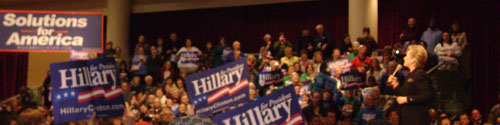
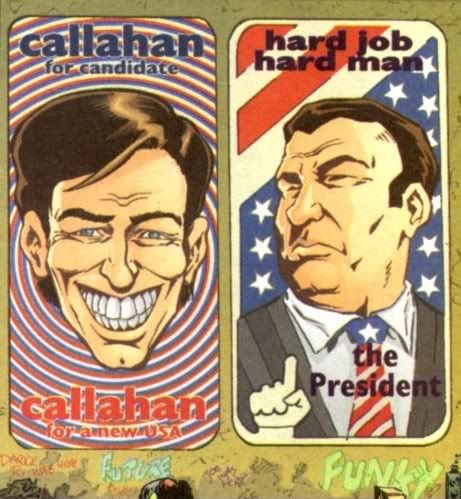 One of the most generally overlooked pieces of recent political fiction is Warren Ellis's and Darick Robertson's comic book series